The increasing complexity of quantum computers demands control systems capable of orchestrating a growing number of qubits with ever-greater precision, and a team led by Agustin Silva and Alvaro Orgaz-Fuertes at the Technology Innovation Institute are addressing this challenge with a new platform called Manarat. As quantum processors scale beyond the capabilities of single control modules, achieving synchronized operation becomes increasingly difficult, and this research introduces a scalable control architecture built upon the Quantum Instrumentation Control Kit (QICK). Manarat overcomes QICK’s limitations by incorporating hardware and software enhancements that enable sub-100 picosecond timing alignment across multiple processing boards, a crucial step towards building larger and more powerful quantum computers. By demonstrating reliable synchronized control of ten flux-tunable qubits using two processing boards, the team confirms that coherent control and sub-nanosecond synchronization are achievable across multiple platforms, paving the way for truly scalable quantum computation.
Open Source Tools Simplify Qubit Control
Scaling Quantum Control: Introducing Manarat Quantum computers promise a revolution in computation, but increasing the number of qubits while maintaining precise control over their delicate quantum states presents a significant challenge. Superconducting qubits are a leading technology in this field, yet scaling these systems is difficult due to noise and maintaining qubit coherence. A key obstacle is the increasing complexity of the control electronics needed to manage a growing number of qubits, quickly becoming a major cost and logistical hurdle for researchers. Recent advances have seen the emergence of open-source control platforms designed to reduce complexity and cost.
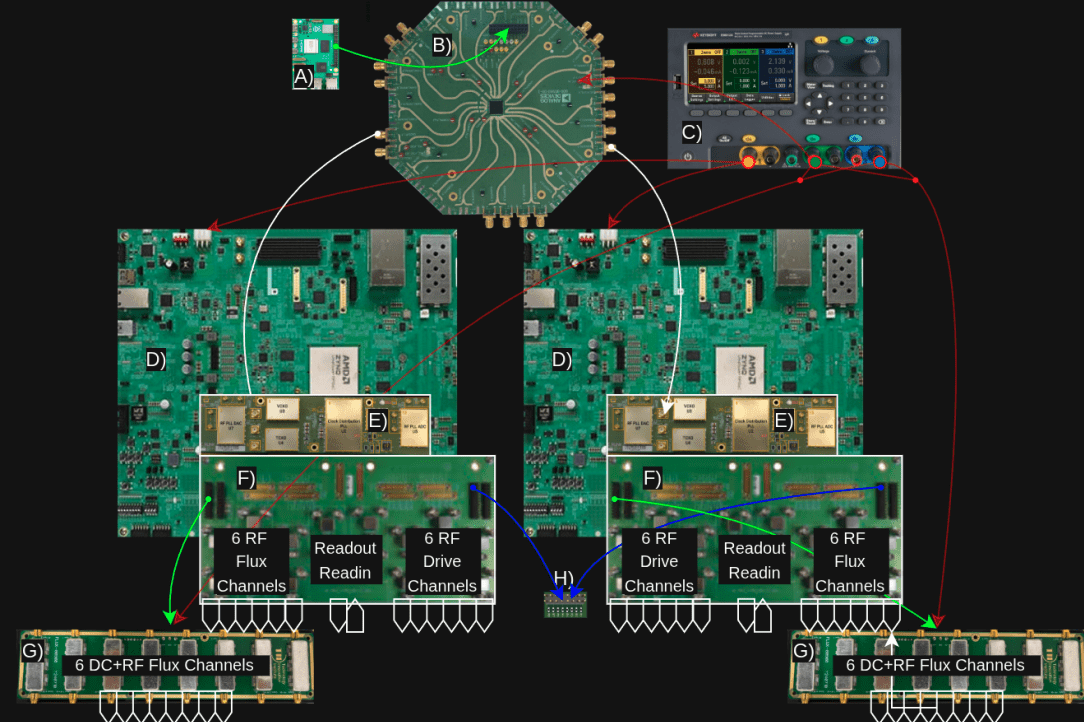
The Quantum Instrumentation Control Kit (QICK) is a prominent example, utilizing powerful AMD RFSoC devices to directly generate microwave pulses for qubit manipulation. This simplifies the control process by streamlining the overall system. However, QICK’s current limitation is its inability to easily synchronize multiple control boards, hindering its application to mid- and large-scale quantum processors that require numerous control channels. To address this limitation, researchers have developed Manarat, a scalable control platform built upon the foundation of QICK. Manarat incorporates hardware, firmware, and software enhancements to achieve sub-100 picosecond synchronization across multiple RFSoC boards.
This level of precision is crucial for coherent multi-qubit control, allowing for distributed control of quantum processors with a scalable architecture. Achieving this synchronization requires overcoming challenges in distributing a highly stable clock signal, aligning program execution across boards, and ensuring rapid, coordinated responses to synchronization triggers. The Manarat platform has been successfully demonstrated on a 10-qubit superconducting processor controlled by two RFSoC boards. This validation confirms that sub-nanosecond synchronization and coherent control are achievable across multiple boards, paving the way for the development of larger, more powerful quantum computers. By extending the capabilities of QICK, Manarat represents a significant step towards overcoming the scalability challenges currently facing superconducting quantum computing and unlocking the full potential of this transformative technology.
Manarat Enables Scalable Qubit Control Systems
Manarat: Scaling Control for Quantum Computers Researchers have developed a new control system, named Manarat, designed to overcome a critical limitation in scaling up superconducting quantum computers: the precise and coordinated control of a growing number of qubits. While superconducting qubits are a leading platform for quantum computation, controlling even a modest number requires a complex network of control electronics. Manarat addresses this challenge by extending the capabilities of the Quantum Instrumentation Control Kit (QICK), an open-source platform, to seamlessly integrate multiple control boards. The core innovation lies in achieving exceptionally precise synchronization between these boards.
Previous systems struggled to align the timing of control signals across multiple boards, hindering coherent multi-qubit operations. Manarat achieves sub-100 picosecond synchronization, a level of precision where even the smallest timing errors can disrupt quantum processes, by distributing a highly stable clock signal and implementing a novel synchronization scheme. The system incorporates custom hardware and software modifications to the QICK architecture, including a specialized analog front-end for precise control of qubit parameters. Researchers validated Manarat on a 10-qubit processor, successfully demonstrating synchronized control sequences for calibrating two-qubit gates.
This represents a significant step towards building larger, more complex quantum processors, as it demonstrates the feasibility of scaling control beyond the limitations of a single control board. Compared to existing multi-board control systems, Manarat is specifically designed and experimentally validated for superconducting qubit processors, focusing on the fundamental challenge of synchronized control. The ability to achieve this level of synchronization opens the door to more complex quantum algorithms and error correction schemes, paving the way for more powerful and reliable quantum computers.
Scalable Control Validated on Superconducting Qubits
Manarat, a scalable control platform, extends the open-source Quantum Instrumentation Control Kit (QICK) framework to enable synchronized operation across multiple radiofrequency system-on-chip (RFSoC) boards. The system achieves sub-100 picosecond timing alignment through the integration of a low-jitter clock distribution network, firmware enhancements, and custom analog front-end electronics. This precise synchronization was experimentally validated on a 10-qubit superconducting processor, demonstrating full-system control and coherent two-qubit gate calibration across control boundaries. These results establish a practical pathway for scaling pulse-level control systems to support mid-scale quantum processors.
👉 More information
🗞 Manarat: A Scalable QICK-Based Control System for Superconducting Quantum Processors Supporting Synchronized Control of 10 Flux-Tunable Qubits
🧠 DOI: https://doi.org/10.48550/arXiv.2507.10676