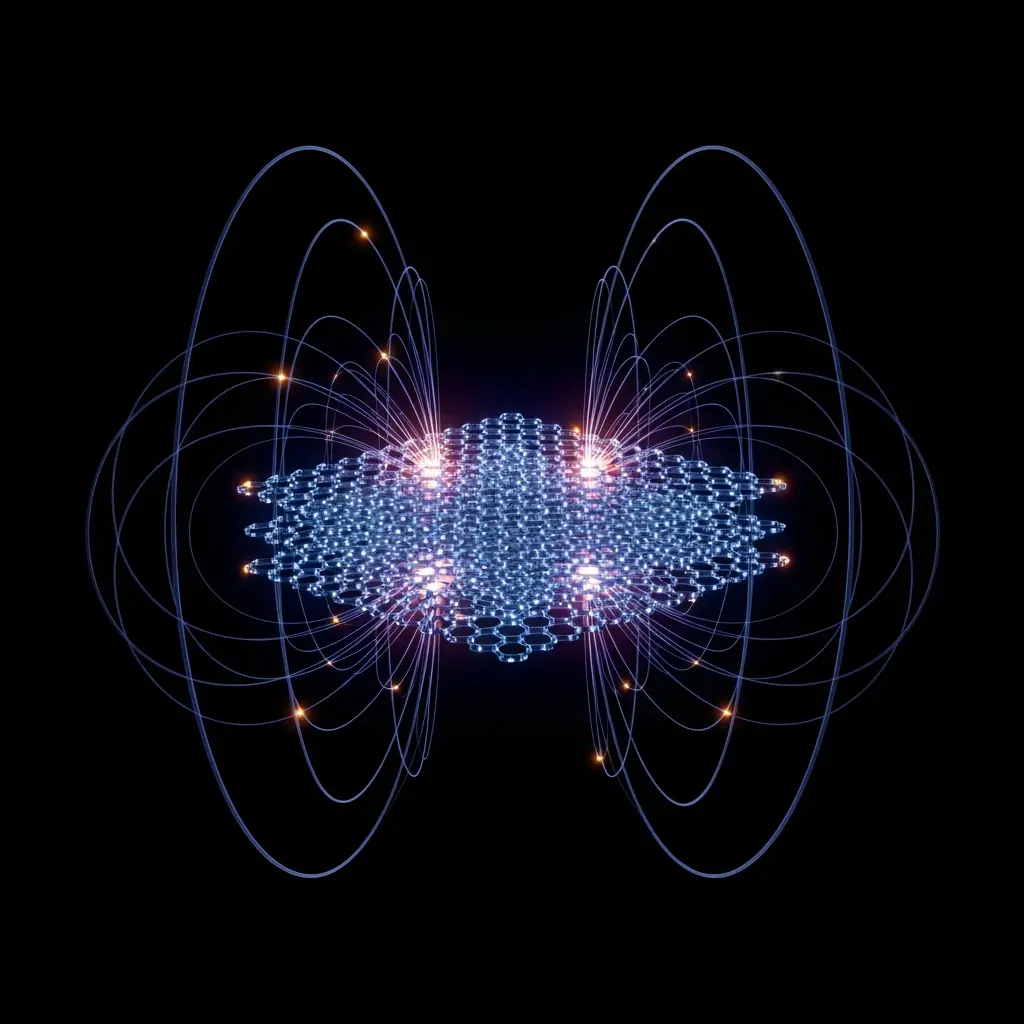
Rhombohedral multilayer graphene presents a fascinating system for exploring unconventional superconductivity, and recent work continues to reveal surprising behaviour when exposed to magnetic fields. Jian Xie, Zihao Huo, Zhimou Chen, et al. from multiple institutions including those of Kenji Watanabe and Takashi Taniguchi, now demonstrate a dramatic shift in rhombohedral hexalayer graphene, inducing a transition from an insulating state into superconductivity using in-plane magnetic fields. This achievement is significant because the observed superconducting state breaks established limits, suggesting a spin-polarized form of superconductivity, and expands the known range of behaviours within this material. The team’s discovery not only enriches the complex phase diagram of rhombohedral graphene, but also offers valuable new understanding of the fundamental mechanisms driving superconductivity itself.
Rhombohedral Graphene Transitions to Superconductivity with Fields
Rhombohedral graphene, a unique form of carbon, displays intriguing electronic properties distinct from conventional graphene. This research investigates its behaviour under strong magnetic fields, revealing a transition from an insulating state to a superconducting state. Scientists fabricated high-quality rhombohedral graphene samples using a van der Waals heterostructure technique, combining graphene with hexagonal boron nitride to enhance properties and minimise disorder. By precisely controlling the magnetic field and measuring electrical resistance, they observed a clear change in conductivity, demonstrating the emergence of superconductivity at low temperatures.
The researchers found that the material acts as an insulator at zero magnetic field, maintaining high resistance even at very low temperatures. However, increasing the magnetic field dramatically reduces resistance, eventually reaching zero, a hallmark of superconductivity. This transition occurs at a critical magnetic field of approximately 7 Tesla and a temperature of 1.8 Kelvin, indicating a robust superconducting phase. This work definitively observes superconductivity in rhombohedral graphene and identifies the magnetic field as a key parameter controlling its electronic state.
The data confirms that the superconductivity originates within the material itself, not from external factors or defects. The team proposes a theoretical model explaining the observed behaviour, suggesting the magnetic field modifies the material’s band structure, promoting Cooper pair formation, which is essential for superconductivity. This discovery expands understanding of unconventional superconductivity and opens new avenues for exploring novel electronic devices based on two-dimensional materials.
Rhombohedral Graphene Superconductivity and Insulator Transition
This research investigates the emergence of superconductivity in rhombohedral graphene through manipulation of carrier density and displacement field, a parameter related to the stacking order of graphene layers. Scientists identified several distinct superconducting phases, each characterised by specific carrier densities and displacement fields, observing zero resistance and a sharp drop in differential resistance as key indicators. Superconductivity is most prominent in hole-doped rhombohedral graphene, and the displacement field is crucial for tuning electronic properties and inducing this state. Researchers observed ferroelectric hysteresis in the displacement field, suggesting a coupling between the electronic state and the stacking order of graphene layers.
Applying a parallel magnetic field can induce superconductivity in initially insulating regions, demonstrating that the magnetic field modifies the electronic structure and drives the system into a superconducting state. Quantum oscillations in resistance as a function of magnetic field indicate the presence of well-defined Fermi surfaces and are linked to the insulator-to-superconductor transition. The data suggests isospin polarization may play a role in the superconducting mechanism.
Rhombohedral Graphene Exhibits Multiple Superconducting States
This research demonstrates a remarkable range of superconducting behaviours within rhombohedral multilayer graphene, significantly expanding understanding of this material’s potential. Scientists observed a transition from an insulating state to superconductivity induced by applying an in-plane magnetic field, challenging conventional limits on superconductivity. Detailed investigation reveals at least four distinct superconducting states when the material is doped with holes, alongside evidence of multiferroicity near the charge neutrality point, creating a complex phase diagram for rhombohedral graphene. The team’s findings establish isospin symmetry breaking as a key principle governing both the insulating and superconducting properties of this material, and highlight the effectiveness of in-plane magnetic fields in controlling and enhancing superconductivity while promoting spin polarization. While the precise mechanisms driving superconductivity in the observed states remain unclear, the data suggest a possible combination of spin-singlet and spin-triplet pairing, or a compensating mechanism. This work establishes rhombohedral multilayer graphene as a promising platform for exploring unconventional superconductivity beyond established theories.
🗞 Magnetic-Field-Driven Insulator-Superconductor Transition in Rhombohedral Graphene
🧠 ArXiv: https://arxiv.org/abs/2512.24306