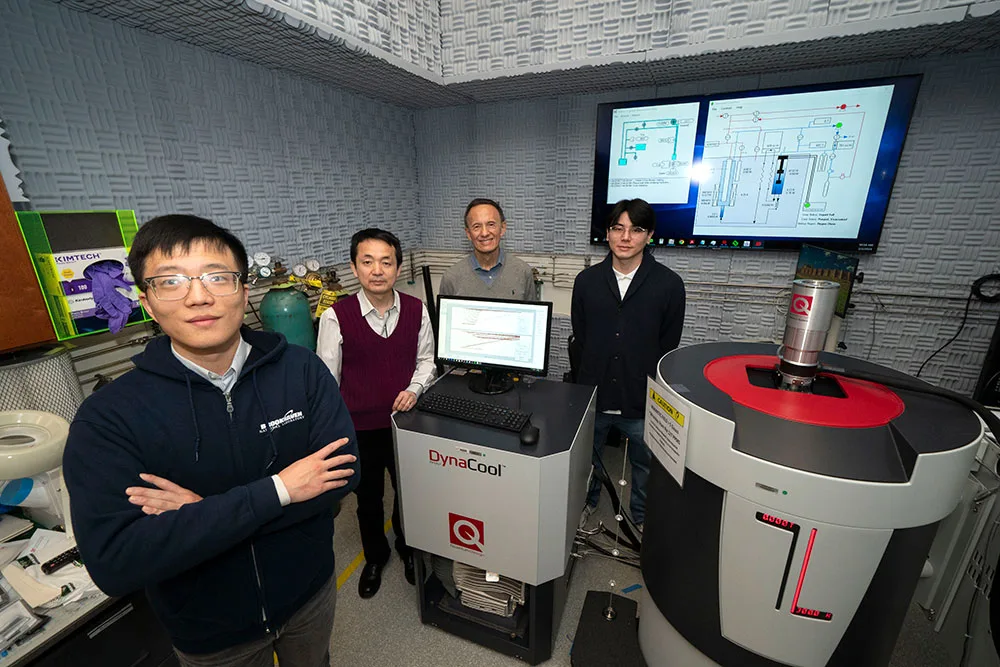
Scientists at the U.S. Department of Energy’s Brookhaven National Laboratory have discovered that adding a layer of magnesium improves the properties of tantalum, a superconducting material used for building qubits in quantum computers. The magnesium layer prevents tantalum from oxidizing, improves its purity, and raises its operating temperature as a superconductor. These improvements could enhance tantalum’s ability to hold onto quantum information in qubits. The research was led by Chenyu Zhou, Mingzhao Liu, Yimei Zhu, and Junsik Mun. The findings were published in the journal Advanced Materials.
Magnesium Enhances Tantalum’s Potential for Quantum Computing
Scientists at the U.S. Department of Energy’s (DOE) Brookhaven National Laboratory have made a significant discovery in the field of quantum computing. They found that a layer of magnesium can enhance the properties of tantalum, a superconducting material with potential for building qubits, the fundamental units of quantum computers. The research, published in the journal Advanced Materials, reveals that a thin layer of magnesium prevents tantalum from oxidizing, improves its purity, and increases the temperature at which it operates as a superconductor. These improvements could potentially enhance tantalum’s ability to retain quantum information in qubits.
The Problem of Oxidation in Tantalum
Previous studies by the team from Brookhaven’s Center for Functional Nanomaterials (CFN), Brookhaven’s National Synchrotron Light Source II (NSLS-II), and Princeton University sought to understand the tantalizing characteristics of tantalum. They collaborated with scientists in Brookhaven’s Condensed Matter Physics & Materials Science (CMPMS) Department and theorists at DOE’s Pacific Northwest National Laboratory (PNNL) to reveal how the material oxidizes.
Oxidation poses a problem for tantalum. When oxygen reacts with tantalum, it forms an amorphous insulating layer that drains small amounts of energy from the current moving through the tantalum lattice. This energy loss disrupts quantum coherence—the material’s ability to retain quantum information in a coherent state. While the oxidation of tantalum is usually self-limiting, the team wanted to explore strategies to limit oxidation further to see if they could improve the material’s performance.
Magnesium as a Protective Layer
The team’s research is part of the Co-design Center for Quantum Advantage (C2QA), a Brookhaven-led national quantum information science research center. While ongoing studies explore different kinds of cover materials, the new paper describes a promising first approach: coating the tantalum with a thin layer of magnesium.
Studies using transmission electron microscopy to image structural and chemical properties of the material, atomic layer by atomic layer, showed that the strategy to coat tantalum with magnesium was remarkably successful. The magnesium formed a thin layer of magnesium oxide on the tantalum surface that appears to keep oxygen from getting through.
The Impact of Magnesium Coating
X-ray photoelectron spectroscopy studies at NSLS-II revealed the impact of the magnesium coating on limiting the formation of tantalum oxide. The measurements indicated that an extremely thin layer of tantalum oxide—less than one nanometer thick—remains confined directly beneath the magnesium/tantalum interface without disrupting the rest of the tantalum lattice.
Collaborators at PNNL then used computational modeling at the atomic scale to identify the most likely arrangements and interactions of the atoms based on their binding energies and other characteristics. These simulations helped the team develop a mechanistic understanding of why magnesium works so well. At the simplest level, the calculations revealed that magnesium has a higher affinity for oxygen than tantalum does.
The Long-lasting Protection and Unexpected Benefits of Magnesium
The scientists also demonstrated that the protection lasts a long time: “Even after one month, the tantalum is still in pretty good shape. Magnesium is a really good oxygen barrier,” Liu concluded.
The magnesium had an unexpected beneficial effect: It “sponged out” inadvertent impurities in the tantalum and, as a result, raised the temperature at which it operates as a superconductor. This could be very important for applications because most superconductors must be kept very cold to operate. In these ultracold conditions, most of the conducting electrons pair up and move through the material with no resistance.
“Even a slight elevation in the transition temperature could reduce the number of remaining, unpaired electrons,” Liu said, potentially making the material a better superconductor and increasing its quantum coherence time.
This research provides valuable insights and new materials design principles that could help pave the way to the realization of large-scale, high-performance quantum computing systems.