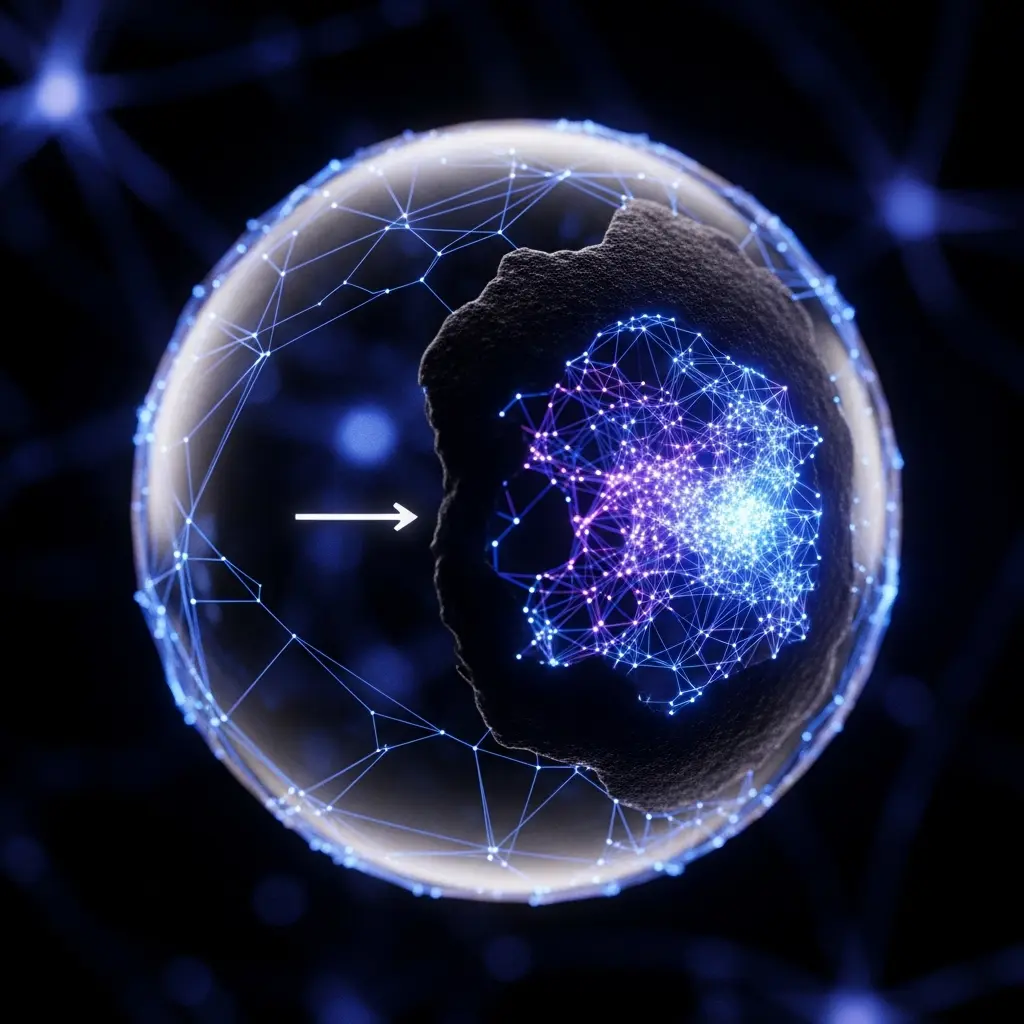
The subtle phenomenon of quantum information masking, where information about a quantum state becomes hidden, presents a significant challenge to secure quantum communication and computation. Sheng-Ao Mao, Lin Zhang, and Bo Li from Hangzhou Dianzi University now demonstrate a powerful new approach to detect this masking, employing supervised machine learning techniques. Their work pioneers the application of machine learning to identify information masking in both fundamental, pure quantum states and more complex, mixed states. By training an advanced XGBoost model and optimising the selection of training data, the researchers achieve remarkably high classification accuracy, offering a crucial step towards robust quantum technologies and improved security protocols.
Machine learning detects hidden quantum information masking
Recent advances demonstrate the widespread application of machine learning within quantum information science, notably in areas such as entanglement detection, characterising quantum steering, and verifying quantum nonlocality. Limited research, however, has explored the potential of machine learning to detect quantum information masking, a phenomenon where quantum information becomes concealed within classical correlations. This research addresses this gap by investigating the application of machine learning algorithms to identify and characterise this masking. The team explores the ability of these algorithms to distinguish between quantum states exhibiting genuine quantum correlations and those that are merely classically correlated, even when the quantum information is subtly masked. Specifically, the study utilises supervised learning techniques, training various machine learning models on simulated quantum states to achieve high accuracy in detecting masked quantum information, potentially advancing applications in quantum communication and cryptography.
The study focuses on utilising machine learning to detect quantum information masking in both pure and mixed qubit states. For pure qubit states, the researchers randomly generate corresponding density matrices and train an XGBoost model. For mixed qubit states, they improve the XGBoost method by optimising the selection of training samples, achieving higher classification accuracy. The team also analyses the area under the curve of the receiver operating characteristic curve, providing further insight into the method’s performance.
XGBoost Detects Masked Quantum Information Robustly
This research demonstrates the successful application of supervised machine learning techniques to detect quantum information masking in both pure and mixed qubit states. By employing the XGBoost model, the team achieved high classification accuracy in identifying masked information, even with limited training samples. To improve performance with mixed qubit states, an active learning approach was developed, strategically selecting the most informative samples to refine the training process through hybrid sampling. Numerical simulations confirm this active learning-based XGBoost method outperforms random sampling and the RandomForest algorithm in most scenarios, offering a robust solution for quantum information masking detection.
While the developed method enhances classification performance, the iterative nature of the active learning process requires more computational time compared to simpler random sampling techniques. The team acknowledges this trade-off and plans to address it in future work by optimising the efficiency of the sample selection process. Further research will also focus on extending this approach to more complex multi-class scenarios, broadening the applicability of this technique for detecting information masking in increasingly sophisticated quantum systems.
🗞 Detection of quantum information masking via machine learning
🧠 ArXiv: https://arxiv.org/abs/2510.12507