

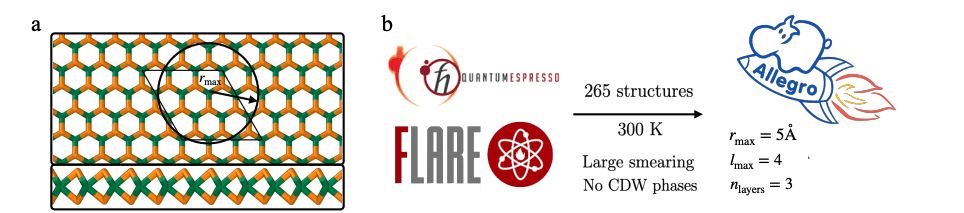
Published on April 18, 2025, researchers presented a study titled Exploring Charge Density Waves in two-dimensional NbSe, employing machine learning models to analyze CDWs and their sensitivity to material structure, with implications for superconductivity.
NbSe₂ exhibits superconductivity and charge density waves (CDWs) down to monolayers. Modeling CDWs considering layer number, twist angle, and strain is computationally intensive. Researchers developed machine-learned interatomic potentials (MLIPs) using the Allegro architecture to efficiently explore commensurate and incommensurate CDW phases and transition temperatures. Their findings reveal strong sensitivity of CDWs to stacking and layer number, with a slight suppression of Tc as thickness increases. This work advances understanding of electron-phonon coupling and superconductivity in 2D systems.
Machine learning (ML) has emerged as a transformative tool in materials science, significantly enhancing computational methods traditionally reliant on ab initio calculations. This article explores how ML innovations are reshaping the field, particularly in phonon calculations and interatomic potentials, offering new avenues for material discovery and design.
Recent advancements have introduced sophisticated ML models tailored for materials science. Notably, E(3)-equivariant graph neural networks (GNNs) and Bayesian force fields represent key innovations. These models leverage symmetry properties to enhance the accuracy of atomic interaction modeling while maintaining physical fidelity.
E(3)-equivariant GNNs incorporate geometric symmetries, enabling them to model three-dimensional structures effectively. This approach ensures that the learned representations respect the physical laws governing material behavior. Bayesian force fields, on the other hand, offer a probabilistic framework, allowing for uncertainty quantification in predictions—a critical aspect for reliable materials modeling.
These ML models are proving invaluable in predicting material properties with unprecedented efficiency. For instance, they can accurately compute phonon dispersion relations and dielectric tensors, tasks that were computationally intensive using traditional methods. This efficiency is particularly beneficial in exploring new materials where rapid iteration is essential.
Research by Bianco, Errea, Calandra, and others has demonstrated the effectiveness of these ML techniques. Their work highlights how integrating ML with existing computational tools can lead to more accurate predictions of material behavior under various conditions, accelerating the discovery process.
Despite their promise, challenges remain. Data requirements for training robust ML models are substantial, and computational costs can be high. However, innovative strategies like active learning are being employed to optimize data usage and reduce costs. This approach allows models to iteratively refine themselves based on selected data points, enhancing efficiency.
Integrating machine learning into materials science is a game-changer, offering faster and more accurate modeling capabilities. While these innovations complement rather than replace traditional methods, they significantly enhance the toolkit available for materials discovery and design. As research progresses, we can expect even greater advancements, further solidifying ML’s role in this field. By embracing these computational breakthroughs, scientists are paving the way for a new era of materials innovation, poised to address some of the most pressing challenges in technology and industry.
👉 More information
🗞 Exploring Charge Density Waves in two-dimensional NbSe
🧠 DOI: https://doi.org/10.48550/arXiv.2504.13675


