Knotted structures, long recognised for their unusual properties, present a significant challenge for practical applications due to difficulties in maintaining their stability. Arunkumar Bupathy of Hiroshima University, alongside Darian Hall and Ivan I. Smalyukh from the University of Colorado, Boulder, and colleagues, now demonstrate a pathway to overcome this limitation by investigating stable knotted structures, termed heliknotons, within chiral liquid crystals. The team develops machine-learned potentials that accurately model the complex interactions between these structures, enabling simulations of their self-assembly into adaptive crystalline arrangements. This achievement, which also involves contributions from Gerardo Campos-Villalobos, Rodolfo Subert, and Marjolein Dijkstra from Utrecht University, provides a powerful new framework for understanding and potentially harnessing the behaviour of complex topological textures, opening doors to novel materials and devices.
Heliknoton Interactions And Coarse-Grained Modelling
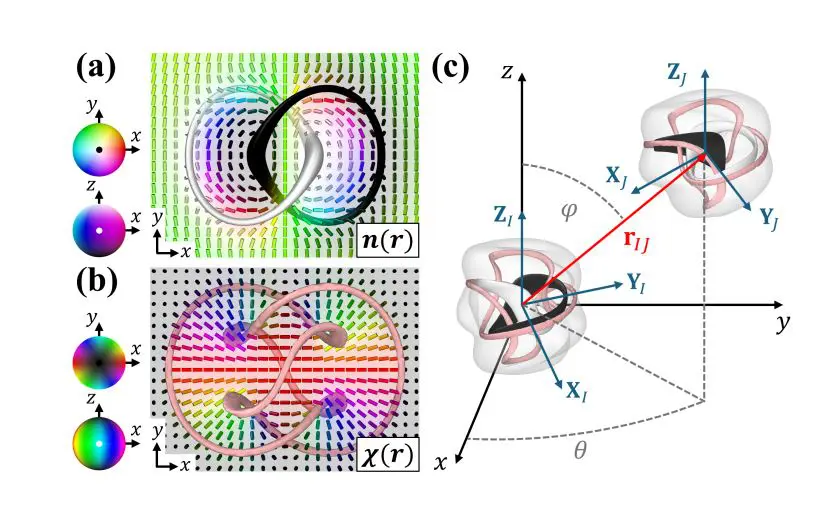
Scientists have developed a multi-scale modeling approach to study heliknotons, topological defects within chiral liquid crystals. This research combines detailed physics-based simulations with machine learning to create simplified models that accurately represent heliknoton interactions, significantly reducing computational demands and enabling investigation of heliknoton behavior at previously unattainable scales. The team began by simulating heliknoton interactions using the Frank-Oseen free energy functional, a method that accurately captures the energetic costs associated with deformations in the liquid crystal. Researchers then employed machine learning algorithms to develop coarse-grained potentials, representing heliknoton interactions in a simplified manner.
This process involved defining symmetry functions and training the model on data from the detailed simulations, successfully capturing the chiral nature of the system even without explicitly using chiral descriptors. This innovative approach allows scientists to treat heliknotons as effective particles, self-organizing into complex crystalline structures. The resulting coarse-grained potentials accurately reproduce the results of the detailed simulations while significantly reducing computational cost, enabling large-scale simulations and providing a framework for understanding heliknoton behavior. The team demonstrated that the model accurately captures the anisotropic interactions between these particles, reproducing experimentally observed assemblies and providing a foundation for studying collective phenomena.
Machine Learning Models Heliknoton Self-Assembly Interactions
Scientists have created a novel methodology to model the interactions and self-assembly of heliknotons, topological textures found within chiral liquid crystals. This approach enables large-scale simulations by combining detailed physics-based simulations with machine learning, beginning with fine-grained simulations grounded in the Frank-Oseen free-energy functional, accurately capturing the energetic costs associated with deformations in the liquid crystal director field. These simulations generate a comprehensive dataset of interaction energies, forming the foundation for a machine learning approach. Researchers then employed machine learning algorithms to develop effective coarse-grained potentials, representing the interactions between heliknotons in a simplified manner.
This involved training the model on the interaction energies obtained from the fine-grained simulations, allowing it to learn the complex relationships governing solitonic interactions. This innovative approach allows scientists to treat heliknotons as quasiparticles, self-organizing into complex crystalline structures. By accurately capturing the anisotropic interactions between these particles, the model reproduces experimentally observed assemblies and provides a framework for studying collective phenomena. The resulting coarse-grained potentials span a wide range of energies, reflecting the long-range perturbations of the surrounding helical fields, and accelerates the design and discovery of knotted metamatter with tunable symmetry.
Heliknoton Self-Assembly Modeled with Machine Learning
Scientists have achieved a breakthrough in modeling complex topological textures, specifically knotted solitonic structures called heliknotons, found in chiral liquid crystals. This research delivers a powerful new framework for understanding and designing materials with complex topologies by successfully modeling these structures at large scales using a machine learning approach that accurately captures their intricate interactions. The team developed a coarse-grained potential, treating each heliknoton as an effective particle, to simulate their behavior, accurately reproducing the observed self-organization of heliknotons into complex crystal assemblies. The method involves calculating interaction energies between heliknoton pairs using fine-grained simulations based on the Frank-Oseen free-energy functional, then training a machine learning model to predict these energies efficiently. Experiments revealed that the trained coarse-grained potential accurately reproduces the anisotropic pair interaction potential of heliknotons within a liquid crystal cell, demonstrating accurate decay of interactions at separations greater than a few micrometers. This achievement enables large-scale simulations of interacting solitons, accelerating the design and discovery of knotted metamaterials with tailored properties and unlocking new possibilities in areas such as advanced optics and materials science.
Heliknoton Interactions Modeled with Machine Learning
This research establishes a new framework for modeling topological solitons, specifically knotted structures known as heliknotons, as quasiparticles defined by their geometric centers and orientations. Scientists developed machine-learned coarse-grained potentials that accurately capture the complex interactions between these structures in chiral liquid crystals, enabling simulations far exceeding the scope of traditional, fine-grained methods and successfully reproducing experimentally observed crystal assemblies. The team’s approach significantly reduces computational cost while maintaining accuracy, allowing for large-scale simulations of these complex systems and opening new avenues for investigating emergent collective phenomena not only in chiral liquid crystals, but also across diverse soft and hard condensed matter systems. While the current work focuses on chiral liquid crystals, the methodology is broadly applicable to any particle-like topological texture. Researchers acknowledge that the accuracy of the coarse-grained potentials is limited by the range of parameters explored during training and plan to expand this range and incorporate material constants to enable efficient exploration of a broader parameter space without requiring retraining of the potentials, further enhancing the predictive power and versatility of the developed modeling framework.
🗞 From Knots to Crystals: Machine-Learned Potentials for Self-Assembling Topological Solitons in Liquid Crystals
🧠 ArXiv: https://arxiv.org/abs/2511.23265