Topological superconductivity, a state of matter with potential applications in quantum computing, typically requires complex conditions such as strong spin-orbit coupling or the application of magnetic fields. However, Yizhi Li, Yanyan Lu, and Jianxin Zhong from Shanghai University, along with Lijun Meng from Xiangtan University, now demonstrate a pathway to achieve this state in simple triangular lattices without these conventional requirements. Their work reveals that long-range chiral pairing, a specific way electrons interact, induces topological superconductivity by spontaneously breaking fundamental symmetry principles. This discovery significantly simplifies the theoretical landscape for designing topological devices, offering a promising route towards more easily realised and controlled quantum technologies by removing the need for external magnetic fields or materials with strong spin-orbit coupling.
Topological Superconductivity and Majorana Zero Modes
This research investigates the potential for achieving topological superconductivity, a state of matter with exotic properties, in various materials and systems. The work focuses on how interactions between electrons, known as pairing, and the arrangement of electron energy levels, or band topology, can give rise to this phenomenon and the emergence of Majorana zero modes, particles with unique quantum characteristics. Scientists explore materials including two-dimensional materials like graphene and silicene, layered structures, iron-based superconductors, and combinations of bismuth and nickel. The team’s approach builds upon established principles of topological insulators, superconductivity, and the Berry phase, a quantum mechanical effect influencing electron behavior. They highlight the importance of specific pairing symmetries and long-range interactions between electrons in driving the emergence of topological superconductivity. The ultimate goal is to identify the precise conditions necessary to realize this state, which holds promise for revolutionary applications in quantum computing.
Long-Range Pairing Drives Topological Superconductivity
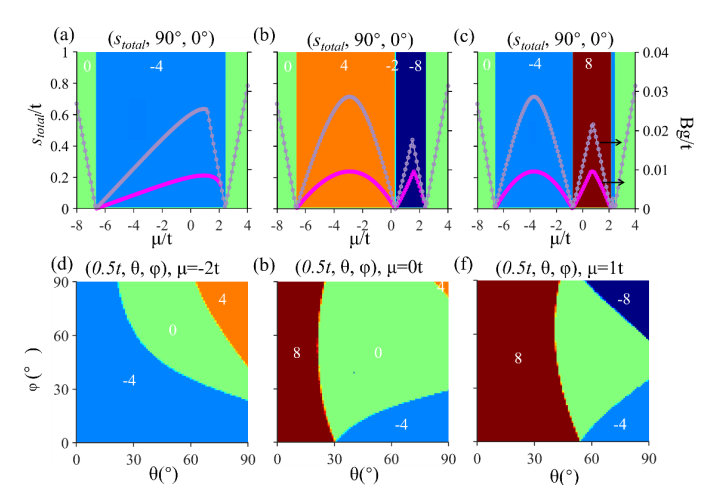
This research demonstrates a pathway to achieving topological superconductivity in a monolayer triangular lattice through long-range pairing, a significant advancement as it avoids the need for spin-orbit coupling and magnetic fields typically required in conventional approaches. Scientists found that the system exhibits topological superconducting states even as the chemical potential varies, a crucial characteristic for potential device applications. Calculations reveal that specific pairing arrangements result in different topological states, indicating a complex interplay between these interactions. Analysis of Berry curvature, a measure of electron band bending, reveals distinct features signaling the emergence of nontrivial topological characteristics. Increasing the strength of long-range pairing primarily modifies the energy gap without altering the fundamental topological properties, demonstrating a robustness in the superconducting state. This work proposes a mechanism for realizing topological superconductivity without relying on spin-orbit coupling and magnetic field, offering a feasible strategy for the experimental design of topological superconductors and reducing the strict requirements for material constraints.
👉 More information
🗞 Long-Range Chiral Pairing enables Topological Superconductivity in Triangular Lattices without Spin-Orbit Coupling and Magnetic Field
🧠 ArXiv: https://arxiv.org/abs/2510.13120