

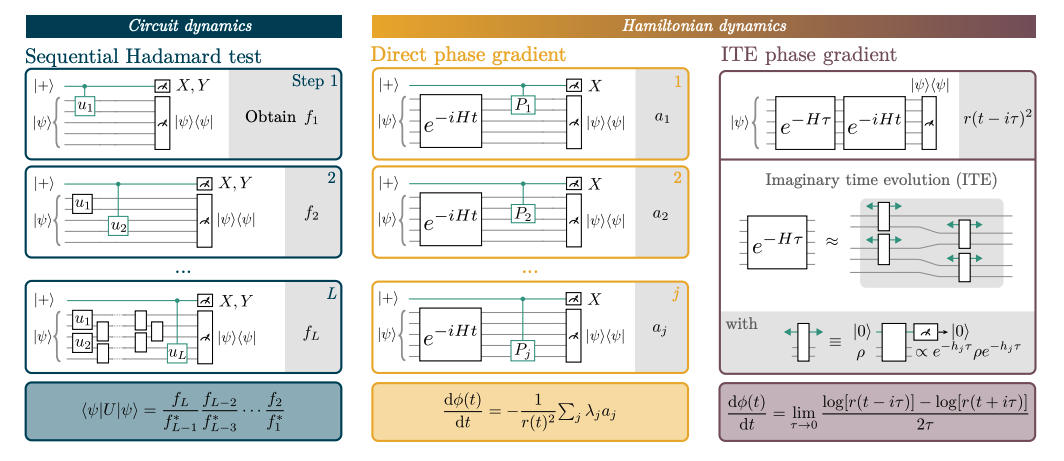
Quantum simulation, a field promising to revolutionise materials science, drug discovery and fundamental physics, frequently encounters limitations imposed by the complexity of implementing quantum algorithms on existing hardware. A central challenge lies in accurately determining the energy levels, or spectral properties, of quantum systems, a task typically achieved through phase estimation. Researchers at the Max-Planck-Institut für Quantenoptik and Harvard University present a novel approach to phase estimation that circumvents the need for complex, globally-controlled quantum operations, instead relying on locally-controlled interactions. This work, detailed in their article, ‘Hardware-efficient quantum phase estimation via local control’, by Benjamin F. Schiffer, Dominik S. Wild, Nishad Maskara, Mikhail D. Lukin, and J. Ignacio Cirac, demonstrates a method that trades circuit depth for increased measurement requirements and classical data processing, offering a potentially viable pathway to spectral analysis using near-term quantum devices. The technique focuses on efficiently measuring the phase of the Loschmidt echo, a quantity reflecting the time evolution of a quantum state, and applies to a broad range of quantum states without requiring specific initial conditions.
Quantum computing currently exhibits vigorous development across theoretical foundations, practical realisation, and classical verification of results. Researchers consistently refine quantum error mitigation strategies, recognising the present limitations of hardware and prioritising techniques to obtain dependable computational outcomes. Variational quantum algorithms, which utilise a hybrid quantum-classical approach, gain prominence as a feasible method for utilising near-term quantum devices, offering a route to algorithm implementation despite the difficulties in constructing fully fault-tolerant computers.
The field actively investigates methods to lessen the impact of noise inherent in quantum hardware, acknowledging this as a persistent obstacle to achieving fault-tolerant quantum computation. Huggins et al. (2021) detail techniques aimed at reducing errors during computation, while Mi et al. (2024) and Huggins et al. (2024) concentrate on stabilising quantum states through engineered dissipation, a process where unwanted energy is deliberately removed from the system. These efforts demonstrate a pragmatic approach, prioritising practical error reduction strategies alongside the pursuit of more robust hardware solutions.
Adiabatic quantum computation, a technique that relies on
Adiabatic quantum computation, a technique that relies on gradually evolving a quantum system to find the solution to a problem, remains a significant area of investigation, building upon foundational work by Lidar et al. (2009) and informing current research exemplified by Schiffer et al. (2022). This approach leverages the adiabatic theorem, which states that a system will remain in its ground state if the change is slow enough, offering an alternative to gate-based quantum computation and attracting continued attention from researchers.
Theoretical investigations delve into exotic quantum phenomena, such as anyons, quasiparticles exhibiting unusual exchange statistics, as detailed in Lesanovsky & Katsura (2012), broadening our understanding of fundamental quantum properties and potentially leading to novel computational paradigms. Complementing these theoretical efforts, the development of quantum computing frameworks like Cirq (Cirq Developers, 2024), a Python library for writing, manipulating, and optimising quantum circuits, and simulators such as qsim (Quantum AI team and collaborators, 2020) provides essential tools for researchers to design, test, and refine algorithms.
A recent approach to phase estimation, a quantum algorithm used to determine the eigenvalues of a unitary operator, prioritises locally controlled operations to reduce circuit depth, offering a practical pathway for measuring spectral properties in large systems using current devices. This method trades circuit complexity, the number of quantum gates required, for increased sampling and classical post-processing, acknowledging the limitations of existing hardware and demonstrating a trend towards resource-aware design. Researchers actively explore methods to optimise algorithms for specific hardware constraints, maximising performance and minimising resource requirements.
👉 More information🗞Hardware-efficient quantum phase estimation via local
🗞 Hardware-efficient quantum phase estimation via local control
🧠 DOI: https://doi.org/10.48550/arXiv.2506.18765


