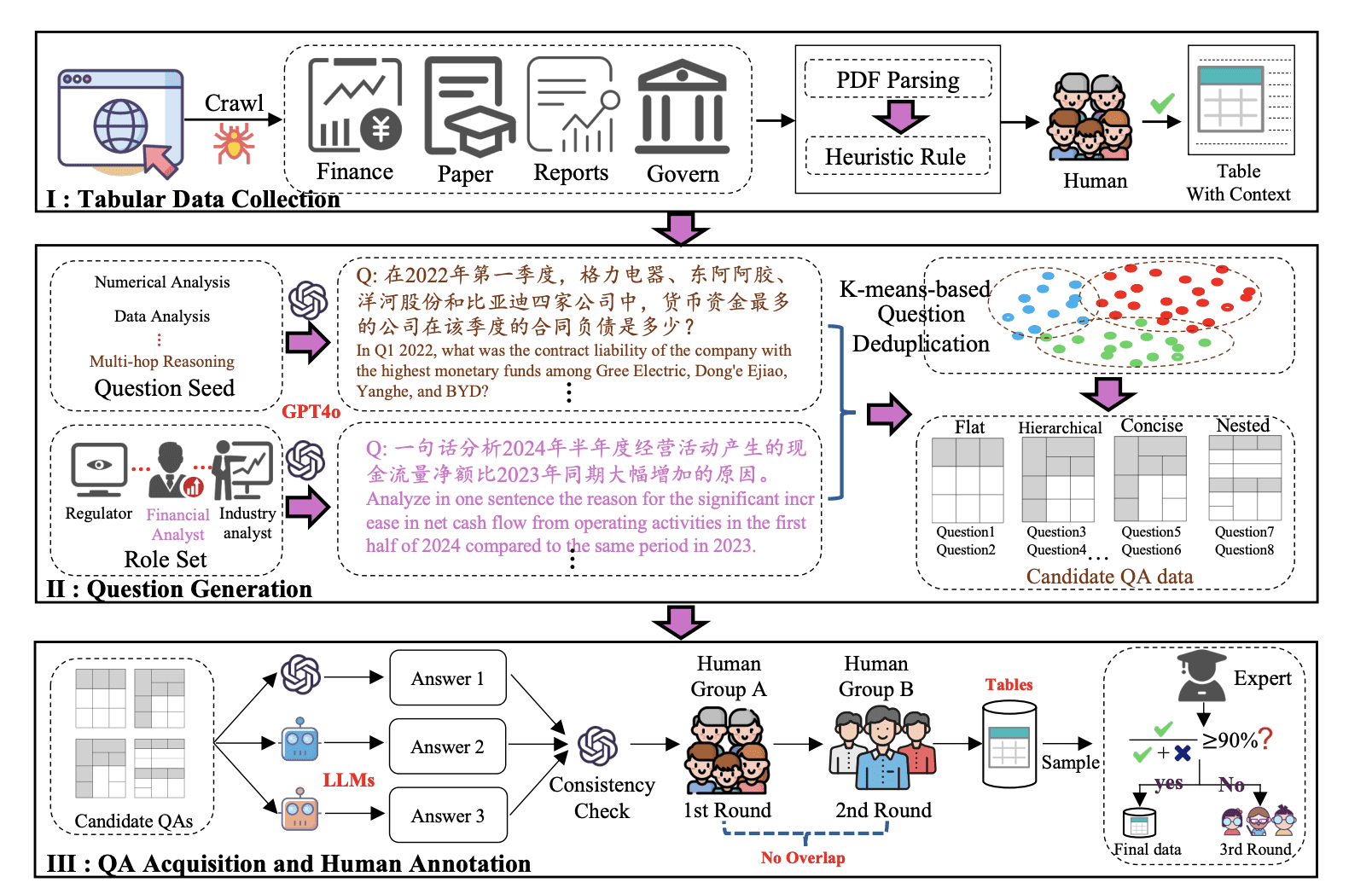
Researchers developed TableEval, a benchmark assessing large language models’ ability to reason with complex, multilingual tables sourced from real-world documents. Evaluation employs SEAT, a framework measuring semantic accuracy at a sub-question level, revealing significant performance gaps in current models and providing a resource for future development.
The ability of large language models (LLMs) to interpret and extract information from tabular data is increasingly vital, yet current benchmarks often fail to reflect the complexity of real-world applications. Researchers are now addressing this limitation with a new evaluation framework designed to test LLMs against genuinely challenging table-based question answering scenarios. Junnan Zhu, Jingyi Wang, Bohan Yu, Xiaoyu Wu, Junbo Li, Lei Wang, and Nan Xu, from Beijing Wenge Technology Co., Ltd. and the University of Chinese Academy of Sciences, present ‘TableEval: A Real-World Benchmark for Complex, Multilingual, and Multi-Structured Table Question Answering’. The work introduces a dataset comprising tables with varied structures – including hierarchical and nested formats – sourced from government, financial, academic, and industrial reports, alongside cross-lingual data in Simplified Chinese, Traditional Chinese, and English. The team also propose a new evaluation metric, SEAT (Semantic Accuracy at the sub-question level), to better assess the alignment between model responses and correct answers.
TableEval: A Rigorous Benchmark for Complex Table Question Answering
Recent progress in Large Language Models (LLMs) has demonstrated potential, yet challenges remain in Table Question Answering (TableQA). Researchers have developed TableEval to address limitations in existing datasets by focusing on the complexities of real-world tabular data and rigorously evaluating LLM performance on tasks involving diverse table structures, multilingual content, and domain-specific reasoning. This new benchmark introduces a comprehensive evaluation framework designed to extend LLM capabilities and unlock the potential of tabular information across applications.
TableEval incorporates tables exhibiting varied structures – concise, hierarchical, and nested – sourced from four domains: government, finance, academia, and industry reports. This deliberate design ensures a more realistic and challenging evaluation environment, requiring LLMs to demonstrate a deeper understanding of table structure and content. The inclusion of cross-lingual scenarios, featuring tables in Simplified Chinese, Traditional Chinese, and English, acknowledges the need for models to process information across languages in a globalised context. Data collection prioritises recent, real-world documents, minimising data leakage – a common issue where training data inadvertently overlaps with test data, ensuring a more accurate assessment of model generalisation.
Recognising that conventional TableQA metrics inadequately assess semantic accuracy, researchers developed a novel evaluation framework called SEAT (Semantic Evaluation of Alignment at the sub-question level). SEAT assesses the alignment between model responses and reference answers at a granular, sub-question level, providing a more nuanced and reliable measure of performance than traditional metrics that often focus solely on overall accuracy. This detailed evaluation approach allows for precise identification of strengths and weaknesses in LLM reasoning abilities, guiding future research and development.
Extensive experimentation utilising TableEval demonstrates a high degree of agreement between SEAT’s evaluations and human judgements, validating its effectiveness as a reliable and objective measure of model performance. While human evaluation remains the gold standard, it is expensive, time-consuming, and subject to inter-annotator variability. SEAT provides a cost-effective and scalable alternative, offering a consistent and objective evaluation framework closely aligned with human judgements.
The availability of the TableEval dataset and the SEAT evaluation framework provides a valuable resource for researchers seeking to advance TableQA and develop more robust LLMs capable of effectively processing and reasoning with complex tabular data. Researchers can utilise TableEval to benchmark models, identify areas for improvement, and track progress over time. The dataset and evaluation framework are publicly available, fostering collaboration and accelerating innovation.
Testing utilising TableEval reveals substantial performance gaps in state-of-the-art LLMs when confronted with complex, real-world TableQA tasks, highlighting critical areas for future development. LLMs often struggle with tasks requiring reasoning about complex table structures, understanding nested relationships, and integrating information from multiple sources. These challenges underscore the need for continued research in table understanding, reasoning, and knowledge integration.
TableEval’s design prioritises realistic complexity, incorporating diverse table structures, multilingual content, and domain-specific data to challenge LLMs with scenarios mirroring real-world applications. By incorporating these complexities, TableEval provides a more accurate and challenging evaluation environment, pushing LLMs to develop more robust and adaptable reasoning capabilities.
The development of TableEval and SEAT represents a step forward in TableQA, providing a more rigorous and comprehensive evaluation framework for assessing LLM capabilities. By addressing the limitations of existing benchmarks and introducing a novel evaluation metric, TableEval enables researchers to develop more robust and reliable LLMs capable of effectively processing and reasoning with complex tabular data. This advancement has the potential to unlock new applications for LLMs in data analysis, decision-making, and knowledge discovery.
👉 More information
🗞 TableEval: A Real-World Benchmark for Complex, Multilingual, and Multi-Structured Table Question Answering
🧠 DOI: https://doi.org/10.48550/arXiv.2506.03949