The Laser Interferometer Gravitational-Wave Observatory (LIGO) has made a significant advance in a quantum technology called “squeezing” that allows them to measure undulations in space-time across the entire range of gravitational frequencies detected by LIGO. This new “frequency-dependent squeezing” technology, in operation at LIGO since May, means that the detectors can now probe a larger volume of the universe and are expected to detect about 60 percent more mergers than before. The results also have ramifications for future quantum technologies, such as quantum computers and other microelectronics as well as for fundamental physics experiments.
The laws of quantum physics dictate that particles, including photons, will randomly pop in and out of empty space, creating a background hiss of quantum noise that brings a level of uncertainty to LIGO’s laser-based measurements. Quantum squeezing is a method for hushing quantum noise or, more specifically, for pushing the noise from one place to another with the goal of making more precise measurements. The solution is to squeeze light in one way for high frequencies of gravitational waves and another way for low frequencies. With its new frequency-dependent squeezing cavity, LIGO can now detect even more black hole and neutron star collisions.
LIGO probes the Universe
LIGO researchers have made a significant advance in a quantum technology called “squeezing”, allowing them to measure undulations in space-time across the entire range of gravitational frequencies detected by LIGO. This new technology, overseen by Lisa Barsotti, a senior research scientist at MIT, and developed by a team of scientists and engineers at MIT, Caltech, and the twin LIGO observatories, allows the detectors to probe a larger volume of the universe and detect about 60% more mergers than before. The results have implications for future quantum technologies such as quantum computers and other microelectronics.
Quantum Physics and LIGO’s Precision Limitations
The Laser Interferometer Gravitational-Wave Observatory (LIGO) has been limited by the laws of quantum physics in its precision. At subatomic scales, empty space is filled with a faint crackling of quantum noise, which interferes with LIGO’s measurements and restricts how sensitive the observatory can be. However, LIGO researchers have reported a significant advance in a quantum technology called “squeezing” that allows them to bypass this limit and measure undulations in space-time across the entire range of gravitational frequencies detected by LIGO.
In 2015, LIGO made history when it made the first direct detection of gravitational waves, or ripples in space and time, produced by a pair of colliding black holes. Since then, the U.S. National Science Foundation (NSF)-funded LIGO and its sister detector in Europe, Virgo, have detected gravitational waves from dozens of mergers between black holes as well as from collisions between a related class of stellar remnants called neutron stars.
Frequency-Dependent Squeezing Technology
The new “frequency-dependent squeezing” technology, in operation at LIGO since it turned back on in May of this year, means that the detectors can now probe a larger volume of the universe and are expected to detect about 60 percent more mergers than before. This greatly boosts LIGO’s ability to study the exotic events that shake space and time.
The development of the new LIGO technology was overseen by Lisa Barsotti, a senior research scientist at MIT. The effort now includes dozens of scientists and engineers based at MIT, Caltech, and the twin LIGO observatories in Hanford, Washington, and Livingston, Louisiana.
Quantum Limit Surpassed: Implications for Astronomy and Quantum Technologies
Surpassing this quantum limit allows for more astronomy, according to Lee McCuller, assistant professor of physics at Caltech and one of the leaders of the new study. The results also have ramifications for future quantum technologies such as quantum computers and other microelectronics as well as for fundamental physics experiments.
The laws of quantum physics dictate that particles, including photons, will randomly pop in and out of empty space, creating a background hiss of quantum noise that brings a level of uncertainty to LIGO’s laser-based measurements. Quantum squeezing, which has roots in the late 1970s, is a method for hushing quantum noise or, more specifically, for pushing the noise from one place to another with the goal of making more precise measurements.
The Tradeoff of Squeezing and the Solution
However, there is a tradeoff that comes with squeezing. By moving the quantum noise out of the timing, or frequency, of the laser light, the researchers put the noise into the amplitude, or power, of the laser light. The more powerful laser beams then push LIGO’s heavy mirrors around causing a rumbling of unwanted noise corresponding to lower frequencies of gravitational waves. These rumbles mask the detectors’ ability to sense low-frequency gravitational waves.
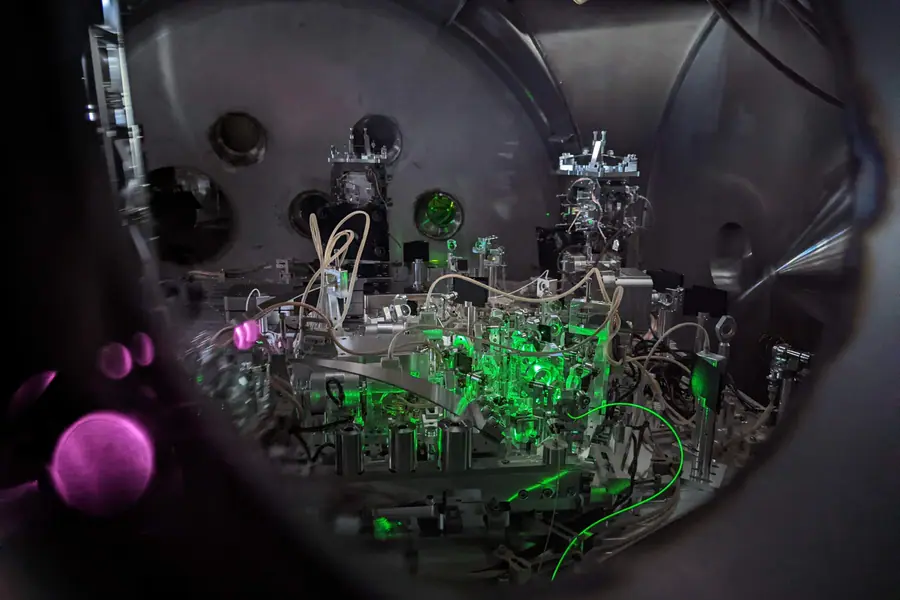
The solution is to squeeze light in one way for high frequencies of gravitational waves and another way for low frequencies. This is accomplished by LIGO’s new frequency-dependent squeezing cavity, which controls the relative phases of the light waves in such a way that the researchers can selectively move the quantum noise into different features of light (phase or amplitude) depending on the frequency range of gravitational waves.
Future of Gravitational Wave Detection
With its new frequency-dependent squeezing cavity, LIGO can now detect even more black hole and neutron star collisions. This advancement is expected to greatly improve our understanding of these cosmic events.
Next-generation larger gravitational-wave detectors, such as the planned ground-based Cosmic Explorer, will also reap the benefits of squeezed light. The future of gravitational wave detection looks promising, with potential for even more sensitivity improvements.
“We can’t control nature, but we can control our detectors,” says Lisa Barsotti, a senior research scientist at MIT who oversaw the development of the new LIGO technology.
“A project of this scale requires multiple people, from facilities to engineering and optics — basically the full extent of the LIGO Lab with important contributions from the LIGO Scientific Collaboration. It was a grand effort made even more challenging by the pandemic,” Barsotti says.
“Now that we have surpassed this quantum limit, we can do a lot more astronomy,” explains Lee McCuller, assistant professor of physics at Caltech and one of the leaders of the new study.
“We can take what we have learned from LIGO and apply it to problems that require measuring subatomic-scale distances with incredible accuracy,” McCuller says.
“When NSF first invested in building the twin LIGO detectors in the late 1990s, we were enthusiastic about the potential to observe gravitational waves,” says NSF Director Sethuraman Panchanathan.
“Before, we had to choose where we wanted LIGO to be more precise,” says LIGO team member Rana Adhikari, a professor of physics at Caltech. “Now we can eat our cake and have it too. We’ve known for a while how to write down the equations to make this work, but it was not clear that we could actually make it work until now. It’s like science fiction.”
“At some point, if you do more squeezing, you aren’t going to gain much. We needed to prepare for what was to come next in our ability to detect gravitational waves,” Barsotti explains.
“The quantum nature of the light creates the problem, but quantum physics also gives us the solution,” Barsotti says.
“We went through a lot of troubleshooting,” says Sheila Dwyer, who has been working on the project since 2008, first as a graduate student at MIT and then as a scientist at the LIGO Hanford Observatory beginning in 2013. “Squeezing was first thought of in the late 1970s, but it took decades to get it right.”
“Even though we are using squeezing to put order into our system, reducing the chaos, it doesn’t mean we are winning everywhere,” says Dhruva Ganapathy, a graduate student at MIT and one of four co-lead authors of the new study.
“It is true that we are doing this really cool quantum thing, but the real reason for this is that it’s the simplest way to improve LIGO’s sensitivity,” Ganapathy says.
“We are finally taking advantage of our gravitational universe,” Barsotti says. “In the future, we can improve our sensitivity even more. I would like to see how far we can push it.”
Summary
LIGO researchers have made a significant advance in a quantum technology called ‘squeezing’, allowing them to measure undulations in space-time across the entire range of gravitational frequencies detected by LIGO. This new ‘frequency-dependent squeezing’ technology, in operation since May, enables the detectors to probe a larger volume of the universe and is expected to detect about 60 percent more mergers than before, boosting LIGO’s ability to study the exotic events that shake space and time.
- Researchers from the Laser Interferometer Gravitational-Wave Observatory (LIGO) have made a significant advance in a quantum technology called “squeezing”, which allows them to measure undulations in space-time across the entire range of gravitational frequencies detected by LIGO.
- The new “frequency-dependent squeezing” technology, operational since May, allows the detectors to probe a larger volume of the universe and is expected to detect about 60% more mergers than before.
- The development of the new LIGO technology was overseen by Lisa Barsotti, a senior research scientist at MIT, and involved research experiments led by Matt Evans and Nergis Mavalvala at MIT. The project now includes dozens of scientists and engineers based at MIT, Caltech, and the twin LIGO observatories in Hanford, Washington, and Livingston, Louisiana.
- The results have implications for future quantum technologies such as quantum computers and other microelectronics, as well as for fundamental physics experiments.
- The technology works by manipulating light in different ways depending on the frequency of gravitational waves of interest, thereby reducing noise across the whole LIGO frequency range.
- The LIGO–Virgo–KAGRA Collaboration operates a network of gravitational-wave detectors in the United States, Italy, and Japan. LIGO Laboratory is operated by Caltech and MIT, and is funded by the NSF.