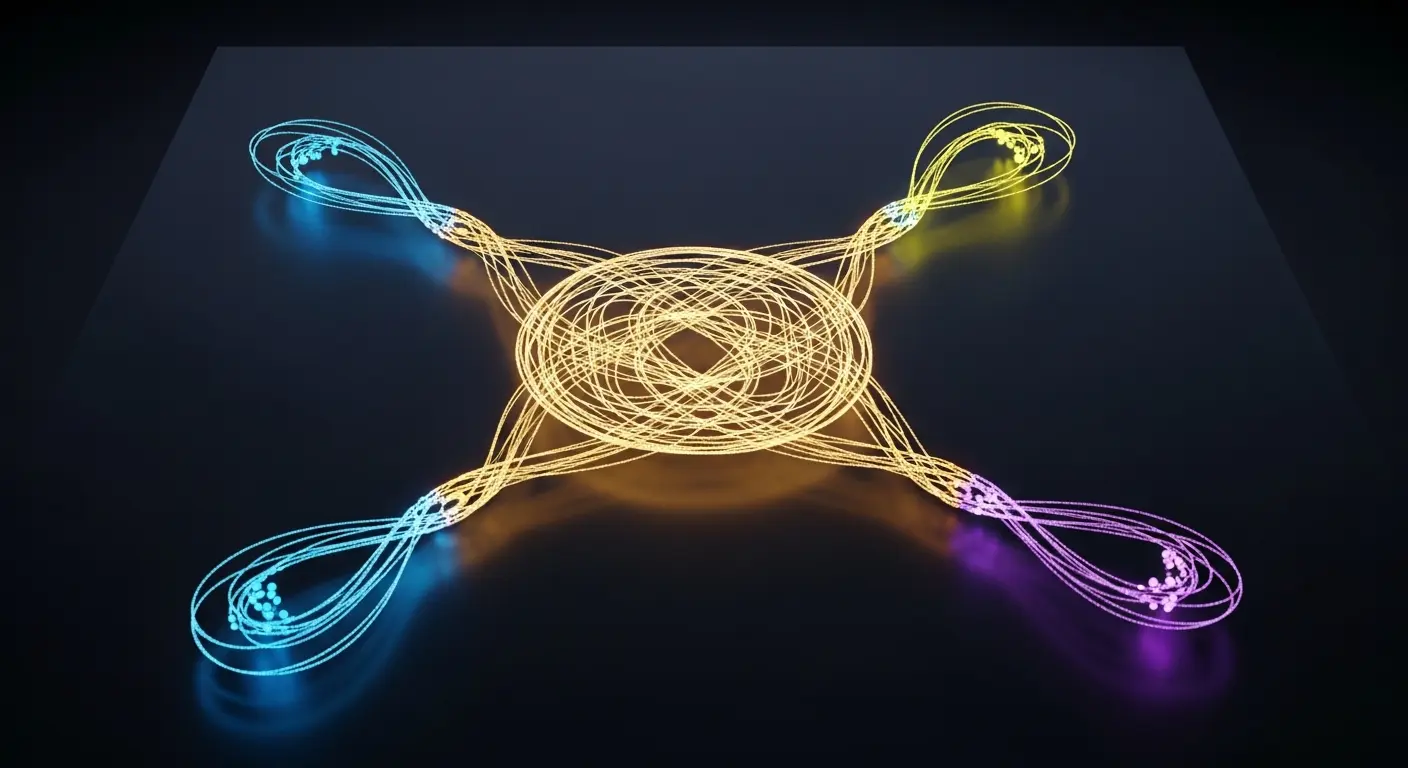
Wojciech J. Jankowski and colleagues from the University of Cambridge and collaborators reveal a universal topological dichroism, where chiral systems exhibit distinct responses to the chirality of light. The research shows integer-quantized dichroic excitation rate differences arising from chiral topological invariants and links these effects to broader principles of optical chirality coupling with quantum states. It proposes using superchiral light to experimentally identify previously unobserved chiral band topologies, establishing a new pathway for materials characterisation.
Superchiral light unlocks integer-quantized absorption differences in chiral materials
Superchiral light proved central to detecting topological dichroism, possessing an exceptionally high degree of optical chirality and pronounced ‘handedness’ in its polarisation. This intense chirality amplifies subtle differences in how chiral materials absorb light, making integer-quantized excitation rates discernible; without this focused beam, the signal would be lost in background noise. The generation of such superchiral light relies on sophisticated techniques, often involving the manipulation of metamaterials or the exploitation of non-linear optical processes to enhance the chiral component of the electromagnetic field. Precisely measuring the differential absorption of left- and right-handed circularly polarised light reveals a material’s unique response, akin to using a fingerprint scanner to identify a material’s fundamental ‘shape’ at a quantum level, remaining consistent despite minor distortions. This ‘fingerprint’ is not merely a surface property but reflects the underlying topological structure of the material’s electronic bands.
Researchers investigated a newly discovered phenomenon called topological optical chirality dichroism, observing integer-quantized differences in how chiral materials absorb light. The investigation focused on three-dimensional chiral topological insulators, exploring connections between optical chirality and complex mathematical concepts like Berry curvatures and Dixmier-Douady invariants, which explain the observed effects. Berry curvature, a geometric property of electronic bands, describes the effective magnetic field experienced by electrons due to their momentum, influencing their dynamics. Dixmier-Douady invariants, originating from algebraic topology, characterise the non-trivial twisting of quantum states within the material. These findings reveal how the optical response is intrinsically linked to strong integer topological invariants, underpinned by complex mathematical structures called bundle gerbe cohomologies, demonstrating a previously unobserved connection in three dimensions. Bundle gerbes provide a rigorous mathematical framework for describing the topological properties of quantum states, allowing for a precise quantification of the observed dichroism.
Universal Quantization of Dichroic Excitation Reveals Topological Chirality
For the first time, integer-quantized dichroic excitation rate differences, varying by a factor of one, have been demonstrated. This breakthrough surpasses earlier methods by establishing a definitive link between optical chirality and bundle gerbes, complex mathematical objects describing the twisting of quantum states. The significance of this quantization lies in its robustness; the observed differences are not sensitive to minor variations in material parameters, providing a highly reliable signature of the underlying topology. The findings reveal topological optical chirality dichroism, or TOCD, a phenomenon enabling direct observation of chiral electronic band topologies and offering a new pathway for materials characterisation without reliance on indirect electronic measurements. Traditional methods, such as angle-resolved photoemission spectroscopy (ARPES), require complex data analysis and are often limited by surface sensitivity.
This optical probing technique is insensitive to surface terminations, offering advantages for real-world material analysis and potentially enabling investigations into fractional topological optical chirality dichroism in future work. Surface terminations can significantly alter the electronic structure of materials, complicating the interpretation of experimental results. The insensitivity of TOCD to these surface effects makes it particularly valuable for studying real-world devices and heterostructures. Consistently, these integer-quantized dichroic excitation rate differences occur across three-dimensional chiral systems. The effect arises from coupling optical chirality to higher tensor Berry curvatures and Dixmier-Douady invariants, including Hopf indices, which describe the twisting of quantum states and reveal subtle details of a material’s electronic structure; candidate materials include chiral heterostructures based on magnetic MnBi2nTe3n+1 compounds and axion insulators. These materials exhibit strong spin-orbit coupling and complex magnetic ordering, leading to the emergence of topological states. However, while these findings demonstrate the potential for fractional topological optical chirality dichroism, achieving consistent fractionalization of dichroic rates remains a significant challenge for future investigation. Fractionalization would require even more exotic topological states and precise control over material parameters.
Linking quantum topology to light absorption via optical chirality differences
Detecting hidden quantum properties within materials has long relied on indirect measurements of electronic behaviour, a process often complicated by surface effects and requiring extensive data analysis. Topological optical chirality dichroism offers a potentially major shortcut, directly linking a material’s internal ‘shape’ at the quantum level to how it absorbs light. This direct link bypasses the need for complex electronic measurements and provides a more intuitive understanding of the material’s topological properties. Realising this elegant approach experimentally, however, hinges on generating ‘superchiral light’, a highly polarised form of illumination whose practical creation and manipulation remains an open question. Current limitations in generating and controlling superchiral light represent a significant hurdle to widespread adoption of this technique.
Acknowledging the current difficulty in creating the necessary illumination does not diminish the significance of identifying this direct optical link to a material’s quantum structure. Scientists have established a direct optical method for identifying the hidden quantum properties of chiral materials, bypassing reliance on indirect electronic measurements. Revealing integer-quantized differences in light absorption connects a material’s internal structure to its response to polarised light, with this ‘handedness’ being vital to the effect. The discovery links optical chirality, how a material interacts with light’s spin, to complex mathematical concepts like Berry curvatures and Dixmier-Douady invariants, describing the twisting of quantum states. This connection opens up new avenues for exploring the interplay between topology, chirality, and light-matter interactions, potentially leading to the development of novel optoelectronic devices and materials with tailored properties. Further research will focus on exploring the limits of this technique and extending it to more complex materials systems.
Scientists demonstrated a direct link between a material’s internal quantum structure and how it absorbs light. This provides a new method for identifying chiral materials’ hidden properties without complex electronic measurements, instead relying on differences in light absorption. The research establishes that these differences are integer-quantized, meaning they occur in distinct steps, and connects them to mathematical descriptions of quantum states. Authors suggest future work will explore the technique’s limits and application to more complex materials.
👉 More information
🗞 Topological Optical Chirality Dichroism
🧠 ArXiv: https://arxiv.org/abs/2603.28752