Researchers demonstrate ultrastrong coupling between light and magnons, collective spin excitations in a ferromagnetic material, using a superconducting resonator. This achieves a 60 MHz Bloch-Siegert shift, confirming antiresonant interactions and enhanced coupling via multiple magnon elements, paving the way for robust, noise-tolerant spintronic and optical technologies.
Light-matter interactions underpin emerging quantum technologies and their resilience. Quantum technologies, encompassing computation and sensing, fundamentally rely on the interaction between light and matter, and achieving strong interactions is crucial for advancements in the field. Researchers now focus on the ‘ultrastrong coupling regime’, where the rate of interaction approaches the resonant frequencies of both light and matter, enabling the creation of quantum entanglement, a key resource for robust quantum systems even in the presence of environmental noise.
A significant challenge in realising the full potential of ultrastrong coupling lies in suppressing ‘antiresonant’ interactions, often overshadowed by the diamagnetic response of materials. Scientists seek methods to minimise this effect and enhance these counter-rotating interactions. Recent investigations explore utilising collective excitations in magnetic materials, known as magnons, to mediate the coupling between light and matter, offering a pathway to create ‘magnon-polaritons’, hybrid light-matter quasiparticles that potentially circumvent limitations imposed by the diamagnetic term.
This research details an on-chip platform designed to achieve this ultrastrong magnon-photon coupling, employing a superconducting resonator coupled to thin ferromagnetic films to facilitate collective magnetic-dipole interactions. This enhances the coupling strength and enables the observation of phenomena driven by antiresonant processes. Experimental results demonstrate a pronounced ‘Bloch-Siegert shift’, a measurable effect indicative of these antiresonant interactions. Researchers observe a cooperative enhancement of coupling strength by increasing the number of magnons interacting with a single photon, a scalability crucial for developing more complex and powerful quantum devices.
The experimental setup meticulously controls the number of magnetic elements contributing to the collective interaction, revealing a direct correlation between the number of elements and the strength of the coupling. Increasing the number of remotely positioned magnetic stripes demonstrably enhances the Dicke cooperativity, a measure of the collective enhancement of the light-matter interaction. This scalability represents a key advantage of the platform, suggesting that the coupling strength can be further amplified by incorporating even more magnetic elements. Researchers demonstrate precise control over the Bloch-Siegert shift by tuning both the number of magnetic stripes and an applied magnetic field, offering a pathway to engineer the properties of the magnon polaritons.
Superconducting circuits integrating ferromagnetic materials present a novel platform for exploring light-matter interactions at the ultrastrong coupling regime, where the interaction strength between photons and magnons—quantised spin waves—becomes comparable to their resonant frequencies. Researchers demonstrate ultrastrong coupling between microwave photons confined within a superconducting resonator and collective magnon modes in thin films of permalloy, a nickel-iron alloy. This system circumvents limitations imposed by diamagnetic effects, which typically suppress the desired antiresonant interactions crucial for achieving this coupling.
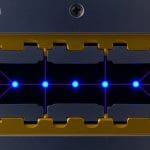
The experimental platform consists of a superconducting resonator patterned with multiple permalloy stripes, acting as sources of magnons. Microwave transmission measurements reveal a pronounced Bloch-Siegert shift—approximately 60 MHz—confirming the presence of ultrastrong coupling and the significant contribution of antiresonant interactions. This shift represents a direct consequence of simultaneous photon and magnon creation or annihilation, a hallmark of this coupling regime. Researchers observe that increasing the number of permalloy stripes enhances the Dicke cooperativity, indicating that the coupling strength scales with the number of coupled magnons, offering a pathway towards greater control over the system.
The observed enhancement of Dicke cooperativity demonstrates a scalable approach to strengthening light-matter interactions. By increasing the number of magnons coupled to a single photon mode, researchers effectively amplify the collective interaction. This control over the coupling strength is vital for manipulating quantum information and developing novel quantum devices. The system’s ability to circumvent the diamagnetic term further distinguishes it, allowing for more pronounced and controllable ultrastrong coupling effects.
This research establishes a robust platform for investigating exotic phenomena driven by antiresonant interactions, bridging the fields of spintronics and optics. The demonstrated scalability and control over the coupling strength position this system as a promising candidate for realising noise-tolerant quantum technologies and exploring fundamental aspects of light-matter interactions at the quantum level. The ability to engineer strong collective interactions between photons and magnons opens avenues for developing advanced quantum sensors, information processors, and simulators.
This research establishes a robust and scalable platform for investigating ultrastrong coupling phenomena, and the ability to control and enhance the light-matter interaction through collective magnetic-dipole interactions opens up new avenues for exploring fundamental physics and developing innovative quantum technologies. Continued investigation of this system promises to yield further insights into the behaviour of hybrid quantum systems and their potential for real-world applications.
👉 More information
🗞 On-chip magnon polaritons in the ultrastrong coupling regime
🧠 DOI: https://doi.org/10.48550/arXiv.2507.06065