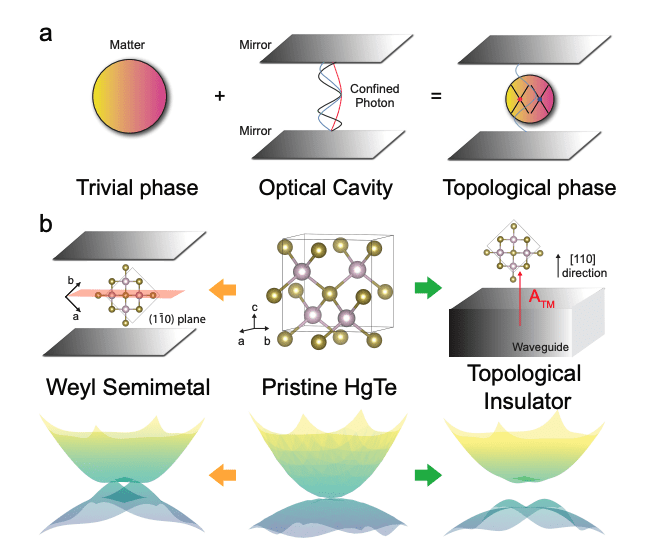
The manipulation of material properties via light presents a compelling avenue for advanced materials design, and recent research details a method for inducing topological phases in mercury telluride (HgTe) using strong light-matter interactions. These topological phases, characterised by unique electronic properties at the material’s surface, are typically achieved through complex material composition or external pressure. However, a collaborative team led by Dongbin Shin from the Gwangju Institute of Science and Technology, alongside I-Te Lu, Benshu Fan, Emil Viñas Boström, Hang Liu, and Angel Rubio from the Max Planck Institute for the Structure and Dynamics of Matter, with contributions from Mark Kamper Svendsen of the Niels Bohr Institute, University of Copenhagen, Simone Latini from the Technical University of Denmark, and Peizhe Tang from Beihang University, now demonstrates an alternative approach. Their work, detailed in the article ‘Multiple Photon Field-induced Topological States in Bulk HgTe’, utilises the principles of quantum electrodynamic density functional theory (QEDFT) to show how carefully engineered photonic structures, such as optical cavities and waveguides, can reconfigure the electronic structure of HgTe, driving it into distinct topological states including Weyl semimetals, nodal-line semimetals, and topological insulators. This process, unlike previous laser-induced effects, relies on steady-state photon-matter hybridisation, offering the potential for stable and controllable topological phenomena.
Recent advances in materials science demonstrate stable control over topological phases within materials through strong light-matter interactions, offering potential benefits for quantum computing, spintronics, and materials design. Researchers successfully induce and manipulate emergent topological phases in mercury telluride (HgTe) by coupling it with photonic structures, including optical cavities and waveguides. This approach moves beyond transient excitation, establishing a new paradigm for materials design by achieving stable, engineered topological states.
The research details how strong light-matter interactions within these photonic structures induce emergent topological phases in HgTe, reconfiguring its electronic and ionic structures. Distinct topological phases – Weyl, nodal-line, and topological insulator – emerge contingent upon the sample’s orientation and the strength of the coupling. A topological insulator is a material that behaves as an insulator in its interior but conducts electricity on its surface, while Weyl and nodal-line phases represent exotic states of matter with unique electronic properties.
Researchers utilised state-of-the-art electrodynamic density functional theory (QEDFT) calculations to model these interactions and confirm the emergence of these topological phases. QEDFT is a computational method that combines principles of quantum mechanics and electromagnetism to describe the behaviour of electrons and photons in materials. These calculations reveal that the photon fields within the photonic structures mediate a symmetry-breaking mechanism within HgTe, fundamentally altering its band structure and driving it into the observed topological phases. The band structure describes the allowed energy levels for electrons within a material, and its alteration is crucial for inducing topological changes. This computational approach provides a rigorous theoretical framework for understanding and predicting the emergence of topological phases.
The ability to manipulate and realise diverse topological phases on demand opens avenues for future research. Potential applications include the development of novel quantum devices, spintronic materials that utilise electron spin for information storage and processing, and advanced materials with tailored electronic properties.
This research benefits from funding originating from multiple sources, including the Max Planck Institute New York City Center for Non-Equilibrium Quantum Phenomena, the Cluster of Excellence “CUI: Advanced Imaging of Matter”, and grants from the European Research Council, National Natural Science Foundation of China, and National Research Foundation of Korea. This collaborative effort demonstrates a comprehensive approach to understanding and engineering topological phases through light-matter interactions, and highlights the importance of international collaboration in advancing scientific knowledge.
Specific roles within the research were clearly delineated, with D.S. performing the ab initio calculations—meaning calculations based on first principles—and S.L., P.T., and A.R. authoring the manuscript. B.F. and P.T. analysed the topological phase of HgTe, while E.V.B., M.K.S., I.L., and S.L. investigated conditions for strong light-matter coupling. I.L. and A.R. developed the QEDFT code used in the simulations, and all authors participated in discussing the results and refining the final paper, demonstrating a collaborative and interdisciplinary approach to scientific inquiry.
👉 More information
🗞 Multiple Photon Field-induced Topological States in Bulk HgTe
🧠 DOI: https://doi.org/10.48550/arXiv.2506.23494