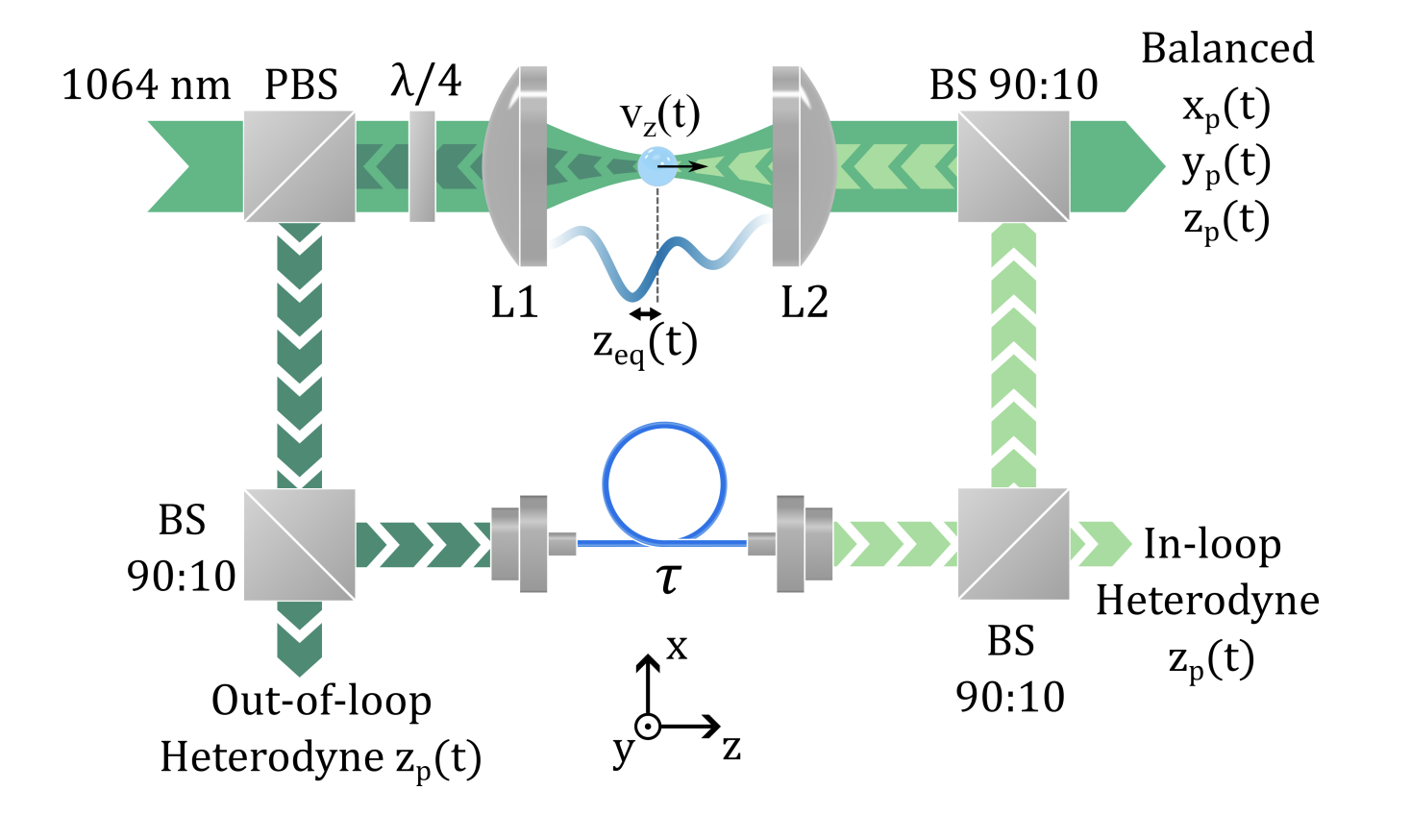
The manipulation of objects at the nanoscale presents considerable challenges, particularly concerning their control and cooling. Recent research details a novel approach to cooling a levitated nanoparticle utilising coherent feedback, circumventing the limitations inherent in measurement-based control systems. This technique preserves the delicate quantum correlations within the system, offering more precise and tunable control over its motion. Bruno Melo, Daniël Veldhuizen, Grégoire F. M. Tomassi, Nadine Meyer, and Romain Quidant, all from the Nanophotonic Systems Laboratory within the Department of Mechanical and Process Engineering at ETH Zurich, publish their findings in a paper entitled ‘Cooling of an optically levitated nanoparticle via measurement-free coherent feedback’, demonstrating phonon occupations reaching a few hundred phonons and outlining a theoretical framework to improve performance towards the motional ground state.
Active control of levitated nanoparticles is advancing rapidly, demonstrating increasingly sophisticated manipulation and exploration of quantum phenomena. Researchers now pursue comprehensive control over all six degrees of freedom – three translational and three rotational – of levitated particles, as evidenced by studies from Pontin et al. (2023) and Gao et al. (2024), who demonstrate cooling across these dimensions and even rotational motion to exceptionally low phonon numbers. Phonons represent quanta of vibrational energy, and achieving low phonon numbers signifies a very cold, and therefore more controllable, system. Bang et al. (2020) further extend this control by successfully cooling a nanodumbbell, showcasing the ability to manage more complex particle geometries and refine techniques for precise thermal management. These advancements establish a foundation for exploring fundamental physics and developing novel technologies utilising nanoscale mechanical systems.
Recent progress focuses on miniaturisation and on-chip integration, aiming for practical applications and portable systems. Melo et al. (2024) demonstrate vacuum levitation and motion control directly on a chip, representing a crucial step towards scalable and deployable devices. Simultaneously, researchers employ advanced techniques to enhance control precision and optimise system performance. Lepeshov et al. (2023) and Afridi et al. (2025) utilise metamaterials and metaoptics respectively, to manipulate optical forces and refine control over the nanoparticles. Metamaterials are artificially engineered materials exhibiting properties not found in nature, while metaoptics focuses on controlling light using these materials. Lee et al. (2025) actively design microparticles to optimise trapping and detection capabilities, demonstrating a proactive approach to system performance and pushing the boundaries of what is achievable.
A significant limitation to achieving ultimate control is
A significant limitation to achieving ultimate control is laser noise, which introduces fluctuations in the optical trap used to levitate and manipulate the particle. To address this, researchers are developing techniques to mitigate these effects and reach lower temperatures. A novel approach involves coherent feedback control, differing from traditional measurement-based feedback systems. This method allows for more precise manipulation and preservation of quantum coherence, a key requirement for exploring quantum phenomena. By carefully adjusting the feedback phase and delay, researchers can explore the nanoparticle’s dynamics and develop strategies for reaching the motional ground state – the lowest possible energy state.
Researchers are actively exploring the potential of this technique for manipulating complex degrees of freedom, such as rotational motion and internal vibrations. The theoretical framework developed alongside these experiments provides insights into the limitations imposed by laser noise and guides the development of strategies for overcoming these challenges. By minimising noise, the full potential of coherent feedback can be unlocked, pushing the boundaries of cooling performance and enabling new avenues of research.
This work establishes a foundation for exploring fundamental physics, developing ultra-sensitive sensors, and building quantum technologies. The ability to manipulate levitated nanoparticles with such precision and control represents a significant step forward in the field of nanomechanics and quantum control, and ongoing research actively pursues new applications for this technology. Foundational work by Romero-Isart et al. (2010), Harris et al. (2014) and Monteiro et al. (2017) continues to underpin these advancements, establishing the theoretical and experimental basis for this rapidly evolving field.
👉 More information🗞Cooling of an optically levitated nanoparticle
🗞 Cooling of an optically levitated nanoparticle via measurement-free coherent feedback
🧠 DOI: https://doi.org/10.48550/arXiv.2506.21341