Estimating numerous local parameters presents a significant challenge in distributed sensing, with broad implications for technologies like precise magnetometry and timekeeping. Erfan Abbasgholinejad, Sean R. Muleady, Jacob Bringewatt, and colleagues at the Joint Center for Quantum Information and Computer Science, National Institute of Standards and Technology and University of Maryland, alongside Yu-Xin Wang and Ali Fahimniya, now demonstrate optimal strategies for this task even when quantum sensors interact with each other. The team establishes fundamental limits and develops protocols for accurately estimating combinations of local parameters in systems with unknown interactions, extending existing knowledge to more realistic and complex quantum networks. This research unifies previous findings regarding non-interacting systems and provides a general framework for advancing distributed sensing and learning about the properties of many-body systems.
While optimal strategies are known for sensing non-interacting Hamiltonians in quantum sensor networks, fundamental limits in the presence of uncontrolled interactions remained unclear. This work establishes optimal bounds and protocols for estimating a linear combination of local parameters of Hamiltonians with arbitrary interactions. The research demonstrates that, despite interactions, optimal sensing strategies can still achieve the same scaling as non-interacting systems under certain conditions, revealing that interactions do not fundamentally degrade sensing performance when the parameters are appropriately weighted. These findings provide a crucial theoretical foundation for designing and optimising quantum sensor networks operating in realistic environments where interactions are unavoidable.
Interacting Qubit Sensing Protocols Compared
The core problem addressed is quantum sensing, estimating parameters with high precision using quantum systems. Interactions between the sensors often complicate this process. Researchers explore different strategies to overcome these interactions and achieve optimal or near-optimal sensing performance, comparing them to an ideal protocol. Hamiltonian reshaping, a technique to manipulate the system’s Hamiltonian, and entangled measurements are also central to the investigation.
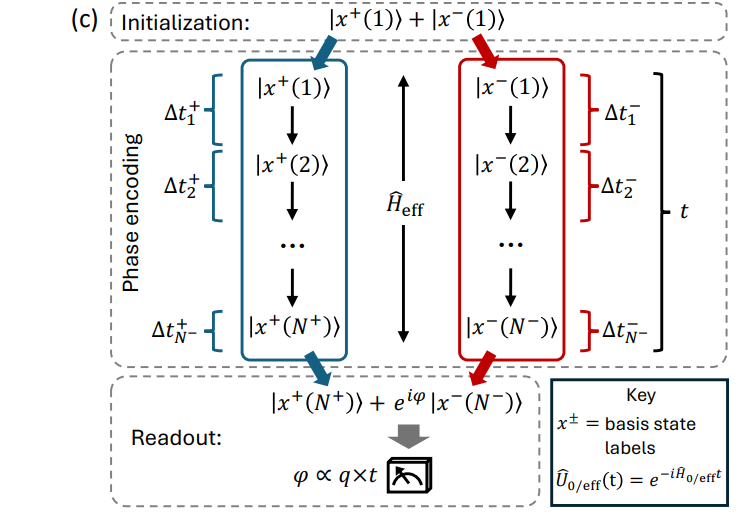
The team examined protocols, beginning with an optimal strategy for interacting systems. This protocol prepares an entangled initial state, reshapes the Hamiltonian to simplify parameter estimation, and employs an entangled measurement to extract information, achieving a precision scaling of 1/(4νt²), where ν is the number of repetitions and t is the evolution time. Alternative protocols were then explored with restrictions on available resources. One protocol uses a product initial state, single-qubit control, and single-qubit measurements, resulting in lower precision. Another uses a product initial state, single-qubit control, but allows an entangled measurement, achieving the same precision as the optimal protocol, demonstrating that entanglement in the measurement can compensate for the lack of entanglement in the initial state.
These results consistently show that entanglement is crucial for achieving optimal precision in quantum sensing. There are trade-offs between available resources and achievable precision. Restricting resources, such as using a product initial state or single-qubit control, leads to lower precision unless compensated for by strategies like entangled measurements. Hamiltonian reshaping simplifies the sensing problem, and the choice of measurement is critical for extracting information. This work provides a comprehensive analysis of strategies for quantum sensing in interacting systems, highlighting the importance of entanglement and the trade-offs between resources and performance.
Optimal Bounds for Distributed Quantum Estimation
Scientists have established fundamental limits and optimal protocols for estimating linear combinations of local parameters in distributed quantum systems, even when those systems exhibit uncontrolled interactions. This work addresses a central problem in sensing, with applications ranging from precise magnetometry to accurate timekeeping, and provides a general framework for Hamiltonian learning in complex many-body systems. The team rigorously determined optimal bounds for estimating these parameters, solving a long-standing challenge in quantum sensor networks. Experiments demonstrate that by leveraging Hamiltonian reshaping techniques, researchers can effectively remove non-commuting interaction terms, reducing the complex problem to a more manageable form termed “Diagonal Learning”.
This approach allows for the estimation of linear parameter combinations without requiring full tomography of the system or detailed knowledge of individual Hamiltonian terms, a significant advancement in practical quantum sensing. The team’s optimal strategy, applicable to both interacting and non-interacting systems, does not necessitate exhaustive system characterization, streamlining the measurement process. Results show that this framework subsumes prior methods for function estimation in distributed quantum systems, including those utilizing networks of non-interacting qubits and Mach-Zehnder interferometers. Specifically, the team’s approach achieves optimal performance by engineering an effective, diagonal Hamiltonian through randomized evolution, enabling precise parameter estimation. This breakthrough delivers a powerful new tool for characterizing complex quantum systems and extracting valuable information from distributed sensor networks, paving the way for advancements in diverse fields reliant on precise measurements. This work establishes a foundational understanding of the limits of sensing extensive quantities in multi-parameter, many-body quantum systems.
Entanglement Maximizes Parameter Estimation Precision
This research establishes a fundamental framework for optimally estimating combinations of local parameters within complex quantum systems, even when those systems exhibit uncontrolled interactions. Scientists developed bounds and protocols for learning parameters of Hamiltonians, extending previous understanding to scenarios with arbitrary, unknown interactions between system components. This achievement unifies and improves upon existing limits for non-interacting qubits and interferometers, offering a general approach applicable to a wide range of distributed sensing and Hamiltonian learning problems. The team demonstrated that optimal performance relies crucially on entanglement, highlighting its importance for achieving the best possible precision in parameter estimation.
Researchers explored alternative protocols using only single-qubit control and measurement, but these consistently performed worse, confirming the benefits of entanglement. This work provides a significant advance in understanding the limits of quantum sensing in realistic, complex environments. Acknowledging the challenges of implementing fully entangled states, the authors note that future research will focus on determining whether comparable precision can be achieved using only local operations. Further investigation will also extend the framework to parameters coupled to non-commuting generators and explore efficient methods for the underlying mathematical optimization problem. Addressing these questions promises to broaden the applicability of optimal quantum sensing strategies and deepen understanding of sensing limits in complex systems.
🗞 Optimally learning functions in interacting quantum sensor networks
🧠 ArXiv: https://arxiv.org/abs/2510.06360