

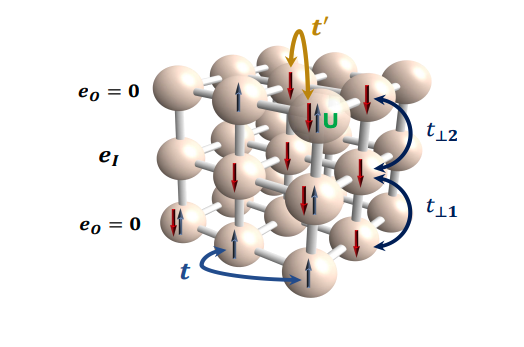
The pursuit of higher temperature superconductivity, a phenomenon where materials conduct electricity with zero resistance, receives considerable attention due to its potential for transformative technologies. Xun Liu and Mi Jiang, from Soochow University, investigate this pursuit through computational modelling of multilayered copper oxides, known as cuprates, which currently exhibit the highest confirmed superconducting transition temperatures. Their research, utilising large-scale dynamical cluster quantum Monte Carlo simulations, focuses on a three-layer system where the outer layers possess a higher concentration of ‘holes’ – absences of electrons that contribute to conductivity – than the central layer. This differentiation, they demonstrate, induces distinct electronic behaviours; the outer layers remain metallic, while the central layer transitions into a superconducting state. Crucially, this arrangement enhances the overall superconducting transition temperature, suggesting the central layer drives superconductivity while the outer layers function as a charge reservoir. This work offers a new understanding of the mechanisms behind high-temperature superconductivity in complex materials.
Motivated by the highest superconducting transition temperatures (Tc) observed in multilayer cuprates, researchers investigated the trilayer Hubbard model using large-scale dynamical cluster quantum Monte Carlo simulations. The study focused on systems where the outer layers (OL) exhibit higher hole doping than the inner layer (IL), a configuration believed to be relevant to realistic multilayer cuprates. Their exploration revealed a strong differentiation between the IL and OL across a range of doping combinations. Specifically, the OLs remained metallic, while the IL underwent a transition from a pseudogap state to a superconducting state. Significantly, the maximum Tc of the composite trilayer system was enhanced compared to single-layer models, and an imbalance in hole doping between the IL and OL proved beneficial to overall superconductivity. The research provides strong evidence that the IL itself drives d-wave superconductivity, with the OLs acting primarily as a charge reservoir.
The methodology employed involved simulating the behaviour of electrons within the trilayer Hubbard model – a theoretical representation of three layers of copper oxide, the key material in cuprate superconductors – using advanced computational techniques. Researchers used quantum Monte Carlo simulations, a powerful method for solving complex quantum mechanical problems, adopting a ‘dynamical cluster’ approach to investigate electron behaviour over a range of energies and momenta. The simulations were performed on relatively large computational clusters to improve accuracy and capture more realistic behaviour.
To ensure reliability, the researchers carefully considered the
To ensure reliability, the researchers carefully considered the limitations of the computational methods, employing techniques to mitigate the ‘sign problem’ – a common challenge in quantum Monte Carlo simulations that can lead to inaccurate results. The calculations were performed on clusters containing 24 sites, balancing computational cost with the need for accurate representation of the material’s properties. The researchers focused on d-wave pairing symmetry, consistent with experimental observations and previous theoretical work on cuprate superconductors. By systematically varying the hole doping levels in the IL and OL, they were able to map out the conditions that favour the emergence of superconductivity and identify the key factors that contribute to the enhanced Tc observed in multilayer cuprates.
This study, employing dynamical cluster quantum Monte Carlo simulations of the trilayer Hubbard model, elucidates the mechanisms underpinning enhanced superconductivity in multilayer cuprates. The research demonstrates a clear differentiation between the inner and outer layers, with the outer layers remaining metallic while the inner layer exhibits a transition from a pseudogap to a superconducting state. Crucially, the simulations reveal that the inner layer drives the d-wave superconductivity, while the outer layers function primarily as a charge reservoir. This finding challenges existing theories centred on composite pictures or proximity effects, suggesting a more nuanced interplay between layers.
The simulations indicate that an imbalance in hole doping between the inner and outer layers is beneficial to achieving a higher superconducting transition temperature (Tc). This enhancement surpasses that observed in single-layer models, highlighting the synergistic effect of layer differentiation. The results support a scenario where the inner layer’s superconducting properties are central to the overall performance of the trilayer system, with the outer layers providing the necessary charge carriers to sustain this superconductivity.
Future work could explore the impact of varying
Future work could explore the impact of varying interlayer hopping parameters and the influence of different electron correlations on the observed layer differentiation. Investigating the robustness of these findings in more complex models, incorporating additional layers or accounting for specific material properties, would further refine our understanding of high-temperature superconductivity in multilayer cuprates and potentially guide the development of novel superconducting materials.
Enhanced superconductivity via layer differentiation in trilayer Hubbard model
DOI: https://doi.org/10.48550/arXiv.2507.06614


