Researchers have long grappled with defining observable laws within quantum field theory in curved spacetime, a challenge significantly more complex than in flat spacetime due to the absence of a clear vacuum state. Hideyasu Yamashita from Aichi-Gakuin University addresses this fundamental problem by investigating the empirical validity of laws governing Majorana fields in curved spacetime. This work builds upon previous research examining the Klein-Gordon field and extends the analysis to explore whether theoretical predictions can genuinely be tested through experimental procedures. Establishing such empirical laws is crucial for solidifying the physical status of quantum field theory in curved spacetime, moving it beyond purely mathematical consideration and potentially resolving concerns about its testability.
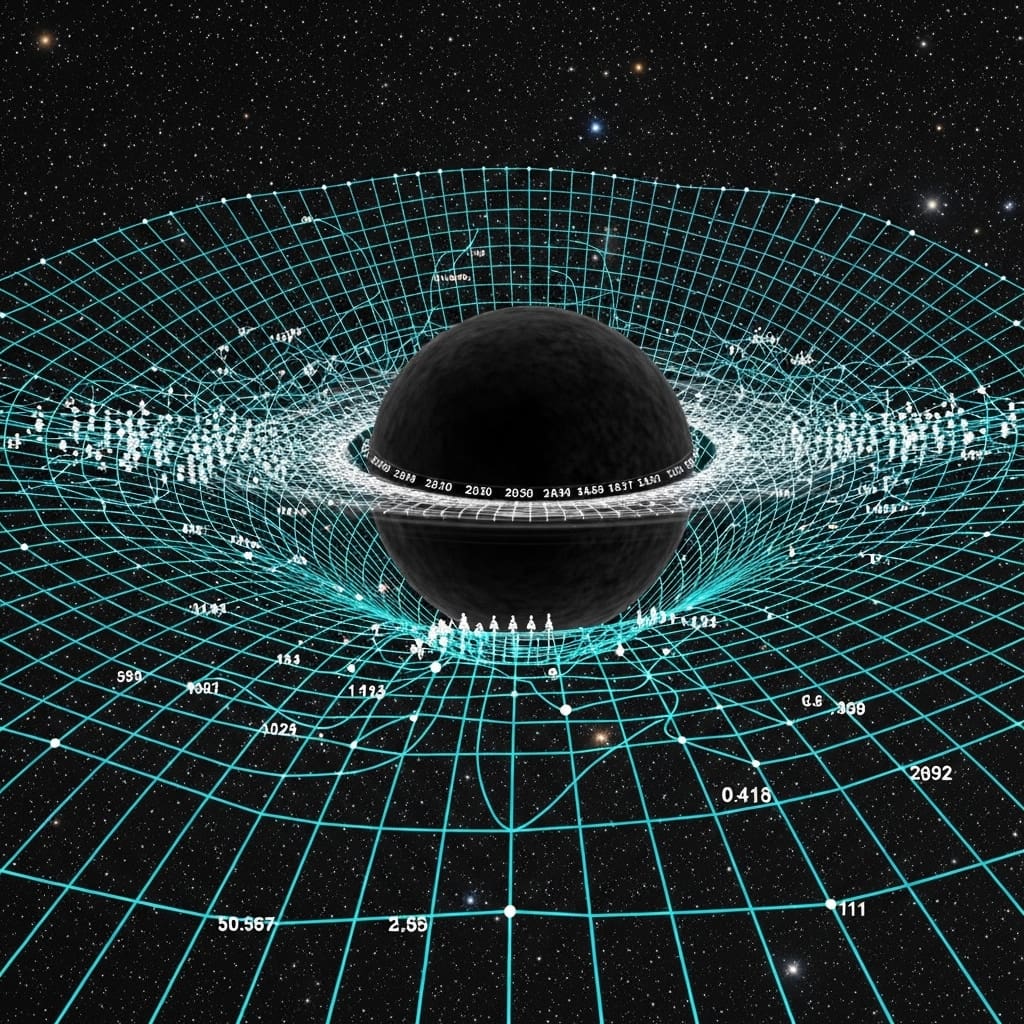
Clarifying how we might verify theoretical predictions when the concept of a vacuum becomes uncertain. Scientists are revisiting fundamental questions about the nature of physical laws within quantum field theory in curved spacetime (QFTCS), attempting to reconcile quantum mechanics with general relativity and describing fields existing not in flat space. But in the warped spacetime around massive objects.
A central difficulty arises from the absence of a clear “vacuum” state in QFTCS, readily available in quantum field theory in Minkowski spacetime(QFTM). This deficiency threatens to undermine the ability to empirically verify or falsify theoretical predictions. Recent work addresses this problem by focusing on the Majorana field, a particle predicted by extensions to the standard model. Within the context of curved spacetime.
The core issue investigated concerns how to define “empirical laws”, those verifiable through experiment. When the usual tools for establishing such laws are absent or ill-defined. Establishing empirical validity in QFTCS demands careful consideration of what constitutes a feasible measurement process. By focusing on relatively familiar observable quantities, such as field strength and momentum, may offer a pathway toward identifying testable predictions.
Even these observables require complex mathematical machinery for rigorous definition in curved spacetime — to circumvent these difficulties, the current investigation adopts a more basic approach. Concentrating on mathematically elementary quantities that can be defined without advanced techniques like microlocal analysis, and although no Majorana particle has been definitively proven, the conceptual simplicity of the Majorana field, specifically its algebraic structure. Makes it an ideal test case for exploring the foundations of empirical laws in QFTCS.
The project employs a specific type of algebra, known as a CAR algebra, to describe the possible states of the Majorana field, presenting two definitions, one using real vector spaces and another using complex vector spaces, to ensure a consistent mathematical foundation. By carefully constructing these algebras, scientists aim to establish a rigorous basis for identifying and verifying potential empirical laws governing fields in curved spacetime, moving beyond purely mathematical considerations toward a more physically grounded theory.
Defining testability for quantum fields in curved spacetime using restricted observables
Calculations proceeded by establishing a theoretical framework for examining empirical laws within quantum field theory in curved spacetime (QFTCS), building upon prior work. This effort specifically addresses the challenge of defining observability when the conventional notion of a vacuum state is absent, a key distinction between QFTCS and its flat spacetime counterpart, QFTM.
Here, the project focused on the Majorana field, chosen for its mathematical properties despite the current lack of experimental confirmation of its existence as a physical particle. Instead of attempting direct experimental verification, The effort prioritised identifying conditions under which theoretical laws could be considered empirically testable, even in principle.
A deliberate restriction was placed on the observables considered, moving away from quantities requiring advanced mathematical tools like microlocal analysis. In turn, this decision aimed to focus on “mathematically basic” observables, acknowledging a trade-off between mathematical simplicity and intuitive physical familiarity. For instance, while quantities like the stress-energy tensor are commonly associated with field strength, their rigorous definition in curved spacetime presents significant hurdles.
Meanwhile, the project concentrated on observables definable without such complex analysis, allowing for a clearer assessment of empirical verifiability. Through defining “empirical law” required careful consideration. As a law in theoretical physics is only observable if it can be verified or falsified through an experimental procedure — the project sought to identify laws expressible in terms of relatively familiar quantities. Hypothesising the existence of measurement procedures for these quantities to establish a basis for determining empirical content within QFTCS.
Such an approach differed from simply seeking novel physical results, as QFTCS currently lacks definitively experimentally verifiable predictions — instead, to frame laws in a way that allows for, at least in principle, empirical assessment, even when direct measurement proves exceptionally difficult. As might be the case with elusive particles like neutrinos. Through focusing on the mathematical structure of observability. Meanwhile, the project sought to clarify the status of QFTCS as a physical, rather than purely mathematical, theory.
Real and complex canonical anticommutation relations and operator definitions
Once defined, the real CAR algebra over a vector space V, utilising a pre-inner product — generates a C∗-algebra through the identity and operators φ(v) for each v in V. These operators adhere to R-linearity, with φ(v)∗ equalling φ(v) for all v, and a fundamental anticommutation relation: {φ(v), φ(u)} = 2(v|u)1, where {X, Y} signifies XY + YX. If (v|v) equals zero, then φ(v) itself is zero.
An almost equivalent definition exists for the complex version, CAR(h), employing a complex pre-inner product and operators a(v) over h. Here, v to a(v) is antilinear. At the same time, the anticommutation relations become {a(v), a(u)} = 0 and {a(v), a(u)∗} = ⟨v|u⟩1 — if ⟨v|v⟩ is zero, then a(v) is zero for all v and u in h. These definitions remain valid even when the pre-inner products are not necessarily inner products, though the algebra is effectively equivalent to that defined over the quotient space V/N. Where N represents the null space.
The Majorana field is then considered. The even subalgebra of the C∗-algebra generated by its field operators forms the observable algebra — by contrast, the Dirac field’s corresponding algebra contains numerous non-observables due to its U gauge symmetry, or equivalently, the charge superselection rule. The project focuses on mathematically basic observables, defined without the need for microlocal analysis, despite a potential loss of immediate familiarity. Specifically, The effort examines the case where the pre-inner product is positive-semidefinite, but not necessarily definite, allowing for a more general framework for defining the CAR algebra. As a result, the observable algebra of the Majorana field.
Defining measurability in active spacetime through quantum field theory
Once a theory ventures beyond flat spacetime, establishing what can be empirically verified becomes a surprisingly difficult task. This latest work grapples with that problem, specifically within the framework of quantum field theory in curved spacetime, and builds upon previous investigations. For decades, physicists have struggled to reconcile the predictive power of quantum field theory with the complexities introduced by gravity and curved geometries.
Unlike its flat-space counterpart, defining a vacuum state proves elusive when spacetime itself is active. As a result, determining which theoretical “laws” actually correspond to observable phenomena remains a significant hurdle. To address this issue is not merely an academic exercise. A clear understanding of empirical laws is fundamental to assessing the physical validity of any theory claiming to describe the universe.
Scientists are attempting to establish criteria for observability. Examining how probabilistic statements about quantum fields can be meaningfully tested when a traditional vacuum is absent. By focusing on conditional probabilities, they propose a route toward identifying statements that could, in principle, be verified through experiment. While this approach offers a potential framework, translating it into concrete experimental tests remains a distant prospect.
Beyond the immediate technical difficulties, the very nature of spacetime at extreme scales, where quantum gravity effects are dominant, is still largely unknown. Future work might concentrate on exploring specific curved spacetime scenarios, such as those near black holes, where observational data could potentially constrain theoretical predictions. In the end, this line of inquiry highlights that the foundations of physical laws themselves may need re-evaluation when gravity enters the picture.
👉 More information
🗞 The empirical laws for Majorana fields in a curved spacetime
🧠 ArXiv: https://arxiv.org/abs/2602.16907