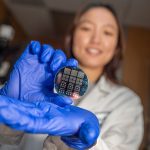
The growing need for robust ultraviolet (UV) detection in fields ranging from space exploration to environmental science drives the search for more versatile sensor technologies. Yicheng Wang, Jixiang Jing, and colleagues from The University of Hong Kong, alongside collaborators at several other institutions, have developed a novel UV detector that addresses limitations in current designs. Their research introduces a self-powered, ultra-thin, and flexible device constructed from a diamond-MoS₂ heterojunction, overcoming the constraints of rigid, externally powered sensors. The resulting detector not only exhibits high sensitivity and performance, but also demonstrates dynamically tunable photoresponse through mechanical bending, and paves the way for scalable, integrable, and cost-effective UV sensing solutions with a working 3×3 pixel imager prototype.
Diamond Membrane Powers Self-Sufficient UV Sensing
The increasing demand for ultraviolet (UV) sensing arises from its critical applications in diverse fields, including space exploration, atmospheric monitoring, and industrial hygiene. Traditional UV detectors frequently rely on external power sources, limiting their usability in remote, portable, or energy-constrained applications. Consequently, significant interest exists in developing self-powered UV detectors that can operate autonomously, offering greater convenience, efficiency, and reduced logistical complexity. Furthermore, the need for flexible and robust devices drives research into novel materials and designs capable of withstanding harsh environments and conforming to complex surfaces, opening possibilities for wearable sensors and adaptable monitoring systems. The spectral range of UV light, typically categorised as UVA (315-400 nm), UVB (280-315 nm), and UVC (100-280 nm), necessitates detectors with specific sensitivities tailored to the target application; for example, monitoring stratospheric ozone depletion requires sensitive UVC detection.
Diamond, with its exceptional properties such as high carrier mobility, wide bandgap (approximately 5.5 eV), high thermal conductivity, and chemical inertness, presents a promising material for UV detection. The wide bandgap ensures minimal interference from visible and infrared light, enhancing selectivity for UV wavelengths. However, realising high-performance, self-powered, and flexible UV detectors requires innovative approaches to material integration and device architecture. A key challenge lies in efficiently collecting and separating photogenerated electron-hole pairs, as recombination can significantly reduce detector sensitivity. This work focuses on developing a novel heterojunction structure based on a diamond membrane and a two-dimensional (2D) material, molybdenum disulfide (MoS2), to achieve efficient UV detection and self-powered operation, ultimately leading to the creation of flexible devices suitable for a wide range of applications. The use of a 2D material like MoS2 introduces a type-II band alignment, facilitating charge separation and enhancing photocurrent generation.
Diamond-MoS2 Heterojunction for Flexible UV Detection
This research details the development of a novel ultraviolet (UV) detector based on a heterojunction formed by integrating a diamond membrane with a single layer of molybdenum disulfide (MoS2). The researchers successfully created a large-scale, flexible UV detector with a thickness of only 5 microns by combining the properties of diamond and MoS2. This innovative device exhibits significantly higher sensitivity to UV light compared to existing diamond UV detectors, and it operates without requiring an external power source, achieving a responsivity of up to 117% through mechanical bending. The detector functions via the photovoltaic effect; incident UV photons generate electron-hole pairs in both the diamond and MoS2 layers, and the heterojunction facilitates charge separation, driving a photocurrent. Key features of the detector include its mechanical flexibility, potential for large-scale production via roll-to-roll processing, and the ability to tune its sensitivity by mechanically bending the device, offering a unique method for dynamic control of detector performance. The bending induces strain in the MoS2 layer, altering its electronic properties and modulating the charge transfer efficiency at the heterojunction.
The fabrication process is straightforward and utilises cost-effective materials, resulting in a stable and reliable device. The process begins with the scalable production of ultraflat and ultraflexible diamond membranes using chemical vapour deposition (CVD) techniques, followed by the transfer of a single layer of MoS2, exfoliated from bulk material or grown via CVD, to form a heterojunction. Electron beam lithography and metal deposition are then employed to pattern and deposit electrodes, completing the detector. The resulting device demonstrates a detectivity of 2.1 x 10¹¹ Jones, a figure of merit indicating the detector’s ability to discern a weak signal from noise. This research demonstrates a promising pathway for next-generation UV detectors with improved performance, flexibility, and scalability. The combination of diamond and MoS2 leverages the strengths of both materials; diamond provides a robust, wide-bandgap platform, while MoS2 enhances charge separation and facilitates self-powered operation. Potential applications include environmental monitoring (detecting ozone depletion or air pollutants), security (detecting counterfeit currency or explosives), biomedical sensing (UV-induced skin cancer detection), and space exploration (monitoring solar radiation). Further research will focus on optimising the heterojunction interface and exploring alternative 2D materials to further enhance detector performance and broaden its spectral response.
👉 More information
🗞 Self-Powered, Ultra-thin, Flexible, and Scalable Ultraviolet Detector Utilizing Diamond-MoS Heterojunction
🧠 DOI: https://doi.org/10.48550/arXiv.2507.13909