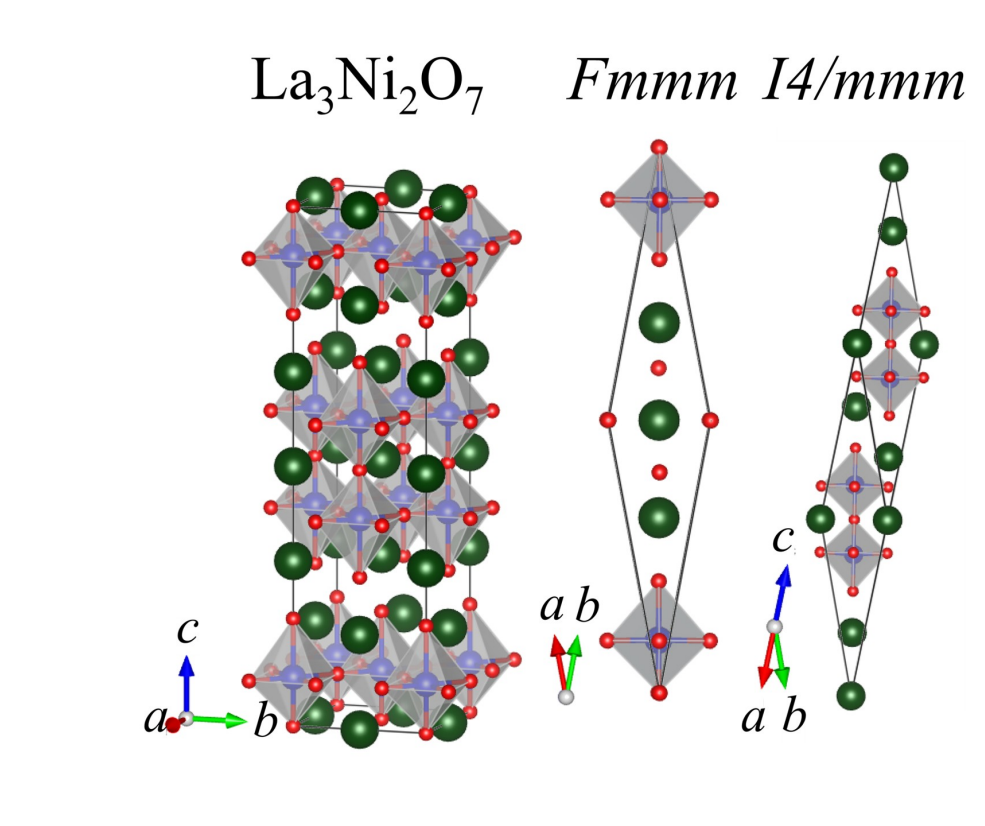
The pursuit of high-temperature superconductivity has taken a new turn with investigations into nickelate materials, and recent work sheds light on the behaviour of LaNiO₂ under extreme pressure. Wei-Yang Chen from State, alongside Cui-Qun Chen and Meng Wang, lead a team that explores the complex interplay of electron interactions within this material, revealing crucial details about its superconducting properties. Their calculations demonstrate a robust superconducting state, suppressed by competing electronic orders, and importantly, explain the observed decrease in superconductivity with increasing pressure, a phenomenon previously puzzling to researchers. This achievement provides valuable insight into the mechanisms governing high-temperature superconductivity and offers a pathway towards designing new materials with enhanced properties, potentially revolutionising energy transmission and storage.
DMRG Reveals Nickelate Phase Transitions Under Pressure
Scientists have uncovered detailed information about the behavior of a two-dimensional nickelate material under pressure, revealing its complex electronic phases. Using a powerful computational technique called Density Matrix Renormalization Group (DMRG), they investigated how the material’s electronic properties change with both pressure and the number of electrons. The study identifies distinct phases, including a superconducting state, a unique phase known as a Luttinger liquid, and potentially a conventional metallic state. This work emphasizes the crucial role of the ratio between electron interactions and their ability to move through the material in determining the stability of the superconducting state.
The team meticulously mapped the material’s phase diagram, providing a comprehensive picture of its behavior under varying conditions. Detailed analysis of electron correlations further supported the identification of different phases, providing a deeper understanding of the material’s complex electronic structure. These computational results provide valuable insights into strongly correlated electron systems, and may contribute to a better understanding of high-temperature superconductivity. Ultimately, the findings could guide the design of new materials with enhanced superconducting properties and provide a benchmark for theoretical models of correlated electron systems.
Nickelate Superconductivity, DFT and DMRG Calculations
To understand the unusual pressure dependence of superconductivity in the nickelate La₃Ni₂O₇, scientists combined density functional theory (DFT) and density matrix renormalization group (DMRG). DFT calculations accurately described the material’s electronic structure under different pressures, allowing researchers to construct a simplified model with precisely determined parameters. This model served as input for the DMRG calculations, which determined the ground state of the system. The method reveals a robust superconducting state that is suppressed by competing spin density wave order, and provides a detailed understanding of the pressure dependence observed experimentally.
Lanthanum Nickelate Superconductivity Under Extreme Pressure
Scientists have achieved a detailed understanding of the unusual behavior of superconductivity in lanthanum nickelate (La₃Ni₂O₇) under extreme pressure, revealing key insights into its electronic structure and the interplay between superconductivity and competing electronic orders. Through a combination of density functional theory and density matrix renormalization group calculations, the team meticulously mapped the pressure dependence of superconducting temperature (Tc) in this complex material. The work establishes a robust superconducting state by suppressing competing spin density wave order, and provides new insight into the unusual pressure dependence of superconductivity. Results demonstrate a strong spin density wave order at certain electron densities, exhibiting a real-space spin pattern similar to that observed in other materials.
Intriguingly, the team discovered that superconductivity in certain electron orbitals weakens with increasing pressure, ultimately transitioning to a unique state known as a Luttinger liquid above 80 GPa. This finding aligns with experimental observations of decreasing superconducting temperature with increasing pressure and a transition to a metallic state above the same pressure. Measurements confirm that the ratio of electron interactions to their ability to move through the material moderately reduces with increasing pressure, playing a dominant role in the weakening of superconductivity.
Pressure Suppresses Superconductivity in Nickelate Materials
This research successfully investigates the unusual behaviour of superconductivity in a nickelate material under increasing pressure. By combining advanced computational techniques, scientists mapped a quantum phase diagram revealing a superconducting phase alongside competing spin density wave and metallic states. The results demonstrate that superconductivity weakens with applied pressure, transitioning to a metallic state, a finding that aligns with experimental observations of decreasing superconducting transition temperatures. Crucially, the study identifies the ratio of electron interaction to their ability to move through the material as a key factor governing this weakening, suggesting that a reduction in this ratio suppresses superconductivity. While the research establishes a strong link between the interaction-to-hopping ratio and superconductivity, the authors acknowledge that some factors were not fully accounted for, and may influence the precise boundary between superconducting and metallic states. Future work will focus on exploring the impact of orbital hybridization and a quantum mechanical effect to further refine the understanding of these competing phases and potentially identify pathways to enhance superconductivity in this material.
🗞 Superconductivity of bilayer two-orbital Hubbard model for La Ni O under high pressure
🧠 ArXiv: https://arxiv.org/abs/2511.01801