Magnets present compelling opportunities to investigate unusual states of matter and the transitions between them, particularly when subjected to external magnetic fields, and a key phenomenon is the Bose-Einstein condensation (BEC) of magnons, which occurs as the magnetic field increases. J. Khatua, S. M. Kumawat, and G. Senthil Murugan, alongside colleagues including C. -L. Huang, Heung-Sik Kim, and K. Sritharan, now report evidence suggesting this condensation occurs in a novel material, a honeycomb-lattice antiferromagnet. This research significantly expands understanding of BEC-driven transitions, as it demonstrates the possibility of achieving this state in a high-spin, quasi-two-dimensional magnet with minimal magnetic anisotropy, a combination rarely observed and offering new avenues for exploring exotic magnetic behaviour. The team’s findings, obtained from analysis of single crystals, reveal potential signatures of magnon BEC and broaden the scope of materials where this fascinating phenomenon can occur.
Magnon Bose-Einstein Condensation and Quantum Magnetism
Research into quantum magnetism focuses on understanding exotic magnetic phases and the potential for Bose-Einstein condensation of magnons, which are collective spin excitations within a material. This active field of condensed matter physics aims to harness quantum phenomena and deepen our understanding of how materials behave at the quantum level. Key to this research are concepts like quantum criticality, where materials exhibit unusual behavior due to quantum fluctuations, and frustrated magnetism, where competing interactions prevent simple magnetic order. Magnons, as quantized spin waves, can behave like bosons, allowing them to condense into a macroscopic quantum state.
This condensation manifests as a coherent state of spin waves. The dimensionality of a material significantly influences magnetic behavior, with lower dimensions often exhibiting stronger quantum fluctuations and a greater tendency towards exotic phases. Magnetic anisotropy also plays a crucial role in determining a material’s magnetic characteristics. The search for these exotic phases often connects to the field of topological magnetism, where materials exhibit unique topological properties. Researchers are investigating a wide range of materials, including honeycomb lattice antiferromagnets like FeP3SiO11, triangular lattice antiferromagnets such as Ba2MnTeO6, and double perovskites like Ba2MnTeO6.
Layered materials, where magnetic interactions are confined to two dimensions, are also of particular interest. Specific compounds like YbCl3 and metal phosphorous trichalcogenides, including MnPS3 and FePS3, are being studied to explore diverse crystal structures and compositions. This research has fundamental implications for our understanding of quantum magnetism, quantum phase transitions, and the emergence of exotic quantum states. Beyond fundamental physics, the ability to control and manipulate magnons could lead to new spintronic devices that utilize spin rather than charge for information processing. Furthermore, these exotic magnetic materials could potentially serve as building blocks for quantum computers.
Honeycomb Lattice Synthesis and Structural Characterisation
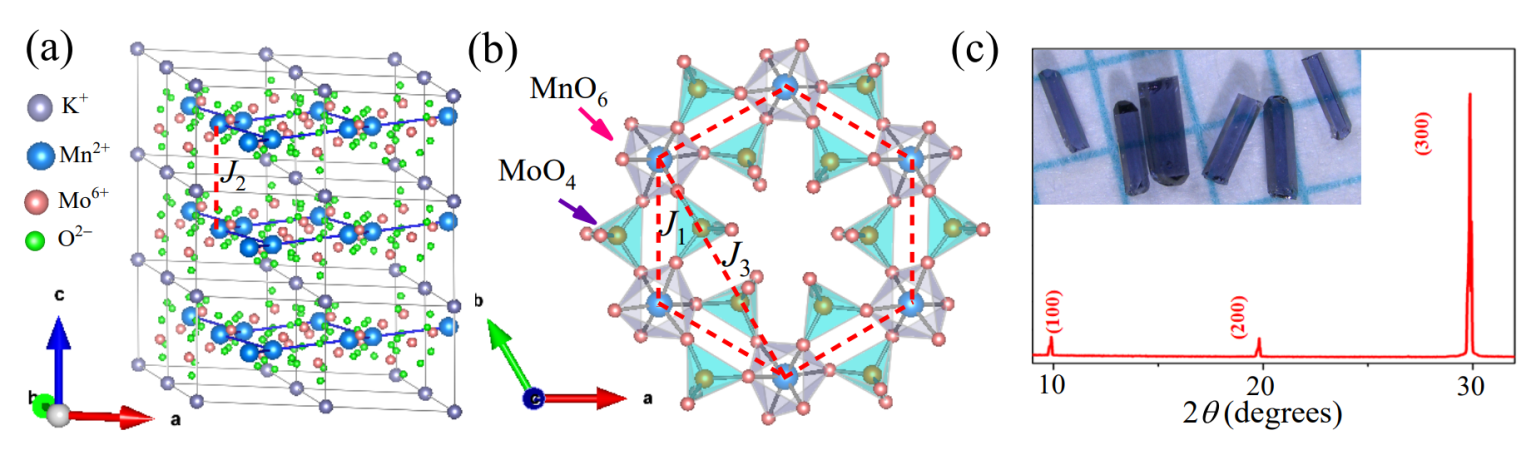
Scientists investigated the magnetic properties of K₄MnMo₄O₁₅, synthesizing both polycrystalline and single-crystal samples through a solid-state reaction method. Careful control of calcination and sintering temperatures ensured a single-phase compound. Single crystals, approximately 5 × 2 × 2 mm³ in size, were grown by carefully heating and cooling the powder. To determine the crystal structure, researchers performed powder X-ray diffraction measurements at room temperature. Magnetic measurements were then conducted using a superconducting quantum interference device vibrating-sample magnetometer, across a range of temperatures and magnetic fields.
Additional measurements utilized a specialized magnetometer to expand the sensitivity of the magnetic characterization. Specific heat measurements were performed, providing thermodynamic insights into magnetic transitions. Density functional theory calculations were performed to account for strong electronic correlations within the manganese atoms, evaluating exchange coupling parameters between localized spins.
Magnon Bose-Einstein Condensation in Honeycomb Antiferromagnet
Scientists have achieved a significant breakthrough in understanding quantum magnetism by observing potential Bose-Einstein condensation of magnons in K₄MnMo₄O₁₅. This material exhibits a field-induced transition to a fully polarized state at a critical magnetic field of 6. 4 Tesla. Experiments reveal that as the material approaches this critical field, thermodynamic signatures consistent with magnon BEC emerge. The research team discovered that the material undergoes long-range magnetic ordering at 2.
21 Kelvin, confirmed by specific heat measurements and magnetic susceptibility analysis. Density functional theory calculations revealed intraplanar antiferromagnetic interactions, alongside weaker interplanar interactions, resulting in a negative Curie-Weiss temperature. Applying a magnetic field perpendicular to the plane of the honeycomb lattice causes the magnetic order to transition, ultimately leading to the fully polarized phase. Critical scaling of thermodynamic quantities provides evidence supporting the realization of magnon BEC, a quantum phenomenon where magnons condense into a single quantum state. This work expands the understanding of how dimensionality and magnetic anisotropy influence the characteristics of the BEC transition across various spin systems, opening new avenues for exploring quantum magnetism in two-dimensional materials.
Magnon BEC in Honeycomb Lattice Antiferromagnet
Scientists have successfully synthesized single crystals of K₄MnMo₄O₁₅, a quasi-two-dimensional honeycomb-lattice antiferromagnet, and investigated its magnetic properties. The team demonstrates that this material exhibits field-tunable quantum critical behavior, providing an example of magnon Bose-Einstein condensation in a high-spin system. Results, including a characteristic lambda-like anomaly in both magnetic susceptibility and specific heat measurements, confirm the presence of long-range magnetic order at low temperatures and support the possibility of a BEC quantum critical point.
🗞 Possible Bose-Einstein condensation of magnons in a S = 5/2 honeycomb lattice
🧠 ArXiv: https://arxiv.org/abs/2510.12682