

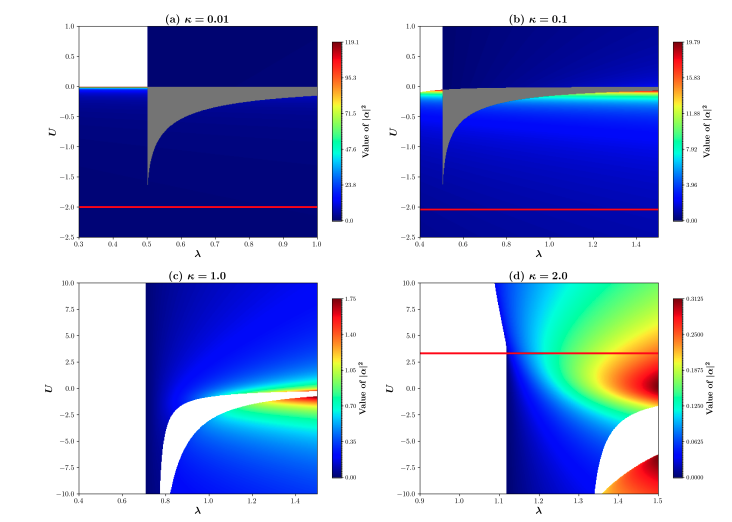
The behaviour of light and matter in open systems often gives rise to unexpected phase transitions, and recent work by Arash Azizi and Reed Nessler, both from Texas A and M University, reveals a surprising complexity in these processes. They investigate how a subtle interaction between photons, known as the Kerr effect, fundamentally alters a well-known phenomenon called superradiance, creating a boundary between different types of transitions. The researchers demonstrate that this boundary does not represent a general region of complex behaviour, but instead converges on a single, precise point of ‘tricriticality’, a rare state where multiple phase transitions meet. This discovery pinpoints the specific conditions required to achieve this higher order of criticality in optical systems, offering a unique opportunity to explore the fundamental limits of phase transitions and control light-matter interactions with unprecedented precision.
First-order regimes do not form a line of tricritical points; instead, genuine tricriticality is an isolated phenomenon, emerging only at a specific dissipation rate of approximately 0. 732. This discovery pinpoints the precise conditions for realising a rare multicritical point in a quantum optical system, identifying this dissipation as a unique gateway to a higher order of criticality. Quantum phase transitions, driven by quantum fluctuations at zero temperature, are a cornerstone of modern many-body physics, marking qualitative changes between distinct ground states and underpinning our understanding of phenomena like superconductivity and magnetism.
Photon Fluctuations Near Superradiant Phase Transition
Scientists have investigated the stability of a system as it approaches a superradiant phase, a state where it emits a strong, coherent beam of light. They analysed how quantum fluctuations, inherent in electromagnetic fields, seed this transition from a stable, low-photon state to a highly energetic superradiant state. This analysis involved a mathematical technique called Lyapunov stability analysis, which determines the stability of a system by examining how it responds to small disturbances. By linearizing the equations governing the system, they calculated the photon number fluctuation and derived an expression demonstrating that it increases as the system nears the threshold of the superradiant phase, indicating the growing influence of quantum fluctuations.
The team identified a specific threshold where the system becomes unstable and transitions to the superradiant state, consistent with predictions from established stability criteria. The calculated photon number fluctuation and the derived threshold condition provide a precise determination of the boundary between the normal and superradiant phases, confirming that quantum fluctuations play a crucial role in initiating the transition. This research validates the theoretical model used to describe the system and provides insights into the underlying physics of the phase transition, with potential applications in quantum optics, laser physics, and quantum information processing.
Kerr Interaction Defines Unique Tricritical Point
Scientists have discovered a remarkable interplay between interaction and dissipation in quantum systems, revealing a new type of phase transition beyond conventional understanding. Their research demonstrates that a specific interaction between photons, known as a Kerr interaction, fundamentally alters a superradiant phase transition, creating a boundary that separates continuous and discontinuous changes in the system’s behaviour. The team pinpointed this unique point at a precise dissipation rate of approximately 0. 732, identifying it as a “sweet spot” for achieving a higher order of criticality.
This discovery reveals that genuine tricriticality, a rare multicritical phenomenon, is not a generic property but an isolated event accessible only under specific conditions. Experiments confirmed that at this precise dissipation rate, the system exhibits a unique scaling behaviour for the order parameter, distinctly different from other transitions. The research establishes a universal instability threshold, independent of the Kerr nonlinearity, and confirms this threshold through analysis of quantum fluctuations. The team developed a theoretical framework to classify the nature of the transition, identifying conditions where the system undergoes either continuous transitions or discontinuous transitions accompanied by bistability. This framework, visually confirmed through simulations, provides a comprehensive understanding of the observed phase behaviour and its dependence on key parameters.
Kerr Nonlinearity Drives Higher-Order Criticality
This research demonstrates that incorporating a Kerr nonlinearity fundamentally alters the standard superradiant phase transition, inducing an isolated tricritical point at a specific dissipation rate. The team discovered that while the initial instability leading to the transition remains consistent regardless of the Kerr nonlinearity, the order of the transition, whether continuous or discontinuous, is fully governed by the interplay between this nonlinearity and cavity dissipation. This results in a unique scaling behaviour for the photon amplitude at the tricritical point, differing significantly from standard transitions. The findings reveal a precise condition, a “sweet spot” of dissipation, where this higher-order criticality emerges, offering a pathway to observe and control this phenomenon.
The authors acknowledge that achieving the necessary Kerr strength currently poses a technological challenge, but highlight the rapid advancements in engineering nonlinearities, particularly within superconducting circuits, as promising avenues for future experiments. Circuit QED systems are identified as the most suitable platform for observing this predicted tricriticality, given their capacity for strong light-matter coupling, in situ Kerr engineering, and precise dissipation control. Future work will likely focus on experimentally mapping the phase boundary and verifying the predicted scaling behaviour of the photon amplitude at the identified dissipation rate.
🗞 The Kerr-Induced Superradiant Tricritical Point
🧠 ArXiv: https://arxiv.org/abs/2509.04530


