Quantum computing is a rapidly evolving field, but noise-induced, particularly crosstalk errors, pose significant challenges. These errors occur when radiofrequency pulses used to implement a quantum gate on neighboring qubits cause unwanted resonances. Researchers from the Karlsruhe Institute of Technology and the University of Grenoble Alpes have developed an extension of the randomized compiling (RC) protocol to mitigate these errors. This method, which improves the noise estimation protocol without adding new qubits or circuits, represents a significant step towards a noiseless, scalable quantum computer. However, further research is needed to enhance the efficiency and precision of these devices.
Introduction to Quantum Computing and Crosstalk Errors
Quantum computing is a rapidly advancing field, with numerous platforms currently available, such as the IBMQ digital quantum computers. These devices can implement a universal set of quantum operations on arrays of superconducting transmon qubits, with some devices containing up to 128 qubits. However, these quantum computers are subject to noise, which produces errors that are currently beyond the scope of fault-tolerant quantum error correction codes. One of the main sources of errors in these devices is the two-qubit controlled NOT (CNOT) gate, which can produce errors due to imperfect gate application and qubit decoherence.
The Challenge of Crosstalk Errors
Crosstalk errors, caused by unwanted resonances while applying radiofrequency (RF) pulses to implement a quantum gate on neighboring qubits, are a significant issue in superconducting qubit architectures. Despite considerable experimental efforts and software mitigation approaches, these errors can severely limit the performance of noisy intermediate-scale quantum (NISQ) computers. The noise in these devices is a mixture of random incoherent noise channels and coherent noise channels, induced by the weak residual couplings between a qubit and its environment.
Mitigating Crosstalk Errors with Randomized Compiling
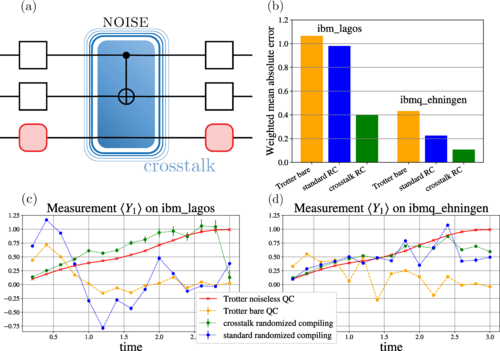
Researchers from the Karlsruhe Institute of Technology and the University of Grenoble Alpes have developed and applied an extension of the randomized compiling (RC) protocol to mitigate crosstalk errors. The RC protocol turns coherent noise due to crosstalk into a depolarizing noise channel that can then be treated using established error mitigation schemes such as noise estimation circuits. This approach was applied to the quantum simulation of the nonequilibrium dynamics of the Bardeen-Cooper-Schrieffer (BCS) Hamiltonian for superconductivity, a particularly challenging model to simulate on quantum hardware because of the long-range interaction of Cooper pairs.
Improved Noise Estimation Protocol
The researchers demonstrated that their method of twirling neighboring qubits dramatically improves the noise estimation protocol without the need to add new qubits or circuits. This allows for a quantitative simulation of the BCS model. The team’s work represents a significant step forward in the quest for a noiseless and scalable quantum computer that could achieve quantum advantage.
Conclusion and Future Directions
Despite the challenges posed by noise-induced errors, error mitigation schemes are essential for making NISQ a reliable platform for quantum computing. The researchers’ work on mitigating crosstalk errors through an extension of the RC protocol represents a promising development in this field. However, further research and development are needed to continue improving the efficiency and precision of NISQ computers.
Mitigating crosstalk errors by randomized compiling: Simulation of the BCS model on a superconducting quantum computer is a research article authored by H. Perrin, Thibault Scoquart, Alexander Shnirman, Joerg Schmalian, and Kyrylo Snizhko. The article was published on February 5, 2024, in the Physical Review Research journal. The research focuses on the simulation of the BCS model on a superconducting quantum computer and how to mitigate crosstalk errors through randomized compiling. The article can be accessed through the DOI: 10.1103/physrevresearch.6.013142.