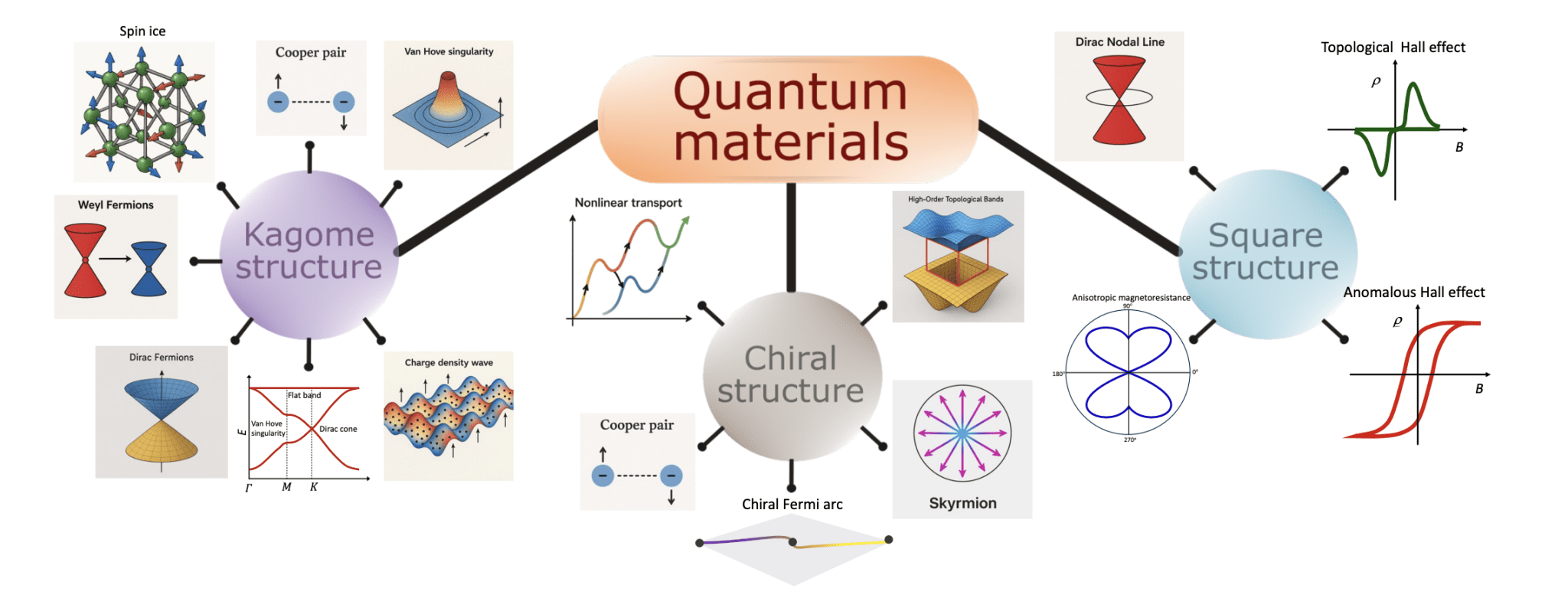
Topological quantum materials represent a rapidly expanding frontier in materials science, promising robust electronic states with potential applications in future technologies. Avdhesh K. Sharma, Snehashish Chatterjee, and colleagues at the Max Planck Institute for Chemical Physics of Solids, along with Premakumar Yanda, Claudia Felser, and Chandra Shekhar, present a comprehensive overview of three prominent structural frameworks, kagome, chiral, and square-net, that host a remarkable diversity of topological phases. These unique geometries give rise to exotic electronic behaviours, including the emergence of particles like Dirac and Weyl fermions, and can lead to phenomena such as unconventional superconductivity and enhanced thermal transport. This research is significant because it clarifies how the interplay of geometry, symmetry, and electron interactions shapes the properties of these materials, paving the way for the rational design of new quantum materials with tailored functionalities.
Kagome and Topological Quantum Material Properties
The Rise of Topological Quantum Materials The search for novel quantum materials has intensified, driven by the promise of groundbreaking technologies and a deeper understanding of fundamental physics. Topological quantum materials, characterized by robust electronic states resistant to external disturbances, are at the forefront of this research. These materials possess unique crystal structures, including kagome, chiral, and square-net lattices, which dictate their unusual electronic properties and open doors to previously unseen quantum phenomena. Understanding and harnessing these materials represents a significant leap forward in condensed matter physics and materials science.
The significance of these lattices lies in their ability to host exotic electronic behaviours. Kagome lattices, resembling woven bamboo, can support features that influence electron movement and interaction. Chiral materials, lacking mirror symmetry, give rise to unique electronic states, offering potential for novel electronic devices. Square-net materials, with their planar atomic arrangements, enable the formation of specific electronic states, further expanding the range of possible quantum effects. These distinct structures each provide a unique platform for exploring the interplay between geometry, symmetry, and quantum mechanics.
Achieving high-quality single crystals with precise composition is crucial for realizing the full potential of these materials, as even minor imperfections can drastically alter their electronic properties. Researchers are actively exploring various synthesis techniques, carefully controlling physical and thermodynamic conditions to optimize crystal growth. A thorough understanding of the complex interplay between electron interactions, spin-orbit coupling, and crystal symmetry is essential for predicting and controlling the emergence of topological states, requiring a combination of advanced experimental techniques and sophisticated theoretical modelling. The exploration of these materials is revealing a rich tapestry of quantum phenomena, including quantum spin liquids, charge density waves, and the emergence of flat bands. Furthermore, the unique symmetries of these materials give rise to phenomena like the Berry phase and pair density waves. By carefully tuning the composition and structure of these materials, scientists are paving the way for future technologies based on robust, topologically protected quantum states and potentially revolutionary electronic devices.
Single Crystal Growth for Topological Materials
Researchers investigating novel quantum materials prioritize a meticulous approach to material synthesis, recognizing that structural perfection profoundly influences their inherent properties. The study of kagome, chiral, and square-net structures, promising platforms for topological phenomena, demands high-quality single crystals, free from the defects that plague polycrystalline materials. This necessitates a shift away from conventional methods and a dedication to techniques capable of producing crystals with uniform, unbroken atomic lattices. The primary method employed is a refined version of the flux technique, chosen for its suitability with the intermetallic nature of many of these materials and their tendency to incorporate low-melting-point elements.
This process involves carefully combining the constituent elements in precise ratios, guided by solubility phase diagrams, and sealing them within a quartz ampoule under vacuum. The mixture is then heated to a high temperature, ensuring complete liquefaction and thorough homogenization, before undergoing slow, controlled cooling, typically around 2 to 5°C per hour, to minimize defects and maximize crystal size. Innovatively, researchers often utilize one of the constituent elements as both a reactant and the flux itself, streamlining the process and reducing potential contamination. For example, antimony or tin can serve this dual role in certain compounds, dissolving other elements and facilitating crystal growth.
Beyond single-element fluxes, the team also explores eutectic compositions, binary mixtures with particularly low melting points, to further optimize the growth environment. Following cooling, centrifugation refines the crystal growth and reveals well-defined facets, indicating structural order. The team acknowledges the challenges inherent in flux growth, particularly the potential for flux intercalation, where flux atoms become trapped within the crystal lattice, altering its properties. They meticulously control stoichiometry, cooling rates, and purity to mitigate this, recognizing that even minor variations can significantly impact the complex physics of these materials. They are actively working to address issues like residue flux, slow cooling rates, and crucible contamination, striving for scalable and safe crystal growth procedures. This dedication to material quality is paramount, as it directly enables the accurate characterization of these fascinating quantum materials and unlocks their potential for future technological applications.
Large Anomalous Hall Effect in Kagome Material
Unveiling Exotic Quantum States in Kagome Materials Recent research focuses on a fascinating class of materials possessing unique geometric structures, kagome materials, and their potential to host a wealth of exotic quantum phenomena. These materials, characterized by arrangements of atoms forming kagome lattices, exhibit electronic behaviours dramatically different from conventional substances, opening doors to novel technological applications. Investigations reveal that the interplay of geometry, atomic composition, and quantum effects gives rise to a surprising diversity of interconnected quantum states. One particularly striking discovery involves Co₃Sn₂S₂, a magnetic material exhibiting exceptionally large anomalous Hall conductivity, reaching approximately 1100 W⁻¹cm⁻¹, sustained up to 100 K.
This remarkably high value points to the material’s intrinsic topological nature, confirmed by the observation of quantized Hall conductance. Researchers have directly observed step-like chiral edge states, solidifying the material’s status as a realized magnetic Weyl semimetal, a state of matter predicted over a decade ago but only recently observed experimentally. The ability to manipulate magnetic domains within this material using light suggests potential for advanced spintronic devices. Another prominent area of investigation centers on the AV₃Sb₅ family of materials, which exhibit a complex interplay of multiple quantum states, including charge density waves, pair density waves, superconductivity, and nematic order.
This arises from the unique arrangement of atoms and the presence of specific points in the material’s electronic structure. The charge density wave in these materials is particularly unusual, reconstructing the electronic structure in a way that breaks rotational symmetry while preserving translational symmetry, and manifesting in diverse stacking patterns. Remarkably, the charge density wave exhibits characteristics such as broken symmetry, time-reversal symmetry breaking, and chiral charge order, leading to phenomena like the superconducting diode effect, where the material conducts electricity more easily in one direction than another. Applying pressure or introducing specific chemical substitutions can further enhance superconductivity, and even induce a double-dome superconducting state.
The sensitivity of these materials to external stimuli and chemical composition offers exciting possibilities for tailoring their properties and realizing new functionalities. These discoveries highlight the potential of kagome materials to serve as platforms for exploring fundamental physics and developing next-generation technologies. The intricate interplay of quantum states and the ability to manipulate these states through external means promise a future filled with innovative materials and devices.
Lattice Geometry Dictates Quantum Material Properties
This review demonstrates how the geometry of crystal lattices, specifically kagome, chiral, and square-net structures, plays a crucial role in determining the quantum properties of materials. These structures give rise to unique electronic band structures and topologically protected states, leading to phenomena such as Dirac and Weyl fermions, unconventional superconductivity, and novel charge density waves. The research highlights that symmetry, spin-orbit coupling, and electron correlations are key factors influencing these emergent properties. The authors note that realizing these quantum states requires high-quality single crystals and acknowledge that geometrical frustration and distortions within these lattices can significantly alter their behaviour. Future research directions include further exploration of the interplay between these factors and the potential for discovering new quantum phases of matter within these material classes. The review emphasizes that continued advances in material synthesis and characterization are essential for fully understanding and harnessing the potential of these topological quantum materials.
👉 More information
🗞 Topological quantum materials: kagome, chiral, and square-net frameworks
🧠 DOI: https://doi.org/10.48550/arXiv.2507.12410