Quantum computers demand exquisitely sensitive components to read and control qubits, and amplifying the incredibly weak signals they produce presents a significant engineering challenge. Ahmad Salmanogli from Ankara Yildirim Beyazit University, Hesam Zandi from K. N. Toosi University of Technology, and Mahdi Esmaeili, along with colleagues at the Iranian Quantum Technologies Research Center and Kharazmi University, investigate the potential of Josephson Parametric Amplifiers (JPAs) to overcome these limitations.
Unlike traditional amplifiers which struggle in the ultra-cold environments required for quantum computing, JPAs are specifically designed for millikelvin operation, offering both low power consumption and exceptionally low noise. This research provides a comprehensive review of JPA technology, exploring how designs incorporating arrays of Josephson junctions can improve performance, enhance signal handling, and ultimately contribute to more stable and reliable quantum circuits. The team’s detailed analysis and proposed architectures represent a crucial step towards building practical and scalable quantum computers.
Cryogenic Amplification Challenges for Quantum Systems
The development of quantum technologies, such as quantum computers and highly sensitive sensors, relies on the ability to detect and amplify incredibly weak signals without introducing disruptive noise. These signals, often representing the states of individual quantum bits or photons, are easily overwhelmed by unwanted interference, demanding a new generation of amplifiers optimized for the quantum realm. Current electronic amplifiers struggle in these cryogenic environments, exhibiting significant noise and inefficient performance at the extremely low temperatures required for quantum systems. Josephson Parametric Amplifiers (JPAs) offer a compelling solution to these challenges.
These innovative devices, built upon the principles of superconductivity, are specifically designed to operate at millikelvin temperatures, achieving near-quantum-limited noise performance, the absolute minimum allowed by the laws of physics. JPAs utilize the unique properties of Josephson junctions, which exhibit nonlinear inductance, to amplify signals with minimal added noise and exceptionally low power consumption. This makes them ideally suited for amplifying the faint signals generated by quantum systems, preserving the delicate quantum information they encode. Early JPA designs relied on single Josephson junctions, but these suffered from limitations in power handling and stability.
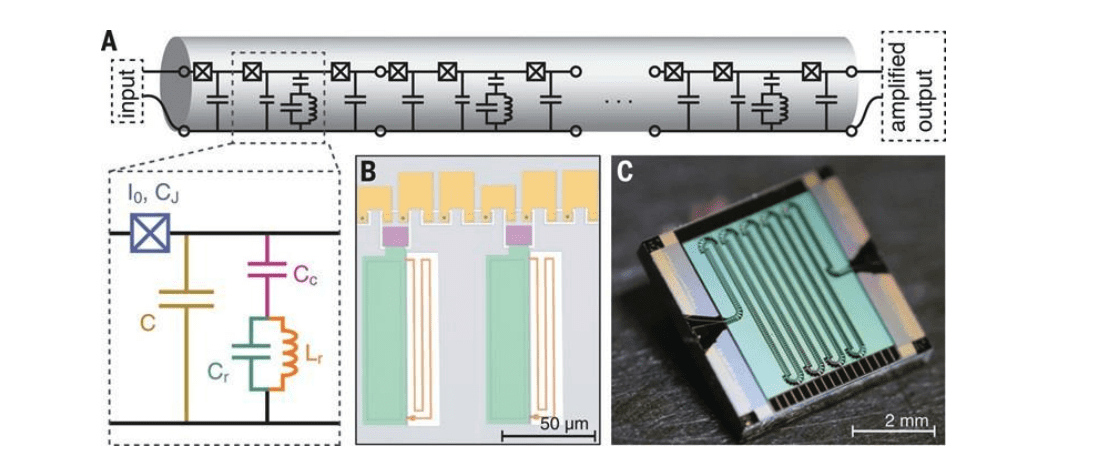
To overcome these drawbacks, researchers are now exploring JPA designs incorporating arrays of Josephson junctions. By distributing the amplification process across multiple junctions, these arrays enhance linearity, broaden dynamic range, and improve overall performance. This approach allows for more robust and reliable amplification of quantum signals, paving the way for more complex and powerful quantum systems. Recent advancements have led to diverse JPA architectures, each tailored to specific applications. These include designs optimized for single-frequency amplification, phase-sensitive amplification, and even broadband amplification using traveling-wave structures. The development of these specialized JPAs, coupled with ongoing theoretical and computational modeling, promises to unlock new capabilities in quantum computing, sensing, and communication, bringing the potential of these transformative technologies closer to reality.
Cryogenic Amplifiers Enhance Weak Quantum Signals
Researchers pursued a dual approach to amplify extremely weak signals, focusing on both Josephson Parametric Amplifiers (JPAs) and High Electron Mobility Transistors (HEMTs) optimized for cryogenic environments. Recognizing the limitations of conventional amplifiers at ultra-low temperatures, the team investigated how to achieve both low noise and high gain, crucial for applications like qubit readout and quantum communication. The JPA development centered on overcoming inherent limitations in single-junction designs, specifically gain compression and sensitivity to manufacturing variations. To address these challenges, the team explored innovative JPA architectures utilizing arrays of Josephson junctions.
These arrays distribute the nonlinear response, enhancing power handling, linearity, and coherence while simultaneously reducing phase noise. Extensive simulations and theoretical analysis were employed to compare different array designs and optimize performance trade-offs. Concurrently, the team focused on refining HEMT technology for cryogenic applications, paying particular attention to transistor layout and gate design. Recognizing that high-frequency instabilities can arise at low temperatures, they implemented stabilization techniques, including source air bridges, gate-end interconnects, and increased gate resistance, to ensure stable and reproducible operation.
This meticulous approach resulted in HEMTs achieving minimum noise temperatures and gains, establishing new benchmarks for InP-based cryogenic amplifiers. A key aspect of the HEMT research involved carefully tuning impedance matching to minimize noise figures. Through precise circuit board layout adjustments and electromagnetic simulations, the team achieved an ultra-low noise figure, demonstrating the potential for HEMT-based amplifiers to rival the performance of JPAs. Furthermore, the team investigated the relationship between noise figure, transconductance, and the generation of entangled microwave photons, revealing that optimized designs can significantly enhance the likelihood of achieving nonclassical behavior, essential for quantum information processing.
Low-Noise Amplification for Quantum Technologies
Josephson Parametric Amplifiers (JPAs) and High Electron Mobility Transistors (HEMTs) represent distinct approaches to amplifying extremely weak signals, particularly crucial for emerging quantum technologies. While conventional amplifiers struggle at the ultra-low temperatures required for many quantum systems, both JPAs and HEMTs offer viable solutions, each with unique strengths. JPAs excel by leveraging the properties of superconducting materials to achieve exceptionally low noise, approaching the theoretical quantum limit, and operate efficiently in cryogenic environments. This makes them ideal for applications like qubit readout, where preserving the delicate quantum state of information is paramount.
Recent research demonstrates that carefully designed HEMTs can also achieve remarkably low noise figures, representing a significant advancement in HEMT performance and making them competitive alternatives. Furthermore, these HEMTs demonstrate a notably high gain, exceeding the gain typically provided by JPAs. This increased gain, combined with low noise, enhances their utility in various quantum and low-temperature applications. Importantly, the design of these HEMTs focuses on impedance matching, carefully adjusting the circuit layout to maximize amplification. Simulations and experimental results reveal a strong correlation between minimizing the noise figure and increasing the likelihood of generating entangled microwave photons, a key resource for quantum communication and computation. The research highlights that optimizing parameters within the amplifier circuit is crucial for maximizing entanglement generation. This work demonstrates that with careful engineering, HEMTs can provide a compelling combination of low noise, high gain, and cryogenic compatibility, offering a valuable addition to the toolkit for building future quantum technologies.
Josephson Amplifiers Outperform at Cryogenic Temperatures
This study investigates radio-frequency (RF) amplifiers for cryogenic applications, specifically comparing Josephson Parametric Amplifiers (JPAs), Complementary Metal-Oxide-Semiconductor (CMOS) amplifiers, and High Electron Mobility Transistors (HEMTs). The research demonstrates that JPAs offer a compelling combination of low power consumption and ultra-low noise, making them particularly well-suited for amplifying weak quantum signals in extremely cold environments. Unlike CMOS amplifiers, which struggle with noise at low temperatures, and HEMTs, which require significant power, JPAs excel in preserving signal fidelity and coherence, critical for applications like qubit readout and quantum communication. The work further explores advanced JPA designs utilizing arrays of Josephson junctions, overcoming limitations found in single-junction JPAs, such as limited power handling and sensitivity to fabrication variations. These arrays distribute the nonlinear response, improving performance characteristics like linearity and tunability. While HEMTs demonstrate excellent high-frequency performance and low noise, the research highlights the unique advantages of JPAs in the specific context of cryogenic quantum systems.
👉 More information
🗞 Technical Review on RF-Amplifiers for Quantum Computer Circuits: New Architectures of Josephson Parametric Amplifier
🧠 DOI: https://doi.org/10.48550/arXiv.2507.13187