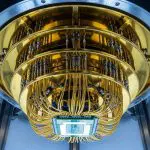
Quantum computing, a rapidly evolving field, promises to solve complex problems more efficiently than classical computers. The IQM Spark prototype, a 5-qubit superconducting quantum computer, is designed to provide low-barrier access to hardware and software components for educational and research purposes. The system can teach concepts of superconducting quantum hardware, quantum error mitigation, and performing experiments. It can also be used for research, including the simulation of neutrino oscillation and estimation of Jones polynomials. The prototype estimates the probabilities of Z-basis states of measured qubits, a process crucial for the operation of quantum computers.
What is the Purpose of On-Premises Superconducting Quantum Computers in Education and Research?
Quantum computing is a rapidly evolving field that promises to solve complex problems more efficiently than classical computers. This technology is expected to offer significant computational time and hardware resource advantages, a concept known as “quantum advantage”. Several quantum algorithms have been developed to demonstrate this advantage, such as prime number factorization of large integers and simulating molecules’ chemical and physical properties. However, most of these algorithms assume an error-free quantum hardware with a number of quantum bits or qubits beyond the reach of current technology.
In reality, the loss of quantum information is inherent in any physical system. Therefore, a fault-tolerant quantum computer would employ a built-in quantum error correction, where the number of error-free logical qubits is less than the error-prone and noisy physical qubits. Even without error correction, noisy intermediate-scale quantum (NISQ) computers are thought to exhibit quantum advantage over classical high-performance computers in the range of 100 to 1000 qubits, depending on the quality of the quantum hardware and the connectivity between the qubits.
Among many physical platforms, superconducting quantum hardware is well-suited for scaling the number of qubits and improving their fidelity while maintaining connectivity. This makes it a preferred technology in the NISQ era, with roadmaps towards fault tolerance.
How Does the IQM Spark Prototype Work?
The IQM Spark prototype is a 5-qubit superconducting quantum computer designed to enable low-barrier access to both its hardware and software components. The hardware is self-contained with a packaged superconducting quantum processing unit (QPU), a dilution refrigerator, and control electronics. The software components allow for both a direct manipulation of the qubits by microwave pulses or to run small scale quantum algorithms composed of quantum gates.
This system can be harnessed for a range of educational activities, from teaching the concepts of superconducting quantum hardware to developing an understanding of quantum error mitigation and performing experiments from different fields of research.
What are the Educational Applications of the IQM Spark Prototype?
The IQM Spark prototype can be used for a variety of educational purposes. These include calibration, benchmarking, visualization of pulses with an oscilloscope, error mitigation, and execution of simple quantum algorithms. By providing hands-on experience with a real quantum computer, students can deepen their understanding of quantum theory and quantum computing.
What are the Research Applications of the IQM Spark Prototype?
The IQM Spark prototype can also be used for research purposes. Some of the research results that have been reproduced using this system include the simulation of neutrino oscillation, estimation of Jones polynomials, and an introduction into embedding techniques for quantum chemistry. These applications demonstrate the potential of quantum computers to contribute to technological progress in various scientific fields.
How Does the IQM Spark Prototype Estimate Expectation Values of Observables?
A quantum computer estimates the probabilities of the Z-basis states of the measured qubits by repeating the same multi-qubit Z-basis measurement many times and computing the relative frequencies of the outcomes. The number of repetitions is called “shots”. For example, for a single-qubit state, we may estimate the probabilities and use these values to estimate the expectation value of Z. By using certain identities, we can also estimate the expectation values of X and Y. This process is crucial for the operation of quantum computers and the execution of quantum algorithms.
Publication Date: 2024-02-11
Authors: Jami Rönkkö, Olli Ahonen, Ville Bergholm, Alessio Calzona et al.
Source: arXiv (Cornell University)
DOI: https://doi.org/10.48550/arxiv.2402.07315