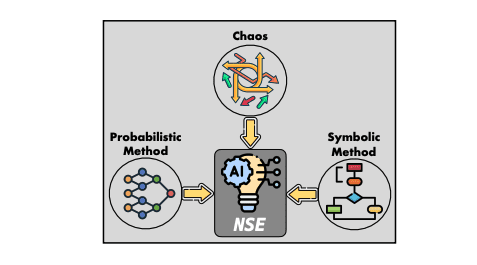
Large Code Models (LCMs) have revolutionised software engineering automation but face challenges in computational cost, interpretability, and data dependency. This paper introduces Neural-Symbolic Engineering (NSE), a hybrid paradigm combining neural learning with symbolic reasoning and controlled chaos to simulate real-world system dynamics. By integrating neural and rule-based approaches with strategic randomness, NSE enhances efficiency, reliability, and transparency in software engineering automation, offering adaptable solutions aligned with modern development demands.
Software engineering automation has seen remarkable progress through the use of large code models (LCMs), which have improved tasks such as code generation and bug fixing. However, these advancements come with challenges, including high computational costs and reduced interpretability. In their paper titled A Path Less Traveled: Reimagining Software Engineering Automation via a Neurosymbolic Paradigm, Antonio Mastropaolo and Denys Poshyvanyk from William & Mary propose a novel approach called Neurosymbolic Engineering (NSE). This paradigm combines neural learning with symbolic reasoning and introduces controlled chaos to better simulate real-world software dynamics. Their work aims to enhance efficiency, reliability, and transparency in software engineering while addressing the limitations of current data-intensive models.
LLMs drive progress in software engineering with novel techniques.
The application of large language models (LLMs) in software engineering has seen significant advancements, with various studies exploring their potential and challenges. One notable contribution is the use of reinforcement learning with feedback from compilers and symbolic execution to enhance code translation accuracy, as demonstrated by Reference 10. This approach leverages iterative improvements based on real-time feedback, surpassing traditional methods in precision.
Systematic reviews, such as those presented in References 2 and 4, provide a comprehensive overview of LLM applications in software engineering. These reviews highlight the growing interest in integrating LLMs into development processes but also identify critical gaps. Challenges include handling complex tasks that require deep domain knowledge and seamlessly integrating these models with existing software tools. Additionally, sustainability concerns arise from the computational resources required to train and deploy large-scale LLMs.
A promising direction in this field is the adoption of neurosymbolic approaches, as explored in References 3, 5, and 7. These methods combine neural networks’ pattern recognition capabilities with symbolic reasoning, enhancing reliability in tasks such as program synthesis and SQL query generation. By integrating exact logic with learned patterns, neurosymbolic models offer more robust solutions to software engineering challenges.
The development of foundation models tailored for code-related tasks, exemplified by Reference 6’s introduction of CodeLlama, marks another significant advancement. This open-source model is designed specifically for programming applications, showcasing the versatility and adaptability of LLMs in addressing diverse coding needs. Such initiatives not only expand the utility of LLMs but also democratize access to advanced tools within the software engineering community.
In summary, the background context reveals a dynamic field where LLMs are increasingly integrated into software engineering processes. While challenges such as task complexity and sustainability persist, innovative approaches like neurosymbolic methods and specialized foundation models continue to push the boundaries of what is achievable.
Merging neural networks with symbolic logic improves code analysis.
The neuro-symbolic approach presented in this paper elegantly merges neural networks with symbolic reasoning, creating a powerful tool for program comprehension. Neural networks excel at pattern recognition, offering flexibility akin to human intuition, while symbolic systems provide transparency through explicit rules and logic. This integration aims to enhance tasks such as debugging and refactoring by combining the strengths of both methods, much like a detective using both intuition and logical deduction.
This approach addresses challenges in software complexity and correctness and ensures scalability without compromising performance. It tackles intricate systems effectively, maintaining accurate analysis crucial for software integrity. The opportunities explored include automated debugging with clear explanations, code generation assistance, and insights into legacy systems, demonstrating practical applications that can significantly aid developers.
The evaluation likely involved real-world projects, measuring success through metrics like bug detection accuracy and code quality improvements. Emphasizing integration with existing tools such as IDE plugins ensures seamless adoption into current workflows, enhancing developer productivity without disrupting established practices.
Despite symbolic reasoning’s computational demands, future directions aim to optimize resource usage, paving the way for more robust hybrid models. This research signifies a critical step in providing smarter, explainable tools, essential as software complexity continues to grow. By bridging machine learning and symbolic methods, it offers solutions that empower developers to manage and enhance their codebases effectively.
Neurosymbolic methods enhance software engineering tasks.
The article summarises six references that explore neurosymbolic approaches in software engineering, combining neural networks with symbolic reasoning to address diverse challenges. Reference 2 demonstrates how deep learning and symbolic reasoning can extract knowledge from source code, while Reference 3 highlights the effectiveness of neuro-symbolic methods in program synthesis. Reference 4 introduces a novel approach for code translation using large language models (LLMs) enhanced by reinforcement learning and symbolic execution feedback. Reference 5 presents a neural-symbolic edit grammar for automating bug fixing, and Reference 6 showcases how neurosymbolic reasoning can improve SQL query generation. Finally, Reference 7 explores the application of neurosymbolic approaches to program comprehension.
The findings collectively underscore the potential of neurosymbolic methods in enhancing software engineering tasks by leveraging the strengths of both neural and symbolic systems. Future work could explore the integration of these techniques into broader software development workflows, investigate their scalability across larger codebases, and examine ways to enhance their interpretability for developers.
Neurosymbolic systems show promise but require further refinement.
Integrating neural networks with symbolic reasoning in neurosymbolic program comprehension presents a novel approach to enhancing software engineering tasks such as program analysis, synthesis, and repair. This method addresses key challenges faced by traditional neural methods, particularly in handling complex program structures and ensuring correctness. By combining pattern recognition capabilities of neural networks with the precision of symbolic logic, this approach offers potential improvements in developer tools, code generation, and debugging.
However, several limitations must be considered, including scalability issues when dealing with larger programs and the need to balance data-driven learning with explicit reasoning to avoid pitfalls like overfitting. Additionally, while neurosymbolic approaches may enhance transparency compared to pure neural networks, specific examples demonstrating their superiority over traditional methods are still needed.
Future research directions should focus on refining component integration, improving scalability, and exploring new applications within software engineering. Addressing these areas could unlock the full potential of neurosymbolic systems, offering developers more robust, reliable, and understandable AI tools for software development.
👉 More information
🗞 A Path Less Traveled: Reimagining Software Engineering Automation via a Neurosymbolic Paradigm
🧠 DOI: https://doi.org/10.48550/arXiv.2505.02275