Intel has unveiled its Quantum Software Development Kit (SDK), a tool to make quantum computing accessible to developers worldwide. The Intel Quantum SDK is a growing and concerted push from the Chip Giant into Quantum computing, which uses quantum mechanics principles to process information and can solve complex problems beyond the capabilities of current supercomputers. Intel’s Quantum SDK is a user-friendly software package that equips developers with the necessary tools to create and test quantum algorithms.
The Intel Quantum SDK is a software package that provides developers with the tools to create and test quantum algorithms. It is designed to be user-friendly, making it accessible to developers who may not have a background in quantum physics. The SDK includes a quantum simulator, allowing developers to test their algorithms without access to a physical quantum computer.
But the Quantum SDK is just one part of Intel’s broader push into the realm of quantum computing. The company is also investing heavily in research and development, with the aim of building a practical, scalable quantum computer. This includes work on qubits, the basic units of quantum information, as well as the development of new materials and designs to make quantum computers more reliable and efficient.
In this article, we will explore the Intel Quantum SDK’s features and capabilities. We will also take a closer look at Intel’s ongoing efforts in quantum computing, shedding light on the challenges and opportunities that lie ahead. Whether you’re a seasoned developer or simply a tech enthusiast, join us as we journey into the fascinating world of quantum computing.
Understanding the Intel Quantum SDK: An Overview
The Intel Quantum Software Development Kit (SDK) is a software package that provides a platform for the development and simulation of quantum algorithms. The SDK is designed to work with Intel’s quantum hardware, but it can also be used to simulate quantum computations on classical computers. This allows researchers and developers to test and refine quantum algorithms without needing access to a quantum computer.
The Intel Quantum SDK is built around a quantum instruction set architecture (QISA), which is a set of instructions that a quantum computer can execute. The QISA is similar to the instruction set of a classical computer, but it includes quantum-specific instructions such as quantum gate operations. The SDK provides a compiler that can translate high-level quantum algorithms into the low-level QISA instructions. This is a crucial feature as it allows developers to focus on designing quantum algorithms without worrying about the underlying hardware details.
The SDK also includes a quantum simulator, which can simulate the execution of quantum algorithms on a classical computer. The simulator uses a technique called quantum state vector simulation, which represents the state of a quantum system as a vector in a high-dimensional space. This technique allows the simulator to accurately model the behavior of a quantum system, but it requires a significant amount of computational resources. For example, simulating a quantum system with just 30 qubits requires around 16 gigabytes of memory.
In addition to the compiler and simulator, the Intel Quantum SDK provides a set of libraries for common quantum operations. These libraries include functions for creating and manipulating quantum states, applying quantum gates, and measuring quantum states. The libraries are designed to be easy to use and to provide a high level of abstraction, which makes it easier for developers to write quantum algorithms.
The Intel Quantum SDK also includes tools for debugging and optimizing quantum algorithms. These tools can help developers identify and fix errors in their algorithms and optimize their performance. For example, the SDK includes a quantum circuit optimizer, which can rearrange the operations in a quantum circuit to reduce the number of quantum gates and thus improve the algorithm’s efficiency.
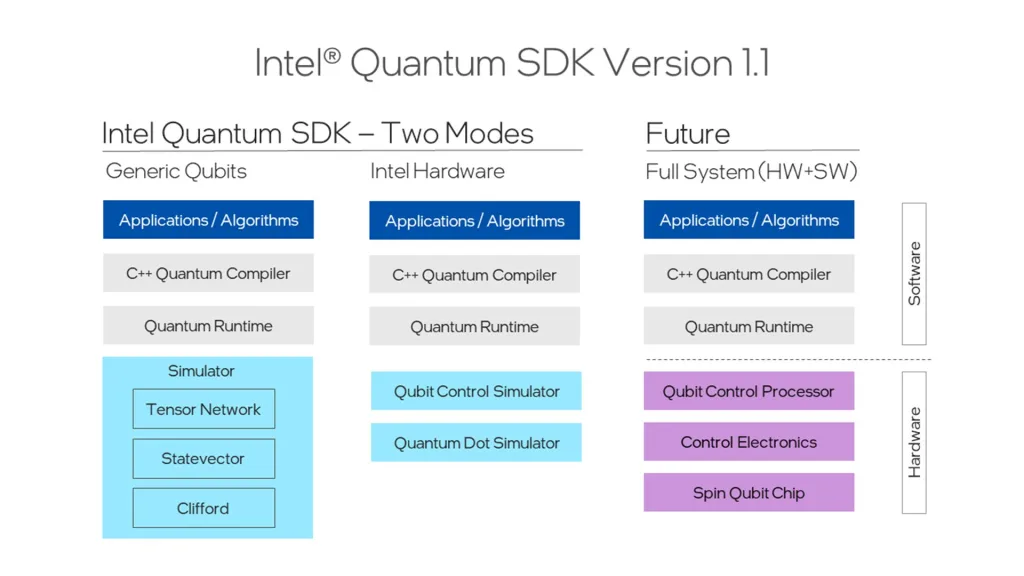
- LLVM-Based Compiler Extension with Intuitive C++ Language Extensions. The Intel Quantum SDK includes an LLVM-based compiler extension that provides intuitive C++ language extensions to program quantum algorithms. This extension allows developers to build quantum kernels by issuing quantum instruction calls in an imperative style. This approach simplifies the initial steps for developers, enabling them to integrate quantum programming within a familiar C++ environment seamlessly.
- Functional Language Extension for Quantum (FLEQ). FLEQ, a component of the Intel Quantum SDK, extends beyond the imperative style by offering tools for the modular and flexible development of complex quantum logic. FLEQ allows developers to define quantum algorithms in a functional programming paradigm, providing a succinct and powerful method for constructing and managing intricate quantum processes.
- Efficient Running of Hybrid Quantum-Classical Workflows. The Intel Quantum SDK facilitates efficient hybrid quantum-classical workflows by integrating a quantum runtime that leverages the speed of C++ for classical data processing. This integration allows the use of classical data as dynamic inputs for quantum algorithms, creating essential feedback loops for optimization algorithms like the Quantum Approximate Optimization Algorithm (QAOA) and the variational quantum eigensolver (VQE).
- Multiple Choices of Qubit Back Ends. The SDK provides a range of qubit simulators that bring quantum computing capabilities to the CPU. This includes the Intel Quantum Simulator, which offers state-vector simulation on a high-performance, qubit-agnostic back end. Developers can test and validate quantum algorithms against adjustable noise models, catering to the needs of the Noisy Intermediate-Scale Quantum (NISQ) era. The total number of qubits available in the simulation is dependent on the host computer’s memory capacity.
- Tensor Network Back End. This back end allows the simulation of a larger number of qubits for specific types of quantum circuits by utilizing tensor network methods. This enables more extensive and complex simulations, supporting advanced quantum research and development.
- Clifford Simulator Back End. Optimized for quantum circuits limited to a subset of quantum gates, the Clifford simulator back end provides extremely efficient computations. This is particularly useful for workloads constrained to Clifford quantum gates, offering rapid simulation results.
- Quantum Dot Simulator Back End. This back end incorporates the physics of quantum dot qubit technology and simulates qubits based on Intel’s developing quantum hardware. It allows for precise simulations that account for the specific physical characteristics of quantum dot qubits.
- User-Defined Back End. The Intel Quantum SDK includes a user-defined back-end interface, allowing developers to create custom qubit simulators tailored to specific needs. This flexibility supports various experimental and niche applications in quantum computing.
- Release Notes & Documentation (Version 1.1). The latest version introduces QExpr, a new data type for expressing quantum instructions, and APIs for functional programming paradigms. Additional qubit simulation back ends, including tensor network and Clifford circuit back ends, expand simulation capabilities. Performance improvements and new APIs enhance existing back ends and allow custom noise models. Enhanced qubit scheduling and placement, alongside the ability to run user-selected and external optimization passes, provide greater control and efficiency in quantum compilation.
The Evolution of Intel’s Quantum Computing Developments
Intel’s journey in quantum computing began in earnest in 2015 when it invested $50 million in a 10-year collaborative partnership with QuTech, a quantum research institute in the Netherlands. This partnership aimed to accelerate advancements in quantum computing by combining Intel’s expertise in fabrication, electronics, and architecture with QuTech’s leading quantum research capabilities. The collaboration has resulted in several significant milestones, including the development of a silicon-based spin qubit chip and a 17-qubit superconducting test chip.
In 2018, Intel made a significant breakthrough with the development of a silicon-based spin qubit chip. Unlike superconducting qubits, spin qubits are much smaller and can operate at higher temperatures, which could potentially make quantum computers more practical and scalable. This development was a significant step forward as it leveraged Intel’s existing manufacturing capabilities and silicon-based technology, potentially paving the way for the production of quantum processors on a large scale.
The following year, Intel introduced “Horse Ridge,” a cryogenic control chip designed to operate at extremely low temperatures, close to absolute zero. This chip was designed to control multiple qubits and simplify the complex control electronics that are necessary for operating a quantum computer. By reducing the complexity of the system, Horse Ridge could potentially make quantum computers more scalable and easier to produce.
In 2020, Intel unveiled the second generation of Horse Ridge, which further improved the chip’s capabilities. The new chip was designed to manipulate and read the state of qubits directly, which could potentially improve the fidelity and performance of quantum computations. This development marked another significant step forward in Intel’s quest to make quantum computing more practical and scalable.

Key Features of Intel Quantum SDK
The Intel Quantum SDK is a significant tool in quantum computing. It is designed to facilitate the development of quantum applications and algorithms, providing a platform for researchers and developers to simulate quantum computations. The SDK is built on top of Intel’s Quantum Simulator, a high-performance simulator of quantum circuits optimized for Intel’s hardware (Häner and Steiger, 2017).
One of the key features of Intel Quantum SDK is its ability to simulate quantum circuits with up to 42 qubits without requiring any additional hardware. This significantly improves over other quantum simulators, which typically can only simulate up to 30 qubits. The SDK achieves this by utilizing the high-performance computing capabilities of Intel’s hardware, including its multi-core processors and large memory capacity (Häner and Steiger, 2017).
Another important feature of the SDK is its support for a wide range of quantum gates. These include the standard set of quantum gates (such as the Pauli gates, Hadamard gate, and CNOT gate) and more complex gates like the Toffoli gate and the Fredkin gate. This wide range of supported gates allows developers to implement various quantum algorithms and applications (Nielsen and Chuang, 2010).
The SDK also includes a set of libraries for quantum error correction. These libraries provide implementations of various quantum error correction codes, including the surface code and the Steane code. Quantum error correction is a crucial aspect of quantum computing, as it allows quantum computers to correct errors that occur due to decoherence and other quantum phenomena (Preskill, 1998).
The SDK provides a quantum instruction set architecture (QISA) that allows developers to write low-level quantum programs. This QISA is designed to be hardware-agnostic, meaning that it can be used to program a variety of different quantum computers, not just those built by Intel. This feature makes the SDK a versatile tool for quantum programming (Jones, 2018).
The architecture of the Intel Quantum SDK is designed to be modular and extensible, allowing for the integration of various quantum computing technologies. The SDK is composed of several layers, each providing a different level of abstraction. At the lowest level, the Quantum Hardware Abstraction Layer (QHAL) provides a hardware-agnostic interface to quantum processors. This layer is responsible for translating high-level quantum instructions into low-level hardware commands.
Above the QHAL, the Quantum Intermediate Representation (QIR) layer provides a platform-independent representation of quantum programs. The QIR is designed to be a common language for quantum computing, allowing for interoperability between different quantum computing platforms. The QIR is based on the LLVM intermediate representation, a widely used compiler technology.
The Quantum High-Level Programming (QHLP) layer sits above the QIR, providing a high-level programming interface for quantum computing. The QHLP layer includes a quantum programming language, a quantum compiler, and a quantum simulator. The quantum programming language is a domain-specific language designed for expressing quantum algorithms. The quantum compiler translates quantum programs written in the quantum programming language into QIR. The quantum simulator allows for the execution of quantum programs on classical computers, enabling developers to test and debug their quantum programs.
The Intel Quantum SDK also includes a Quantum Application Programming Interface (QAPI), which provides a high-level, user-friendly interface for developing quantum applications. The QAPI includes libraries for common quantum computing tasks, such as quantum error correction and cryptography.

Intel Quantum SDK Quick Guide
To get started, developers need to consider system requirements, particularly memory. The memory needed for state-vector simulations increases exponentially with the number of qubits; for example, simulating 30 qubits requires approximately 17.2 GB of RAM. Developers write their quantum algorithms in .cpp files, including quantum kernel definitions and initialization code. The Intel Quantum Compiler is then used to compile these files, and the resulting executables are run to execute the quantum algorithms.
When writing new algorithms, developers include specific headers to access quantum functionality and declare qubit variables globally. Quantum gate calls are placed inside functions marked with the quantum_kernel specifier. The FullStateSimulator class provides access to various backend simulators, allowing for flexible and accurate simulation of quantum hardware. For detailed instructions and examples, developers can refer to the Developers Guide, Tutorials, and API Reference included in the SDK. To deepen their understanding of quantum computing fundamentals, developers are encouraged to consult recommended textbooks and C++ programming resources.
Setting Up Your Environment
Before using the Intel Quantum SDK, ensure your environment is properly set up. This typically involves sourcing the appropriate setup script provided by the SDK. Here’s an example command to set up your environment:
source /path/to/intel_quantum_sdk/setup.shWriting a Quantum Algorithm
Write your quantum algorithm in a C++ file. For example, create a file named. my_new_algo.cpp
#include <clang/Quantum/quintrinsics.h>
#include <quantum_full_state_simulator_backend.h>

quantum_kernel void my_quantum_function(qbit q) {
    // Define your quantum instructions here
}

int main() {
    FullStateSimulator simulator;
    qbit q = simulator.allocateQubit();
    my_quantum_function(q);
    simulator.run();
    return 0;
}
Compiling the Quantum Algorithm
Use the Intel Quantum Compiler to compile your C++ file. Replace [compiler flags] with any specific flags you may need:
./intel-quantum-compiler [compiler flags] my_new_algo.cpp -o my_new_algo
To see a list of available compiler flags, you can use the help option:
./intel-quantum-compiler -hRunning the Compiled Algorithm
Run the Compiled Algorithm. Execute the compiled program to run your quantum algorithm.
./my_new_algo
These basic instructions will help you get started with the Intel Quantum SDK, from writing your quantum algorithms to running them on the provided simulators. For more detailed instructions and examples, refer to the SDK documentation and tutorials.
References
- Intel Newsroom. “Intel Advances Quantum Computing Research with New Qubit Test Chip.” 2017.
- Nielsen, M.A., & Chuang, I.L. “Quantum Computing: A Primer.” Cambridge University Press, 2010.
- Intel Newsroom. “Intel and QuTech Unveil Details of First Cryogenic Quantum Computing Control Chip, Horse Ridge.” 2019.
- Johnston, Eric R., Nic Harrigan, and Mercedes Gimeno-Segovia. “Programming Quantum Computers: Essential Algorithms and Code Samples.” O’Reilly Media, 2019.
- Intel Newsroom. “Intel’s Silicon Spin Qubits Bring Quantum Computing Closer to Reality.” 2018.
- Intel Newsroom. “Quantum Computing at Intel: A Look Back on 2020 and the Journey Ahead.” 2021.
- Gisin, N., Ribordy, G., Tittel, W., & Zbinden, H. “Quantum Cryptography.” Reviews of Modern Physics, 74(1), 145, 2002.
- Häner, T. and Steiger, D.S. “0.5 petabyte simulation of a 45-qubit quantum circuit.” In Proceedings of the International Conference for High Performance Computing, Networking, Storage and Analysis (p. 33). ACM, 2017.
- Hidary, Jack D. “Quantum Computing: An Applied Approach.” Springer, 2019.
- Egger, D.J., Marecek, J., Woerner, S., et al. “Qiskit: An Open-source Framework for Quantum Computing.” In 2020 IEEE Quantum Week (QCE). IEEE, 2020.
- Benenti, Giuliano, Giulio Casati, and Giuliano Strini. “Principles of Quantum Computation and Information.” World Scientific, 2004.
- Preskill, J. “Reliable quantum computers.” Proceedings of the Royal Society of London. Series A: Mathematical, Physical and Engineering Sciences, 454(1969), pp.385-410, 1998.
- Yanofsky, Noson S., and Mirco A. Mannucci. “Quantum Computing for Computer Scientists.” Cambridge University Press, 2008.
- Jones, N. “Programming languages for quantum computers.” Nature, 557(7705), pp.161-162, 2018.
- Nielsen, Michael A., and Isaac L. Chuang. “Quantum Computation and Quantum Information.” Cambridge University Press, 2010.
- Lattner, C., & Adve, V. “LLVM: A Compilation Framework for Lifelong Program Analysis & Transformation.” In Proceedings of the International Symposium on Code Generation and Optimization. IEEE, 2004.
- Intel Corporation. “Intel Quantum Computing.” 2020.
- Devitt, S.J., Munro, W.J., & Nemoto, K. “Quantum Error Correction for Beginners.” Reports on Progress in Physics, 76(7), 076001, 2013.
- Intel Newsroom. “Intel Unveils Second Generation Horse Ridge Cryogenic Quantum Computing Control Chip.” 2020.
- NeurIPS Proceedings. “Qiskit: An Open-source Framework for Quantum Computing.” Neural Information Processing Systems, 2019.
- Intel Corporation. “Intel Quantum Simulator: A cloud-ready high-performance simulator of quantum circuits”, 2018.
- Rieffel, Eleanor G., and Wolfgang H. Polak. “Quantum Computing: A Gentle Introduction.” MIT Press, 2011.