

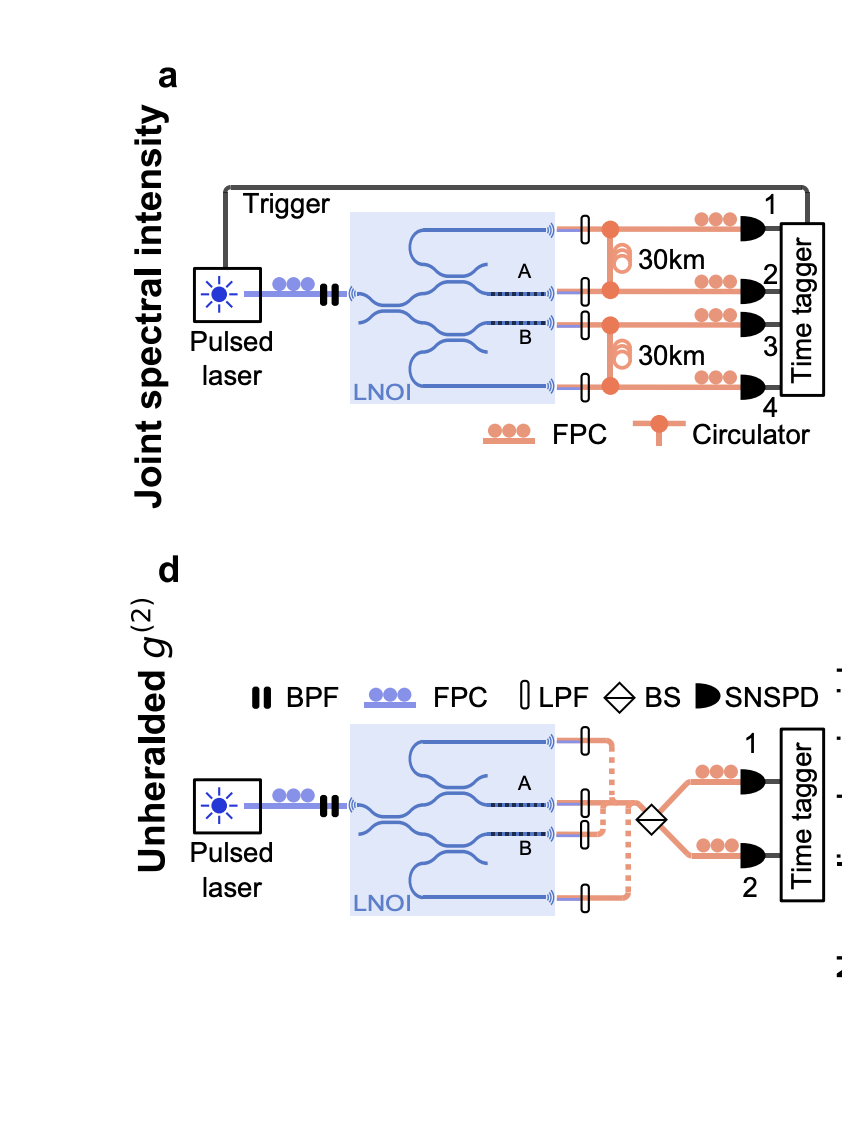
The demand for robust and scalable single-photon sources underpins many developing quantum technologies, including secure communication networks and advanced quantum sensors. Current integrated photonic circuits often rely on spontaneous parametric down-conversion (SPDC), a process where a single photon splits into two lower-energy photons, known as the signal and idler. However, achieving high purity and efficient generation of these photon pairs remains a significant challenge. Researchers at ETH Zurich, specifically Jost Kellner, Alessandra Sabatti, Tristan Kuttner, Robert J Chapman, and Rachel Grange, from the Optical Nanomaterial Group within the Institute for Quantum Electronics, address this issue in their recent publication detailing a novel counter-propagating SPDC source fabricated on a lithium niobate on insulator platform. Their work, entitled “Counter-propagating spontaneous parametric down-conversion source in lithium niobate on insulator”, demonstrates a method for generating highly pure, spectrally uncorrelated photon pairs, offering a potentially scalable solution for future photonic networks.
Integrated photonics increasingly relies on sources of indistinguishable single photons, and spontaneous parametric down-conversion (SPDC) remains a common technique for generating correlated photon pairs. SPDC is a nonlinear optical process where a pump photon spontaneously splits into two lower-energy photons, known as the signal and idler, conserving energy and momentum. Conventional integrated SPDC sources often compromise photon purity or require lossy spectral filtering, limiting the performance of quantum photonic systems. This research presents a novel integrated counter-propagating photon-pair source fabricated on a lithium niobate on insulator platform, directly addressing these limitations and offering a pathway towards scalable quantum technologies.
The design generates signal and idler photons travelling in opposite directions, inherently decoupling their spectral properties and eliminating the need for spectral filtering, simplifying device architecture and reducing photon loss. Researchers demonstrate the generation of spectrally uncorrelated photon pairs, achieving a measured photon purity of 92.3%, a significant improvement over traditional co-propagating designs where both photons travel in the same direction. This enhanced purity and efficiency are critical for applications demanding indistinguishable photons, such as quantum key distribution, a secure communication method, and linear optical quantum computation, a model of computation using photons.
Furthermore, the study validates the scalability of this
Furthermore, the study validates the scalability of this platform by demonstrating Hong-Ou-Mandel interference between two independent sources. Hong-Ou-Mandel interference is a quantum mechanical phenomenon where two identical photons arrive at a beam splitter simultaneously, resulting in a reduction in the probability of detecting both photons, demonstrating their indistinguishability. The observed interference yields heralded visibilities of 71.3%, indicating a strong degree of indistinguishability between photons originating from separate devices, a crucial requirement for advanced quantum applications.
This demonstrated counter-propagating geometry represents an advancement in integrated photonics, offering distinct advantages for practical implementation and addressing key challenges in quantum technology. By intrinsically decoupling the spectral properties of generated photons, this approach bypasses the need for complex filtering mechanisms, enhancing both efficiency and purity, and contributing to a more compact, robust, and efficient integrated photonic system.
Measurements of the joint spectral intensity and unheralded correlations confirm a high degree of spectral separation between signal and idler photons, reaching a photon pair purity of (92 ± 3)%, signifying a substantial improvement over many existing integrated sources. Reported visibilities of (71 ± 3)% confirm the potential for creating large-scale, interconnected quantum photonic circuits.
This research establishes a new paradigm for integrated photonic source design, paving the way for more robust and efficient quantum photonic networks and enabling a wide range of applications in quantum communication, computation, and sensing. Future work will focus on optimizing the device performance, increasing the photon pair generation rate, and exploring new applications for this innovative photon source.
👉 More information🗞Counter-propagating spontaneous parametric down-conversion source in
🗞 Counter-propagating spontaneous parametric down-conversion source in lithium niobate on insulator
🧠 DOI: https://doi.org/10.48550/arXiv.2506.21396


