

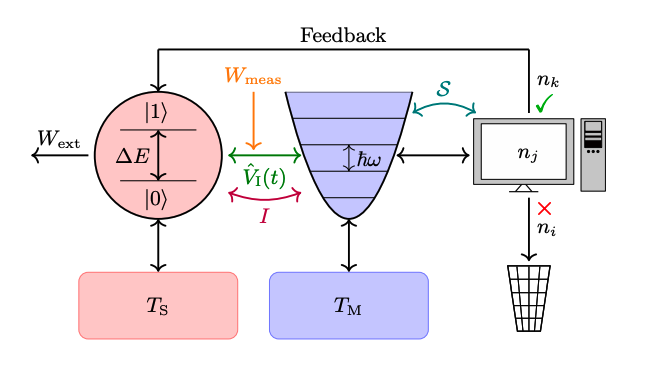
The pursuit of efficient energy conversion continually drives innovation across multiple scientific disciplines, and recent research explores the potential of harnessing quantum mechanics to enhance this process. Information engines, devices that leverage measurement and feedback to transform energy into useful work, represent a novel approach to thermodynamic cycles. A team comprising Rasmus Hagman, Jonas Berx, Janine Splettstoesser, and Henning Kirchberg, from Chalmers University of Technology and the University of Copenhagen, now presents a detailed analysis of the trade-offs inherent in these engines, specifically considering the limitations imposed by finite measurement times. Their work, entitled ‘Optimising finite-time quantum information engines using Pareto bounds’, utilises Pareto optimisation – a multi-objective optimisation technique commonly employed in engineering and biological physics – to establish design principles for maximising both power output and thermodynamic efficiency in quantum information engines, with potential applications in nano-mechanical systems and circuit quantum electrodynamics (circuit QED) platforms. Circuit QED is a branch of physics studying the interaction between light and matter at the quantum level using electrical circuits.
Quantum thermodynamics represents a burgeoning field of research that investigates the fundamental constraints governing energy conversion when quantum mechanical effects become prominent. It synthesises classical thermodynamics, which deals with macroscopic systems and energy transfer, with the principles of quantum mechanics and information theory, to explore the limits of what is physically possible at the smallest scales. Researchers currently examine how quantum coherence—the ability of a quantum system to exist in multiple states simultaneously—and entanglement, a correlation between quantum particles regardless of distance, influence thermodynamic performance, potentially enhancing efficiency and power output beyond classical limits.
A key challenge lies in understanding the impact of environmental interactions and decoherence on these quantum systems. Decoherence, the process by which a quantum system loses its coherence due to interaction with its surroundings, effectively destroys the quantum properties that could offer thermodynamic advantages. Theoretical frameworks, such as the density matrix formalism detailed in works by Breuer and Petruccione (2002) and Alicki and Lendi (1987), provide the mathematical tools necessary to model these complex interactions and quantify the rate of decoherence. Experimental investigations, often utilising superconducting qubits—artificial atoms implemented using superconducting circuits (Salathé et al., 2015)—aim to minimise decoherence and demonstrate functional quantum thermodynamic devices.
The field actively explores the connection between quantum
The field actively explores the connection between quantum information theory and thermodynamics, investigating how quantum measurement and feedback control can be harnessed to extract work from systems. Quantum measurement, unlike classical measurement, inherently disturbs the system being measured, and researchers are investigating how to strategically utilise this disturbance to drive thermodynamic processes. Pareto optimisation, a multi-objective optimisation technique, emerges as a valuable tool for identifying optimal trade-offs between competing performance metrics, such as power, efficiency, and energy conversion rates. This allows scientists to design quantum engines and refrigerators that maximise desired outcomes while acknowledging inherent physical limitations.
Recent research demonstrates a growing trend towards experimental validation of theoretical predictions, indicating the feasibility of realising practical quantum thermodynamic devices. Studies employ diverse physical platforms, including nano-mechanical systems—tiny vibrating structures—and circuit quantum electrodynamics (circuit QED), providing crucial feedback for refining theoretical models and addressing practical engineering challenges. This interdisciplinary field continues to push the boundaries of understanding energy conversion at the quantum scale, with potential implications for future technologies in areas such as energy harvesting and quantum computing.
🗞 Optimising finite-time quantum information engines using Pareto bounds
🧠 DOI: https://doi.org/10.48550/arXiv.2507.00712


