

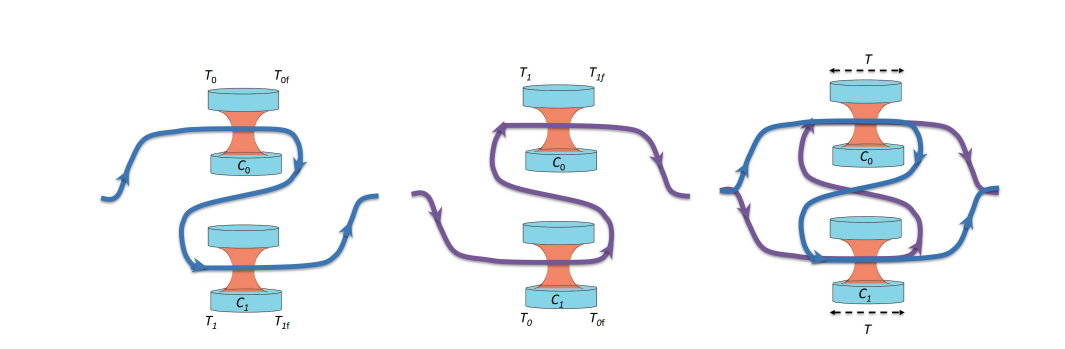
Indefinite causal order, a potentially revolutionary resource for future information processing technologies, receives a significant boost from new research exploring its behaviour within light-matter systems. Lorenzo M. Procopio, L. O. Castaños-Cervantes, and Tim J. Bartley, from Paderborn University, demonstrate how indefinite causal order establishes connections between distant cavity fields that never directly interact, offering advantages over traditional, fixed-order scenarios. The team’s findings reveal that this approach consistently generates strong correlations between these fields, even when starting from a vacuum state, and crucially, enables the complete interchange of a single photon between cavities without altering the state of the atom involved, a feat impossible with conventional systems. This work highlights the potential of indefinite causal order to coherently control interactions between light and matter, paving the way for novel quantum technologies.
The results show that ICO creates entanglement between two distant cavity fields that never directly interact, and, crucially, when both cavity fields begin in the vacuum state, ICO consistently generates greater entanglement than fixed-order scenarios. Furthermore, the research demonstrates that ICO interchanges one photon between both cavities with a total probability of one, all while preserving the initial quantum state.
Indefinite Causal Order for Quantum Advantage
This research explores indefinite causal order (ICO), a quantum phenomenon where the sequence of events is not predetermined, potentially enhancing quantum information processing and communication. The team investigates how ICO can improve quantum algorithms, communication protocols, and precision measurement techniques. The researchers propose and explore using atom interferometers, specifically Sagnac interferometers, as a platform to realise and manipulate ICO, relying heavily on the principles of quantum mechanics, particularly superposition. Different causal orders are represented as sequences of quantum gates, and ICO allows for superpositions of these gate sequences.
The authors utilise concepts from quantum information theory to analyse the potential benefits of ICO, such as increased channel capacity or improved algorithm performance, while also considering the impact of decoherence. The core of the experimental approach involves atom interferometers, which split a beam of atoms into two paths travelling in opposite directions around a closed loop, creating a phase shift sensitive to the area enclosed and rotation rate. The researchers aim to control the atomic paths to create a superposition of different causal orders, proposing the use of guided atoms and waveguides to improve coherence and control. Multi-loop interferometers are explored to increase the complexity of the causal structures that can be realised. The research suggests that ICO could lead to improved quantum communication protocols and enhance precision measurements, potentially contributing to the development of new quantum technologies, such as quantum computers, sensors, and communication networks.
Entanglement via Indefinite Causal Order Demonstrated
Researchers have demonstrated the potential of indefinite causal order (ICO) within a cavity quantum electrodynamics (cQED) system, revealing a new pathway for quantum information processing and light-matter interaction control. Experiments show that ICO can generate entanglement between two distant cavity fields that have no direct interaction, a feat impossible with fixed-order scenarios. Specifically, the research demonstrates that ICO consistently creates substantial entanglement even when both cavity fields begin in a vacuum state, surpassing the performance of systems with a defined order of operations. The team further discovered that ICO enables the interchange of a single photon between the two cavities with a total probability of one, all without altering the atom’s state. This photon exchange is unattainable in conventional cQED systems where the cavities are arranged in series. The team shows that introducing ICO, where an atom traverses two cavities in a superposition of orders, creates strong correlations between the cavity fields even when they do not directly interact. Notably, ICO consistently generates larger field correlations than scenarios with a fixed traversal order, and enables the complete interchange of a single photon between the cavities without altering the atom’s state, a feat impossible with defined order. These findings suggest ICO could offer a new paradigm for coherently controlling atom-field interactions and manipulating quantum states of light and matter. The study successfully implements ICO using a control qubit to place the atom in a superposition of traversal paths. Future work could explore the application of ICO to more complex systems and investigate its potential for quantum information processing and enhanced sensing technologies.
🗞 Indefinite causal order in cavity quantum electrodynamics
🧠 ArXiv: https://arxiv.org/abs/2509.02209


