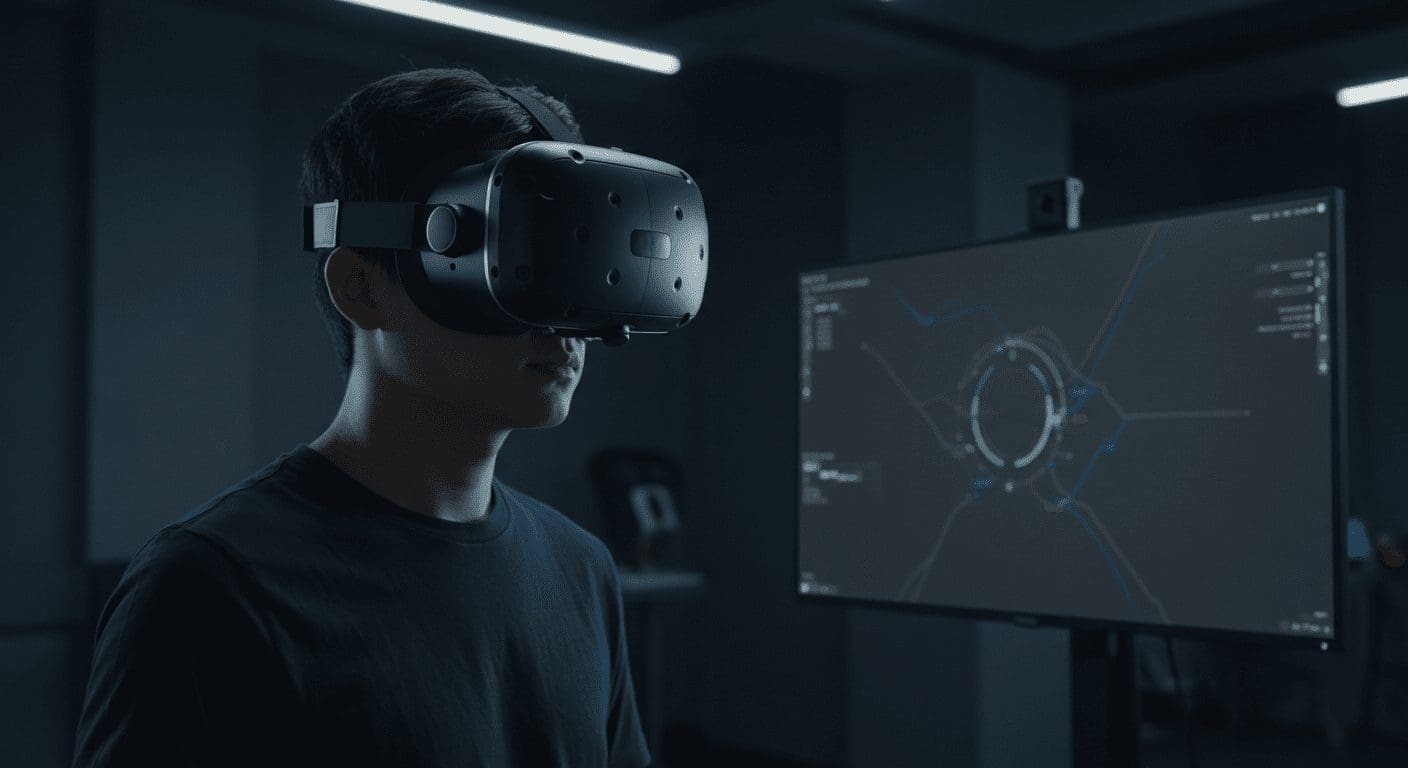
Virtual Reality (VR) signifies a transformative technology that crafts immersive, interactive experiences for users. VR engages multiple senses. It creates the illusion of presence within computer-generated environments. This offers a powerful medium for entertainment, education, training, and beyond. The journey to this sophisticated technology spans centuries. It reflects a long-standing human desire to transcend the boundaries of physical reality. It also explores alternate worlds. This article will delve into the rich history of VR. It will trace its evolution from early conceptualizations and artistic precursors. The article will explore the cutting-edge advancements that define the modern era.
The human fascination with creating and experiencing realities beyond our own has deep roots in history. Ancient myths and legends abound with tales of artificial beings and illusionary worlds. These stories demonstrate an early conceptual interest in simulating or replicating aspects of reality. These narratives show a persistent human drive. People have created intricate automatons capable of mimicking human-like actions. They strive to push the boundaries of what is real and what can be artificially created. Virtual reality is the latest technological embodiment of this enduring aspiration in its modern form.
The path toward VR was paved with artistic and scientific endeavors that gradually refined our understanding of perception and immersion. Early attempts to create convincing illusions of reality laid the groundwork for today’s sophisticated technologies.
The Renaissance marks a pivotal point in creating immersive visual experiences. This era saw the development of perspective in art. Renaissance artists meticulously studied optics. They studied mathematics as well. They aimed to create paintings that offered a convincing illusion of depth and three-dimensional space on a two-dimensional surface. Masters like Masaccio in his “Holy Trinity” used linear perspective to construct believable spatial environments. Piero della Francesca also applied it in “Flagellation of Christ.” This effectively drew viewers into the scene. This artistic pursuit aims to transport the observer into the world depicted on canvas. It reflects a foundational principle of modern VR: creating a compelling sense of “being there.”
The 19th century witnessed the rise of panoramic paintings, another significant precursor to VR. These massive artworks were often displayed in purpose-built rotundas. They surrounded viewers with a 360-degree scene, aiming to create a complete and convincing illusion of reality. Panoramas became a popular form of mass entertainment. They offered a form of “virtual travel” to distant lands. People could experience historical events at a time when global travel was inaccessible to most. Panoramic painters carefully concealed the edges of the canvas.
They often incorporated props and lighting effects. They sought to blur the line between art and reality, fully immersing the audience in the depicted environment. This ambition aims to transport viewers to different places and times. Visual immersion directly foreshadows the core goals of VR technology. The large-scale production and widespread appeal of panoramas in the 19th century demonstrate a strong public appetite for such immersive experiences.
The invention of the stereoscope in 1838 marked a crucial scientific and technological step towards VR . Sir Charles Wheatstone’s research showed how the brain processes two slightly different two-dimensional images. Each image comes from one eye. These images combine into a single three-dimensional object. This process creates a perception of depth . The stereoscope utilized this principle by presenting paired stereoscopic images to each eye. Later, the popular View-Master did the same, providing users with a sense of depth and immersion from flat photographs.
Stereoscopic photos and viewers became immensely popular in the 19th century. They served both entertainment and educational purposes. They offered a form of “virtual tourism”. This allowed people to experience distant places from the comfort of their homes . The cultural impact of the stereoscope was significant. It provided visual access to different parts of the world. It also influenced how people perceived reality . This early understanding and replication of 3D vision remains a fundamental component of VR technology today .
The concept of simulated reality also found its way into early literature. In the 1930s, Stanley G. Weinbaum’s science fiction story “Pygmalion’s Spectacles” envisioned a pair of goggles. These goggles could transport the wearer to a fictional world. They stimulated all the senses – sight, sound, smell, taste, and touch . This early literary exploration of a full sensory virtual world was remarkably similar to modern VR. It played a significant role in conceptualizing immersive simulated experiences. This inspired future inventors and researchers .
The 20th century brought the first technological steps that directly led to the development of Virtual Reality. In 1929, Edwin Link created the Link Trainer. It was patented in 1931. It is widely recognized as the first commercial flight simulator. This electromechanical device used motors linked to the aircraft’s controls. It provided pilots with a realistic sense of pitch and roll. It also simulated turbulence. The Link Trainer was invaluable for pilot training. It provided physical cues. It also offered visual cues that mimicked flying a real airplane. This occurred in a safe and controlled environment. The military widely adopted it during World War II, highlighting the practical value of simulation for training purposes. This adoption laid a crucial foundation for using VR in similar applications today.
Morton Heilig was a true visionary in the field. In the 1950s and 1960s, he conceptualized and built groundbreaking immersive technologies. Heilig’s Sensorama was an arcade-style cabinet. A prototype of it was built in 1962. It was designed to provide a fully immersive cinematic experience by stimulating multiple senses.
This mechanical device featured a stereoscopic color display for 3D visuals. It had stereo speakers for sound. The device included fans to simulate wind and odor emitters to introduce smells. Additionally, it had a vibrating chair to provide tactile feedback. Heilig even created several short films for the Sensorama. One film was a simulated motorcycle ride through New York City. These films showcased its capabilities.
While revolutionary for its time, the Sensorama was limited by its mechanical nature and lacked interactivity . Heilig also patented the Telesphere Mask in 1960, the first example of a head-mounted display (HMD) . This headset provided stereoscopic 3D images with a wide field of view and stereo sound, although it did not incorporate motion tracking . The Telesphere Mask, despite its limitations, remarkably anticipated many features found in modern VR headsets . Heilig’s pioneering work, though facing commercial challenges, laid crucial groundwork by embodying the core concepts of multisensory immersion and head-mounted displays that define VR today .
The 1960s marked a pivotal era with the emergence of the first interactive head-mounted displays. In 1961, engineers at Philco Corporation developed Headsight, an early precursor to the modern HMD . Created for military applications, Headsight incorporated video screens for each eye. It used a magnetic motion tracking system linked to a remote camera . While not used for virtual reality in the contemporary sense, Headsight was a significant step towards interactive VR. It demonstrated the integration of head tracking with a head-mounted display. This allowed users to naturally look around a remote environment.
Ivan Sutherland, a computer scientist, shared his vision of the “Ultimate Display” in 1965. This concept would serve as a fundamental blueprint for VR. Sutherland envisioned a virtual world viewed through an HMD. It could replicate reality so accurately that users would be unable to distinguish it from the actual world. The technology would even allow users to interact with virtual objects realistically.
This ambitious concept was driven by Sutherland’s background in computer graphics. It laid out the long-term goals for VR. These goals continue to inspire researchers.
In 1968, Sutherland created the “Sword of Damocles” along with his student Bob Sproull. It is widely considered the first VR/AR head-mounted display connected to a computer. This device was primitive in terms of user interface and visual realism. It featured simple wireframe graphics. However, it was groundbreaking because it allowed users to view computer-generated images.
These images changed perspective based on their head movements. The head movements were tracked by a mechanical arm suspended from the ceiling. Technically an augmented reality device due to its optical passthrough, the “Sword of Damocles” demonstrated the feasibility of interactive computer graphics within an HMD, marking a landmark achievement in the history of VR.
The 1970s saw the emergence of “artificial reality,” a term coined by Myron Krueger. Krueger’s VIDEOPLACE, developed in 1975, was a pioneering interactive VR system. It utilized computer graphics, light projection, cameras, and screens to create computer-generated environments. These environments responded to people within the space, all without the need for head-mounted displays.
Krueger’s work emphasized full-body interaction and the feeling of presence within virtual environments. It offered a distinct approach to VR. This approach focused on the user’s experience within the space itself.
In 1977, MIT created the Movie Map of Aspen, Colorado, an early interactive virtual tour that allowed users to “wander” through the city using video footage. This project demonstrated the potential of using existing media to create interactive virtual experiences of real-world locations, foreshadowing future developments in digital mapping and virtual tourism .
During the late 20th century, from the 1970s to the 1990s, the primary focus of the VR industry shifted towards practical applications in specialized fields such as medicine, flight simulation, automotive design, and military training . In 1985, NASA Ames Research Center developed the VIEW (Virtual Interactive Environment Workstation) system .
This system utilized head-mounted displays and the first dataglove, invented by Tom Zimmerman at VPL Research, for user interaction with virtual environments . The VIEW system found applications in telerobotics and astronaut training, showcasing the potential of VR for complex tasks in scientific and high-stakes domains .
The late 1980s saw the popularization of the term “virtual reality” by Jaron Lanier, who founded VPL Research in 1984 . VPL Research developed and sold early commercial VR hardware like the DataGlove and the EyePhone HMD, marking a significant step towards commercializing VR technology .
VPL even licensed its DataGlove technology to Mattel. This collaboration created the Power Glove, an early and relatively affordable VR device for home use. In 1988, the Cyberspace Project at Autodesk achieved another milestone. They implemented VR on a low-cost personal computer for the first time. Eric Gullichsen led this project. He later founded Sense8 Corporation. He also developed the WorldToolKit virtual reality SDK. This made VR development more accessible.
The 1990s witnessed the first widespread commercial releases of consumer VR headsets, including the Sega VR headset and the Virtuality arcade systems, which offered immersive gaming experiences, although with limitations.
Nintendo also entered the VR market with the Virtual Boy in 1995, an early attempt at portable VR gaming that faced technical and commercial challenges. In 1991, Carolina Cruz-Neira, Daniel J. Sandin, and Thomas A. DeFanti at the Electronic Visualization Laboratory created the first cubic immersive room. It was known as the CAVE (Cave Automatic Virtual Environment). The CAVE provided a highly immersive, multi-person VR experience for research and visualization.
In conclusion, the history of Virtual Reality is a testament to humanity’s enduring quest for immersive experiences and technological innovation. From the early artistic explorations of perspective and the captivating illusions of panoramic paintings to the groundbreaking electromechanical devices of the 20th century and the digital revolution of the 21st century, VR has undergone a remarkable evolution. The journey has been marked by periods of enthusiastic advancement followed by periods of relative calm, yet the underlying fascination with creating and stepping into alternate realities has consistently driven progress.
The convergence of emerging technologies with VR accelerates rapidly. This creates the potential for transformative applications across various aspects of life and work. These opportunities seem endless. While challenges undoubtedly remain, the historical trajectory of VR suggests a future for immersive digital experiences. These experiences will become increasingly integrated into our daily lives. They will blur the lines between the physical and the virtual in ways we are only beginning to imagine.