Quantum networks represent a transformative technology with potential applications ranging from secure communication to advanced sensing, but building networks that span significant distances presents a major challenge. Yanxuan Shao from Northwestern University, Saikat Guha from the University of Arizona, and Adilson E. Motter, also from Northwestern University, and their colleagues demonstrate a novel approach to overcome these limitations by combining the strengths of both satellite and fibre optic technologies. Their research proposes a hybrid network and associated protocol that significantly improves the distribution of entanglement, a crucial quantum phenomenon, over long distances. This breakthrough paves the way for continental and potentially global quantum networks with markedly higher fidelity than previously achievable, bringing practical quantum communication closer to reality.
Entanglement Distribution Challenges and Current Limitations
Quantum networks promise revolutionary advances in secure communication, distributed computing, and precision sensing, yet establishing these networks over long distances presents significant challenges. Currently, two primary approaches exist: transmitting entangled photons through optical fibers or utilizing satellites to beam them down to ground stations. However, both methods face limitations that hinder scalability and widespread implementation. Optical fibers suffer from signal loss over long distances, requiring complex quantum repeaters to extend the range, while satellite-based systems are hampered by atmospheric interference, diffraction losses, and logistical difficulties.
Researchers are exploring a hybrid approach that combines the strengths of both fiber optics and satellite communication. This innovative network leverages short-distance, high-fidelity entanglement distribution via optical fibers, supplemented by medium Earth orbit (MEO) satellites positioned approximately 10,000 kilometers above the ground. This altitude offers broader coverage than low Earth orbit satellites while minimizing photon loss compared to geostationary satellites. The goal is to create a network that overcomes the limitations of existing technologies and enables truly large-scale quantum communication.
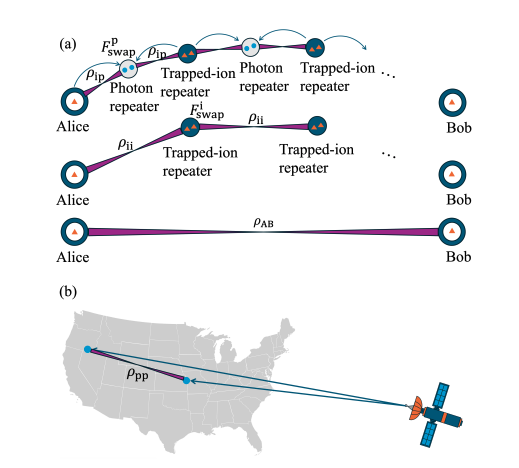
This hybrid design strategically utilizes MEO satellites to bridge long distances where fiber optic transmission becomes impractical. By combining the efficiency of fiber optics for shorter links with the extended reach of satellites, the network aims to achieve higher fidelity and greater overall performance. Using the contiguous United States as a model, the team demonstrates that this hybrid protocol outperforms both purely fiber-based and purely satellite-based approaches, resulting in a more robust and scalable architecture for distributing entanglement across vast geographical areas. The proposed network builds upon existing quantum repeater technology, employing trapped ions as quantum memories and utilizing photon repeaters to facilitate entanglement swapping. This allows for the extension of entanglement distribution over long distances, with the MEO satellites acting as crucial links between ground-based repeater stations. By carefully balancing the advantages of each component, the researchers envision a future quantum internet capable of supporting secure and powerful communication across continents, paving the way for transformative applications in various fields.
Hybrid Entanglement Distribution via Satellite and Fiber
The research team developed a novel approach to distributing entanglement over long distances, combining the strengths of both satellite and fiber optic networks. Recognizing the limitations of each individual technology, signal loss in fiber optic cables and atmospheric effects on satellite links, they designed a hybrid system intended to maximize fidelity and range. This strategy integrates both technologies to create a more robust and scalable quantum network. A key element of their methodology involves carefully modeling the factors that degrade entanglement during transmission. For satellite links, they accounted for atmospheric extinction and diffraction, calculating how these effects broaden the transmitted beam and reduce the number of photons reaching ground stations.
Similarly, for the fiber optic network, they considered signal loss and the need for quantum repeaters to extend the range of entanglement. The team constructed a detailed model of a continental-scale optical fiber network, specifically focusing on the contiguous United States. This model incorporated realistic data on fiber optic cable layouts and distances between census tracts, allowing them to simulate entanglement distribution routes and identify optimal repeater placement. They analyzed network topology to understand its impact on entanglement distribution. To enhance the efficiency of the hybrid system, the researchers incorporated techniques to purify entangled states.
Recognizing that entanglement degrades with each transmission step, they implemented a distillation process to improve the fidelity of entangled pairs. This iterative purification method filters out noise and strengthens the entanglement, allowing for reliable quantum communication over extended distances. The team considered the practical limitations of current technology, such as the efficiency of photon sources and detectors. They based their calculations on the performance of existing satellite-based quantum communication experiments, incorporating realistic estimates for the efficiency of various optical components. This attention to detail ensures that their model is grounded in reality and provides a realistic assessment of the feasibility of their hybrid approach.
Hybrid Network Boosts Long-Distance Entanglement Distribution
Researchers have developed a novel hybrid quantum network that significantly improves long-distance entanglement distribution, a crucial capability for future quantum communication technologies. Current approaches rely on either optical fibers or satellites to transmit quantum information, each with limitations; fiber optic cables suffer from signal loss over long distances, while satellite-based systems are hampered by atmospheric interference and limited interaction windows. This new network combines the strengths of both technologies, utilizing optical fibers for shorter distances and medium Earth orbit (MEO) satellites to bridge larger gaps, achieving superior performance over either method alone. The team’s design addresses the challenges of both existing systems by strategically positioning MEO satellites at an altitude of 10,000 kilometers.
This altitude represents a compromise, minimizing photon loss while maintaining broad spatial coverage. By integrating this satellite network with a series of quantum repeaters along fiber optic links, the researchers demonstrate a substantial improvement in entanglement distribution rates and fidelity across continental distances. The core of the system relies on quantum repeaters, which overcome signal loss in optical fibers by storing and re-transmitting quantum information. These repeaters, incorporating trapped ions to serve as quantum memories, are linked by photon repeaters that facilitate entanglement swapping.
The team’s calculations show that this hybrid approach dramatically reduces the time required to establish entanglement between distant locations, particularly over long distances where traditional fiber optic systems struggle. Specifically, the researchers modeled their network using the contiguous United States as a test case and found that the hybrid system outperforms both purely fiber-based and satellite-based networks. The improvement is significant; the hybrid network achieves higher entanglement distribution rates and maintains greater fidelity, a measure of the quality of the quantum connection, over comparable distances. This advancement paves the way for secure quantum communication across vast geographical areas, enabling applications like ultra-secure data transmission and distributed quantum computing.
🗞 Hybrid satellite-fiber quantum network
🧠 DOI: https://doi.org/10.48550/arXiv.2507.12539