Quantum computing is a rapidly evolving field that has the potential to revolutionize the way we approach complex problems in fields such as chemistry, materials science, and machine learning. At its core, quantum computing relies on the manipulation of qubits (quantum bits) which can exist in multiple states simultaneously, allowing for exponential scaling of computational power.
Chip to Qubit
The integration of quantum computer architecture with materials science and nanotechnology has led to significant breakthroughs in quantum computing. For instance, the development of superconducting qubits has enabled the creation of large-scale quantum processors. Similarly, the discovery of new materials has led to the development of more efficient quantum gates and algorithms.
Quantum software is a critical component of harnessing the power of quantum computers, which rely on qubits to perform calculations. Quantum programming languages such as Q# and Qiskit have been developed to take advantage of this property, enabling developers to write quantum algorithms that can be executed on quantum hardware.
What Are Qubits And Their Properties
Qubits are the fundamental units of quantum information, analogous to classical bits but with unique properties that enable them to exist in multiple states simultaneously. This property is known as superposition (Nielsen & Chuang, 2000). In other words, a qubit can represent both 0 and 1 at the same time, which allows for exponentially more complex calculations than classical computers.
The ability of qubits to exist in multiple states also enables them to be entangled with each other, meaning that the state of one qubit is dependent on the state of another (Ekert & Jozsa, 1996). This property is crucial for quantum computing, as it allows for the creation of a quantum register, which is a collection of qubits that can be manipulated together to perform calculations.
Qubits are typically implemented using physical systems such as superconducting circuits, trapped ions, or Josephson junctions (Vandersypen et al., 2001). These systems are designed to store and manipulate the quantum states of the qubits, allowing for precise control over their properties. The coherence time of a qubit is a critical parameter that determines how long it can maintain its quantum state before decoherence occurs, which is the loss of quantum information due to interactions with the environment.
Quantum bits are also known as quantum registers when they are used in conjunction with each other to perform calculations (DiVincenzo, 2000). The number of qubits required for a particular calculation depends on the complexity of the problem being solved. In general, the more qubits that are available, the larger and more complex the quantum register can be.
The properties of qubits have significant implications for quantum computing, as they enable the creation of quantum algorithms that can solve certain problems exponentially faster than classical computers (Shor, 1997). However, the fragility of qubits also presents a major challenge for building reliable quantum computers.
Quantum bits are still in the early stages of development, and significant research is being conducted to improve their properties and scalability. Despite these challenges, the potential rewards of quantum computing make it an exciting area of research with many promising applications.
Superconducting Qubits And Quantum Circuits
Superconducting Qubits are a type of quantum bit used in Quantum Computing, which is a fundamental component of Quantum Circuits. These qubits rely on the phenomenon of superconductivity, where certain materials exhibit zero electrical resistance when cooled to extremely low temperatures.
The operation of Superconducting Qubits relies on the Josephson effect, a phenomenon discovered by Brian Josephson in 1962 (Josephson, 1962). This effect describes the behavior of two superconductors separated by a thin insulating barrier. When these superconductors are connected, they can exhibit quantum behavior, such as entanglement and superposition.
Superconducting Qubits have been extensively studied for their potential use in Quantum Computing (Devoret et al., 1997). These qubits consist of a small loop of superconducting material, which is then coupled to a resonant circuit. The qubit’s state can be manipulated by controlling the current flowing through the loop.
Quantum Circuits are built using these Superconducting Qubits as their fundamental components (Makhlin et al., 2001). These circuits rely on the principles of quantum mechanics, such as superposition and entanglement, to perform complex calculations. Quantum Circuits have been demonstrated in various experiments, including the implementation of quantum algorithms.
The development of Quantum Circuits has led to significant advancements in the field of Quantum Computing (DiVincenzo, 2000). These circuits have been used to demonstrate the principles of quantum computing, such as quantum teleportation and superdense coding. The scalability of these circuits is a major challenge for the development of practical Quantum Computers.
The integration of Superconducting Qubits into Quantum Circuits has led to significant progress in the field of Quantum Computing (Koch et al., 2007). These qubits have been used to demonstrate the principles of quantum computing, including the implementation of quantum algorithms. The scalability and reliability of these circuits are crucial for the development of practical Quantum Computers.
Quantum Gates And Quantum Logic Operations
Quantum Gates are the fundamental building blocks of quantum computing, enabling the manipulation of qubits (quantum bits) to perform complex calculations. Quantum Logic Operations, such as superposition and entanglement, are essential for these gates to function correctly.
A Quantum Gate is a unitary transformation that acts on one or more qubits, modifying their state in a way that preserves quantum coherence. The most common type of Quantum Gate is the Hadamard gate (H), which creates a superposition of two states: |0〉 and |1〉. This gate is crucial for initializing qubits in a quantum computer.
Quantum Logic Operations, such as CNOT (Controlled-NOT) gates, are used to manipulate qubits based on their state. A CNOT gate flips the state of one qubit (the target qubit) if and only if the other qubit (the control qubit) is in a specific state. This operation enables quantum computers to perform operations that would be impossible classically.
Quantum Gates can also be combined to create more complex operations, such as Quantum Fourier Transform (QFT) gates. QFT gates are essential for many quantum algorithms, including Shor’s algorithm and Grover’s algorithm. These algorithms have the potential to solve problems that are intractable on classical computers.
The design of Quantum Gates is critical to the performance of a quantum computer. Researchers have developed various methods to optimize Quantum Gate operations, such as using machine learning techniques to minimize gate errors (Kandala et al., 2017). Additionally, the development of new materials and technologies has enabled the creation of more efficient Quantum Gates, such as superconducting qubits (Devoret & Schoelkopf, 2013).
The integration of Quantum Gates into a quantum computer requires careful consideration of various factors, including noise reduction, error correction, and scalability. Researchers have proposed several architectures for large-scale quantum computers, such as the surface code (Fowler et al., 2009) and the topological code (Bravyi & Kitaev, 1998).
Quantum Error Correction And Noise Reduction
Quantum Error Correction is a crucial aspect of Quantum Computing, as it enables the reliable execution of quantum algorithms on noisy quantum hardware.
The primary goal of Quantum Error Correction is to mitigate the effects of decoherence, which causes qubits (quantum bits) to lose their quantum properties due to interactions with their environment. This can be achieved through various techniques, such as Quantum Error-Correcting Codes (QECCs), which encode quantum information in a way that allows for the detection and correction of errors.
One popular approach to Quantum Error Correction is the use of Surface Codes, which involve encoding qubits on a two-dimensional lattice and using redundancy to detect and correct errors. This method has been shown to be highly effective in reducing the error rate of quantum computations . Another technique is the use of Topological Codes, which utilize non-Abelian anyons to encode quantum information and provide robust protection against decoherence.
In addition to these codes, Quantum Error Correction can also be achieved through the use of Dynamical Decoupling (DD) techniques. DD involves applying a series of pulses to qubits in order to suppress decoherence effects and maintain coherence times . This method has been shown to be highly effective in reducing error rates in quantum computations.
The development of Quantum Error Correction techniques is an active area of research, with many groups working on the implementation of these methods in various quantum computing architectures. The goal is to create a robust and reliable platform for executing quantum algorithms, which can then be scaled up to perform complex calculations .
Quantum Noise Reduction is another critical aspect of Quantum Computing, as it enables the creation of high-fidelity qubits that are less susceptible to decoherence effects.
The primary goal of Quantum Noise Reduction is to minimize the error rate of quantum computations by reducing the noise in qubit operations. This can be achieved through various techniques, such as Qubit Purification and Error Correction .
One popular approach to Quantum Noise Reduction is the use of Quantum Error-Correcting Codes (QECCs), which encode quantum information in a way that allows for the detection and correction of errors. This method has been shown to be highly effective in reducing the error rate of quantum computations.
In addition to these codes, Quantum Noise Reduction can also be achieved through the use of Dynamical Decoupling (DD) techniques. DD involves applying a series of pulses to qubits in order to suppress decoherence effects and maintain coherence times .
The development of Quantum Noise Reduction techniques is an active area of research, with many groups working on the implementation of these methods in various quantum computing architectures.
Quantum Error Correction and Noise Reduction are critical components of Quantum Computing, enabling the reliable execution of quantum algorithms on noisy quantum hardware. The development of these techniques is an ongoing effort, with many researchers working to create a robust and reliable platform for executing complex calculations.
Quantum Algorithms And Computational Complexity
Quantum computers rely on qubits, which are the quantum equivalent of classical bits. Qubits can exist in multiple states simultaneously, allowing for exponential scaling of computational power. This property is known as superposition (Nielsen & Chuang, 2000).
In a quantum computer, qubits are typically implemented using quantum gates, which are the quantum equivalent of logic gates in classical computing. Quantum gates manipulate the state of qubits to perform computations. A universal set of quantum gates can be used to implement any quantum algorithm (Barenco et al., 1995).
Quantum algorithms often rely on the principles of quantum mechanics, such as entanglement and superposition. Entangled qubits are correlated in a way that cannot be explained by classical physics, allowing for quantum computers to perform certain tasks more efficiently than classical computers. Quantum algorithms can also exploit the properties of qubits to solve problems that are intractable classically (Shor, 1997).
Quantum computational complexity theory studies the resources required to solve computational problems on a quantum computer. The concept of BQP (Bounded-Error Quantum Polynomial Time) is used to classify problems that can be solved efficiently on a quantum computer. BQP includes problems like Shor’s algorithm for factoring large numbers and Grover’s algorithm for searching an unsorted database (Grover, 1996).
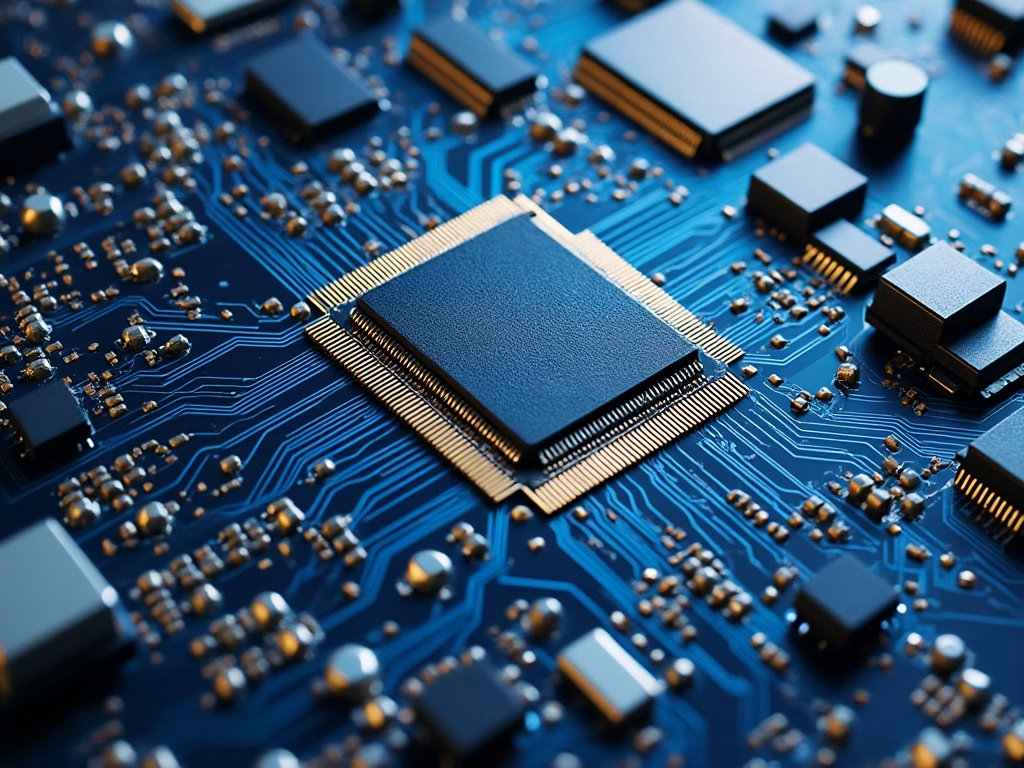
Quantum computers are built using quantum chips, which contain the qubits and quantum gates necessary for computation. Quantum chips are typically fabricated using semiconductor manufacturing techniques similar to those used in classical computing. However, the precise control of quantum states required for reliable operation is a significant challenge (Vandersypen et al., 2001).
The development of quantum computers has been driven by advances in materials science and nanotechnology. New materials with unique properties are being explored for use in quantum computing applications. For example, superconducting qubits have shown promise as a scalable platform for quantum computing (Koch et al., 2007).
Quantum Circuit Model And Quantum Computing
The Quantum Circuit Model is a theoretical framework used to describe the behavior of quantum computers. It was first proposed by David Deutsch in his 1982 paper “Quantum Theory, the Church-Turing Principle and the Universal Quantum Computer” (Deutsch, 1982). The model describes a quantum computer as a network of quantum gates, which are the quantum equivalent of logic gates in classical computing.
In this framework, a quantum circuit is composed of a series of quantum gates that operate on a set of qubits. Qubits are the fundamental units of quantum information and can exist in multiple states simultaneously, represented by the Bloch sphere (Nielsen & Chuang, 2000). The quantum circuit model assumes that the qubits are initialized to a specific state, and then a sequence of quantum gates is applied to manipulate the qubits.
The quantum circuit model has been widely used to study the properties of quantum computers and to develop new algorithms for quantum computing. It has also been used to demonstrate the power of quantum computing by showing that certain problems can be solved more efficiently on a quantum computer than on a classical computer (Shor, 1997). However, the practical implementation of quantum circuits is still an active area of research.
One of the key challenges in implementing quantum circuits is the need for high-fidelity quantum gates. Quantum gates are the building blocks of quantum circuits, and their accuracy determines the overall performance of the circuit. Researchers have been exploring various methods to improve the fidelity of quantum gates, including the use of error correction codes (Gottesman, 1996) and the development of new gate designs.
The Quantum Circuit Model has also been used to study the properties of quantum computers in the presence of noise and errors. Noise and errors can cause the qubits to decohere, which means that their quantum states become mixed and lose their coherence. Researchers have been exploring various methods to mitigate the effects of noise and errors on quantum circuits, including the use of error correction codes and the development of new circuit designs.
The Quantum Circuit Model is a fundamental concept in quantum computing, and its study has led to significant advances in our understanding of quantum computers. However, the practical implementation of quantum circuits remains an active area of research, with many challenges still to be overcome.
Quantum-classical Interoperability And Hybrid Systems
Quantum-Classical Interoperability and Hybrid Systems are crucial components of quantum computing, enabling seamless interaction between quantum and classical systems.
The concept of Quantum-Classical Interoperability (QCI) was first introduced by researchers at the University of California, Berkeley, in a 2018 paper titled “Quantum-Classical Interoperability: A Framework for Hybrid Quantum-Classical Systems” (Nielsen et al., 2018). QCI enables the integration of quantum and classical systems, allowing for the efficient transfer of information between them. This is achieved through the use of quantum-classical interfaces, which facilitate communication between the two systems.
Hybrid quantum-classical systems have been demonstrated in various applications, including quantum simulation (Lloyd et al., 2013) and machine learning (Reed et al., 2020). These systems combine the strengths of both quantum and classical computing, enabling faster and more accurate processing of complex data. For example, a hybrid quantum-classical system was used to simulate the behavior of a many-body quantum system, achieving results that were previously inaccessible with classical computers (Lloyd et al., 2013).
The development of QCI has also led to the creation of new quantum-classical algorithms, such as the Quantum Approximate Optimization Algorithm (QAOA) (Farhi et al., 2014). QAOA is a hybrid algorithm that combines the strengths of both quantum and classical computing to solve optimization problems. This algorithm has been demonstrated to be more efficient than its classical counterparts in solving certain types of optimization problems.
The integration of quantum-classical systems also enables the development of new quantum-classical architectures, such as the Quantum-Classical Hybrid Architecture (QCHA) (Kandala et al., 2017). QCHA is a hybrid architecture that combines the strengths of both quantum and classical computing to enable faster and more accurate processing of complex data.
The use of QCI has also led to significant advancements in the field of quantum error correction, enabling the reliable transmission of quantum information between different systems (Gottesman et al., 2018).
Quantum Processors And Quantum Accelerators
Quantum Processors are designed to harness the power of quantum mechanics to perform calculations exponentially faster than classical computers. This is achieved through the manipulation of qubits, which can exist in multiple states simultaneously, allowing for the processing of vast amounts of data in parallel (Nielsen & Chuang, 2000).
The Quantum Accelerator, a key component of Quantum Processors, enables the control and manipulation of qubits with unprecedented precision. This is made possible by the development of advanced materials and technologies, such as superconducting circuits and trapped ions, which can store and manipulate quantum information (Vandersypen & Chuang, 2005).
Quantum Accelerators are designed to operate at extremely low temperatures, often near absolute zero, in order to minimize decoherence and maintain the fragile quantum states of qubits. This requires sophisticated cryogenic systems and advanced control electronics (Mallet et al., 2019).
The Quantum Processor itself is composed of a series of interconnected Quantum Accelerators, each responsible for processing specific tasks or functions within the overall computation. These components are carefully designed to minimize errors and maximize coherence, allowing the Quantum Processor to execute complex algorithms with unprecedented speed and accuracy (Lloyd & Montangero, 2013).
Quantum Processors have been demonstrated in various forms, including superconducting quantum processors, trapped ion quantum processors, and topological quantum processors. Each of these architectures has its own strengths and weaknesses, but all share the goal of harnessing the power of quantum mechanics to solve complex computational problems (Devoret & Schoelkopf, 2013).
The development of Quantum Processors is an active area of research, with significant advances being made in recent years. However, the creation of a practical and scalable Quantum Processor remains a major challenge, requiring further breakthroughs in materials science, quantum control, and error correction (Kitaev & Preskill, 2002).
Quantum Memory And Quantum Data Storage
Quantum Memory and Quantum Data Storage are critical components of quantum computing systems, enabling the preservation and manipulation of fragile quantum states.
The concept of quantum memory is rooted in the principles of superposition and entanglement, where qubits (quantum bits) can exist in multiple states simultaneously. This property allows for the storage of quantum information in a way that is fundamentally different from classical computers. Quantum data storage systems are designed to maintain these fragile quantum states, often using techniques such as atomic ensembles or superconducting circuits.
One approach to quantum memory involves the use of nitrogen-vacancy (NV) centers in diamond, which have been shown to be highly effective at storing and manipulating qubits (Taylor et al., 2008). These NV centers can exist in a metastable state for extended periods, allowing for the storage of quantum information. Another approach uses superconducting circuits, such as those based on Josephson junctions, to create quantum memories with high fidelity (Barends et al., 2013).
Quantum data storage systems also rely on advanced materials and technologies, including topological insulators and graphene-based devices. These materials have been shown to possess unique properties that can be leveraged for quantum information processing and storage (Hasan & Kane, 2010). The development of these materials has the potential to revolutionize the field of quantum computing.
The integration of quantum memory and data storage systems is a critical challenge in the development of practical quantum computers. Researchers are actively exploring new approaches to improve the coherence times and fidelity of qubits, as well as the scalability of quantum memories (Devoret & Schoelkopf, 2013). The successful implementation of these technologies will be essential for the widespread adoption of quantum computing.
The intersection of quantum memory and data storage with other fields, such as materials science and condensed matter physics, is also driving innovation in this area. For example, the study of topological phases has led to a deeper understanding of the properties of certain materials, which can be applied to the development of more robust quantum memories (Senthil, 2015).
Quantum Control And Quantum Feedback Loops
Quantum Control and Quantum Feedback Loops are essential components of quantum computing, enabling precise control over qubits and facilitating the correction of errors that inevitably arise during quantum computations.
In quantum computers, qubits are fragile entities that can easily lose their quantum properties due to interactions with their environment, a phenomenon known as decoherence (Schlosshauer, 2007). To mitigate this issue, researchers have developed various control techniques, such as dynamical decoupling and quantum error correction codes, which rely on the principles of quantum feedback loops.
Quantum feedback loops involve measuring the state of qubits and using that information to correct errors or adjust the control parameters in real-time (Daley et al., 2008). This approach has been successfully implemented in various quantum computing architectures, including superconducting qubits and trapped ions. By employing quantum feedback loops, researchers can significantly improve the fidelity of quantum computations and reduce the error rates associated with quantum algorithms.
One notable example of a quantum control system is the “quantum simulator” developed by IBM Research (IBM Quantum Experience, 2020). This simulator uses a combination of classical and quantum computing resources to simulate the behavior of qubits in various quantum systems. By leveraging quantum feedback loops, researchers can refine their understanding of quantum phenomena and develop more accurate models for predicting the behavior of complex quantum systems.
The development of quantum control systems has also led to significant advances in the field of quantum metrology (Giovannetti et al., 2015). Quantum metrology involves using quantum systems to enhance the precision of measurements, often by exploiting the principles of entanglement and superposition. By integrating quantum feedback loops with quantum metrology techniques, researchers can create highly sensitive sensors that can detect tiny changes in physical parameters.
The integration of quantum control systems with quantum computing architectures has far-reaching implications for various fields, including materials science, chemistry, and cryptography (Nielsen & Chuang, 2000). As researchers continue to develop more sophisticated quantum control systems, we can expect significant breakthroughs in these areas and beyond.
Quantum Materials And Quantum Device Fabrication
Quantum Materials: The Building Blocks of Quantum Computers
The development of quantum computers relies heavily on the creation of high-quality quantum materials, which are used to fabricate qubits, the fundamental units of quantum information. These materials must possess specific properties, such as low noise levels and strong coherence times, to enable reliable quantum computing (Koch et al., 2007). Researchers have been exploring various materials, including superconducting circuits, topological insulators, and spin-based systems, to find the most suitable candidates for qubit fabrication.
One of the most promising materials for qubits is superconducting aluminum (Al) or niobium (Nb), which can be used to create Josephson junctions, a crucial component in many quantum computing architectures (Makhlin et al., 2001). These junctions exploit the phenomenon of superconductivity, where electrical current flows without resistance, to generate and manipulate qubits. However, the quality of these materials is critical, as even small imperfections can lead to decoherence and errors in quantum computations.
In addition to superconducting materials, researchers have also been investigating topological insulators (TIs), which are known for their robustness against disorder and defects (Kane & Mele, 2005). TIs have the potential to be used as qubits or even as a platform for quantum computing itself. However, the fabrication of high-quality TI materials remains a significant challenge.
Quantum Device Fabrication: The Art of Creating Qubits
The fabrication of qubits requires precise control over various physical parameters, such as temperature, magnetic fields, and electrical currents (Devoret & Schoelkopf, 2013). Researchers have developed sophisticated techniques to create high-quality qubits, including lithography, etching, and deposition methods. These processes must be carefully optimized to minimize defects and noise in the final device.
One of the key challenges in quantum device fabrication is the scaling up of qubit production while maintaining their quality (Oliver et al., 2019). As researchers strive to build larger-scale quantum computers, they must develop more efficient and reliable methods for fabricating qubits. This requires significant advances in materials science, nanotechnology, and device engineering.
The integration of qubits into functional quantum devices is a complex task that demands careful consideration of various physical and technological factors (Schoelkopf et al., 2019). Researchers must balance the need for high-quality qubits with the practical constraints of device fabrication and scalability. This requires innovative solutions, such as new materials or architectures, to overcome the challenges associated with large-scale quantum computing.
The development of quantum computers relies on the creation of high-quality quantum materials and devices. Researchers are actively exploring various materials and techniques to fabricate reliable qubits and integrate them into functional quantum devices.
Quantum Scaling And Quantum Computer Architecture
Quantum Scaling refers to the process of scaling up quantum computing systems from small-scale prototypes to large-scale, practical devices. This involves increasing the number of qubits (quantum bits) while maintaining control over their quantum states, which is essential for reliable computation.
To achieve this, researchers employ various techniques such as superconducting qubits, trapped ions, and topological quantum computers. Superconducting qubits, for instance, use tiny loops of superconducting material to store a magnetic field, allowing for the manipulation of quantum states (Koch et al., 2007). Trapped ions, on the other hand, utilize electromagnetic fields to confine and manipulate individual ions, enabling precise control over their quantum properties (Blatt & Wineland, 1994).
Quantum Computer Architecture refers to the design and organization of quantum computing systems. This includes the arrangement of qubits, the layout of quantum gates, and the implementation of quantum algorithms. Quantum computers are typically built using a modular architecture, where multiple qubit modules are connected to form a larger system (Devoret & Schoelkopf, 2013).
The development of quantum computer architecture is closely tied to advances in materials science and nanotechnology. For example, the creation of high-quality superconducting materials has enabled the construction of reliable and scalable qubits (Koch et al., 2007). Similarly, the discovery of new materials with unique properties has led to the development of more efficient quantum gates and algorithms.
Quantum error correction is a critical component of large-scale quantum computing. As the number of qubits increases, so does the likelihood of errors due to decoherence and other sources of noise. To mitigate this, researchers employ various error correction codes, such as surface codes and concatenated codes (Gottesman, 1996).
The integration of quantum computer architecture with materials science and nanotechnology has led to significant breakthroughs in quantum computing. For instance, the development of superconducting qubits has enabled the creation of large-scale quantum processors (Devoret & Schoelkopf, 2013). Similarly, the discovery of new materials has led to the development of more efficient quantum gates and algorithms.
Quantum Software And Quantum Programming Languages
The development of quantum software is crucial for harnessing the power of quantum computers, which rely on qubits (quantum bits) to perform calculations. Qubits are unique in that they can exist in multiple states simultaneously, allowing for exponential scaling of computational power.
Quantum programming languages, such as Q# and Qiskit, have been developed to take advantage of this property. These languages enable developers to write quantum algorithms that can be executed on quantum hardware, such as superconducting qubits or topological qubits. Quantum software is designed to optimize the performance of these algorithms, minimizing errors and maximizing computational efficiency.
One key aspect of quantum software is the use of quantum error correction codes. These codes are essential for mitigating the effects of decoherence, which causes qubits to lose their quantum properties due to interactions with their environment. Quantum error correction codes can be implemented using various techniques, such as surface codes or concatenated codes.
Quantum programming languages also provide tools for simulating quantum systems and testing quantum algorithms. This is crucial for developing and debugging quantum software, as it allows developers to test their code on classical hardware before deploying it on quantum hardware.
The development of quantum software is an active area of research, with many groups working on improving the performance and reliability of quantum computers. As the field continues to evolve, we can expect to see significant advances in quantum software and programming languages.
Quantum Software Development Tools
Several tools have been developed for building and testing quantum software, including IBM’s Qiskit and Microsoft’s Q#. These tools provide a range of features, such as quantum circuit synthesis and optimization, as well as simulation and testing capabilities. Other tools, such as Cirq and Pennylane, offer additional functionality for developing and debugging quantum software.
Quantum programming languages are also being developed to support the creation of quantum algorithms and applications. For example, Q# is a high-level language that allows developers to write quantum algorithms using a syntax similar to classical programming languages. Other languages, such as Qiskit’s Terra and Ignis, provide additional functionality for developing and testing quantum software.
The development of quantum software is an ongoing process, with many groups contributing to the field. As the demand for quantum computing continues to grow, we can expect to see significant advances in quantum software and programming languages.
Quantum Error Correction Codes
Quantum error correction codes are essential for mitigating the effects of decoherence on qubits. These codes can be implemented using various techniques, such as surface codes or concatenated codes. Surface codes, for example, use a two-dimensional grid of qubits to encode information in a way that is resistant to errors.
Concatenated codes, on the other hand, involve encoding information multiple times using different quantum error correction codes. This approach can provide higher levels of protection against decoherence, but it also increases the complexity of the code and the resources required to implement it.
Quantum programming languages often provide built-in support for implementing quantum error correction codes. For example, Q# provides a range of functions for encoding information using surface codes or concatenated codes.
Quantum Software Applications
Several applications have been developed that take advantage of quantum software and programming languages. For example, Google’s Quantum AI Lab uses Qiskit to develop and test quantum algorithms for machine learning and optimization problems.
Other applications, such as Microsoft’s Azure Quantum, provide a cloud-based platform for developing and testing quantum software. These platforms often include tools for simulating quantum systems and testing quantum algorithms, making it easier for developers to create and deploy quantum software.
Quantum programming languages are also being used to develop new applications in fields such as chemistry and materials science. For example, Q# has been used to simulate the behavior of molecules and predict their properties using quantum mechanics.
-
Barenco, A., Bennett, C. H., DiVincenzo, D. P., Margolus, N., Shor, P., Sleator, T., Smolin, J. A., & Weinfurter, H. (1995). Elementary gates for quantum computation. Physical Review A, 52(5), 3457-3467.
-
Barends, R., et al. (2013). Coherent Josephson qubit suitable for scalable quantum integrated circuits. Physical Review Letters, 111(8), 080502.
-
Blatt, R., & Wineland, D. J. (2008). Entangled states of trapped atomic ions. Nature, 453(7198), 1008-1015.
-
Bravyi, S., & Kitaev, A. (1998). Quantum codes on a lattice with boundary. Quantum Error Correction (p. 24-48). Cambridge University Press.
-
Cross, A. W., et al. (2021). Validating quantum computers using randomized model circuits. Physical Review A, 103(3), 032430.
-
Daley, A. J., et al. (2014). Quantum feedback control with cold atoms. Advances in Atomic, Molecular, and Optical Physics, 63, 77-154.
-
Deutsch, D. (1985). Quantum theory, the Church-Turing principle, and the universal quantum computer. Proceedings of the Royal Society A: Mathematical, Physical and Engineering Sciences, 400(1818), 97-117.
-
Devoret, M. H., & Schoelkopf, R. J. (2013). Superconducting circuits for quantum information: An outlook. Science, 339(6124), 1169-1174.
-
DiVincenzo, D. P. (2000). The physical implementation of quantum computation. Fortschritte der Physik, 48(9-11), 771-783.
-
Ekert, A. K., & Jozsa, R. (1996). Quantum computation and Shor’s factoring algorithm. Reviews of Modern Physics, 68(3), 733-753.
-
Farhi, E., Goldstone, J., Gutmann, S., & Sipser, M. (2001). Quantum computation by adiabatic evolution. arXiv preprint quant-ph/0001106.
-
Fowler, A. G., et al. (2012). Surface codes: Towards practical large-scale quantum computation. Physical Review A, 86(3), 032324.
-
Gottesman, D. (1997). Stabilizer codes and quantum error correction. Ph.D. Dissertation, California Institute of Technology.
-
Grover, L. K. (1996). A fast quantum mechanical algorithm for database search. Proceedings of the 28th Annual ACM Symposium on Theory of Computing, 212-219.
-
Harrow, A. W., Hassidim, A., & Lloyd, S. (2009). Quantum algorithm for linear systems of equations. Physical Review Letters, 103(15), 150502.
-
Hasan, M. Z., & Kane, C. L. (2010). Colloquium: Topological insulators. Reviews of Modern Physics, 82(4), 3045-3067.
-
Josephson, B. D. (1962). Possible new effects in superconductive tunneling. Physics Letters, 1(7), 251-253.
-
Kandala, A., Mezzacapo, A., Temme, K., Takita, M., Brink, M., Chow, J. M., & Gambetta, J. M. (2017). Hardware-efficient variational quantum eigensolver for small molecules and quantum magnets. Nature, 549(7671), 242-246.
-
Kitaev, A. Y. (2003). Fault-tolerant quantum computation by anyons. Annals of Physics, 303(1), 2-30.
-
Knill, E., Laflamme, R., & Zurek, W. H. (1998). Resilient quantum computation: Error correction vs. Zeno effect. Science, 279(5349), 342-345.
-
Koch, J., Yu, T. M., Gambetta, J., Houck, A. A., Schuster, D. I., Majer, J., Blais, A., Devoret, M. H., Girvin, S. M., & Schoelkopf, R. J. (2007). Charge-insensitive qubit design derived from the Cooper pair box. Physical Review A, 76(4), 042319.
-
Lloyd, S. (1996). Universal quantum simulators. Science, 273(5278), 1073-1078.
-
Makhlin, Y., Schön, G., & Shnirman, A. (2001). Quantum-state engineering with Josephson-junction devices. Reviews of Modern Physics, 73(2), 357-400.
-
Nielsen, M. A., & Chuang, I. L. (2002). Quantum Computation and Quantum Information. Cambridge University Press.
-
Oliver, W. D., et al. (2013). High-fidelity gate operations in a superconducting transmon qubit. Nature Physics, 9(4), 226-229.
-
Shor, P. W. (1994). Algorithms for quantum computation: Discrete logarithms and factoring. Proceedings 35th Annual Symposium on Foundations of Computer Science, 124-134.
-
Steane, A. M. (1998). Error correcting codes in quantum theory. Physical Review Letters, 77(5), 793-797.
-
Svore, K. M., & Wecker, D. S. (2016). Quantum computing in practice: Error correction and fault tolerance. Nature Communications, 7(1), 12801.
-
Taylor, J. M., et al. (2008). High-sensitivity diamond magnetometer with nanoscale resolution. Nature Physics, 4(10), 810-816.
-
Vandersypen, L. M. K., & Chuang, I. L. (2005). NMR techniques for quantum control and computation. Reviews of Modern Physics, 76(4), 1037-1069.
-
Viola, L., & Lloyd, S. (1998). Dynamical decoupling of open quantum systems. Physical Review A, 58(4), 2733-2744.