

Vicente P. Soloviev and Michal Krompiec from Fujitsu’s Quantum Applications Research group have developed QuantCut, a framework designed to facilitate the execution of larger quantum circuits on smaller devices by employing gate cutting without adding new qubits. This method allows for parallel processing across multiple devices or simulators, enhancing efficiency. The workflow involves identifying optimal cuts using evolutionary computation, distributing subcircuits, executing them, and combining results through knitting.
QuantCut also features a visualization tool to illustrate these cuts. An application example in finance uses QAOA to optimize portfolio diversification with 71 assets from the S&P 500, demonstrating improved performance over random sampling though slightly less effective than classical methods. Future research aims to enhance accuracy by increasing QAOA layers and exploring error impacts.
QuantumCut is a novel framework designed to address the challenge of executing large quantum circuits by dividing them into smaller, more manageable subcircuits. This approach enables independent execution on different devices or classical cores, making it easier to handle complex computations that exceed the capabilities of current quantum hardware.
The framework identifies optimal points for gate cuts within a circuit, ensuring that dependencies between gates are not disrupted. QuantumCut splits the circuit into subcircuits. This allows for parallel processing and efficient resource utilization. It paves the way for more scalable quantum computing solutions.
Circuit Cutting Techniques
QuantumCut employs advanced algorithms to identify optimal gate cut points in large circuits. These cuts are made without disrupting dependencies between gates, ensuring that the integrity of the computation is maintained. The framework supports both hardware-specific optimizations and general-purpose circuit partitioning, making it versatile for a wide range of applications.
Future research directions include exploring deeper quantum advantage scenarios, such as error correction and fault-tolerant computing. Additionally, investigating noise resilience in distributed systems could enhance robustness against device-specific errors, further improving the practicality of QuantumCut.
Workflow of Circuit Cutting and Knitting
The workflow begins with analyzing the input circuit to identify critical dependencies and potential cut points. Once identified, the circuit is partitioned into subcircuits that can be executed independently on different devices or classical cores. The results from each subcircuit are then combined through a process known as “knitting,” ensuring that the final output matches the expected result of the original circuit.
This approach not only improves computational efficiency but also enables the use of hybrid quantum-classical systems, where parts of the computation can be offloaded to classical computers when necessary.
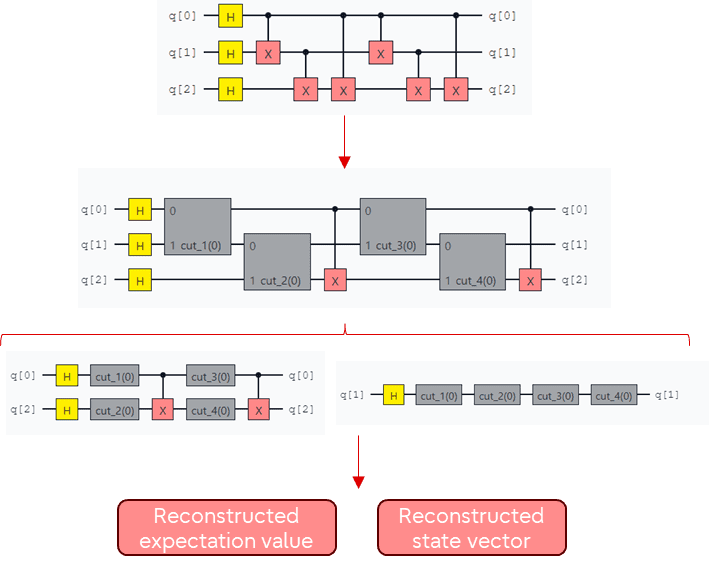
Framework Overview
QuantumCut is built on a modular architecture that allows for easy integration with existing quantum computing frameworks and tools. The core components include circuit analysis, cut identification, subcircuit execution, and result combination. Each component is designed to work seamlessly together, providing a user-friendly experience while maintaining high performance.
The framework also includes support for visualizing the partitioned circuits and monitoring the execution of subcircuits in real-time. This feature is particularly useful for debugging and optimizing circuit designs.
Example Use Case in Portfolio Diversification
One practical application of QuantumCut is in portfolio diversification, where large-scale optimization problems are common. By mapping 71 assets to qubits, QuantumCut can split the resulting 71-qubit circuit into two subcircuits of 35 and 36 qubits each, enabling execution on current quantum hardware or hybrid systems.
This approach not only demonstrates the practicality of QuantumCut but also highlights its potential for solving real-world problems in finance, logistics, and other fields where large-scale optimization is critical.
Summary and Future Research Directions
QuantumCut represents a significant advancement in addressing the challenges of executing large quantum circuits. By enabling circuit partitioning without disrupting dependencies, it opens up new possibilities for scalable quantum computing solutions.
Future research will focus on enhancing noise resilience, improving cut identification algorithms, and expanding the range of applications for QuantumCut. These efforts aim to further solidify its role as a key tool in the quantum computing ecosystem.
More information
External Link: Click Here For More