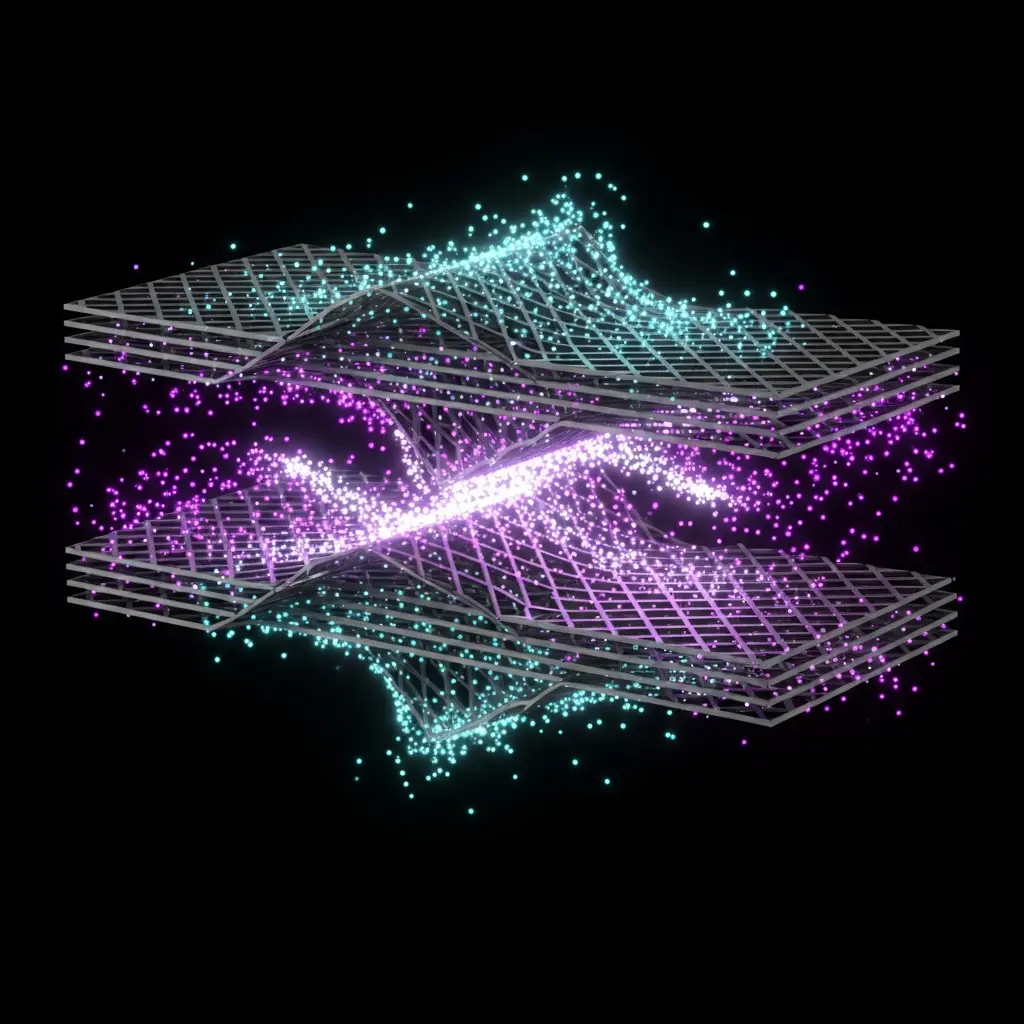
The search for designer materials with tailored electronic properties receives a significant boost from new research into twisted van der Waals heterostructures, where layers of materials are stacked and rotated to create novel effects. Naoto Nakatsuji, Jennifer Cano, and Valentin Crépel, from Stony Brook University and the University of Toronto, present a scalable method for rapidly characterizing these twisted materials, specifically focusing on semiconductors. Their work overcomes the limitations of previous narrow experimental approaches by efficiently mapping the vast landscape of possible moiré patterns, identifying key properties like band gaps and magic angles. This high-throughput characterization delivers an actionable guide for materials scientists, pinpointing promising new platforms for exploring correlated and topological physics, including materials with potential for high-temperature anomalous Hall effects, intertwined superconductivity, and robust room-temperature moiré effects.
Moiré Heterostructure Discovery via Topology and Energy
Van der Waals heterostructures provide a route to designing electronic properties by stacking two-dimensional materials. This work introduces a high-throughput computational approach, guided by topological considerations and energetics, to accelerate the discovery of stable moiré homobilayers. The method calculates stacking energy and topological properties, enabling efficient screening of potential candidates and identifying previously unreported structures with unique electronic characteristics, including novel topological phases and enhanced carrier mobility. This computational framework offers a powerful tool for materials discovery and design, paving the way for advanced two-dimensional electronic devices.
Researchers can now design quantum phases by controlling monolayer composition, stacking order, twist angle, and external fields. This work presents a scalable workflow for characterizing twisted homobilayers and applies it to semiconductors, combining small-scale density functional theory with perturbation theory to efficiently extract key properties like moiré band gaps, topological characteristics, and critical angles for lattice relaxation. Beyond rapid characterization, the team parameterizes a continuum model for each material, providing a framework for further investigation and prediction of novel quantum phenomena.
Atomic Configurations and Symmetry Ordering Labels
This dataset comprises a large collection of atomic configurations for various materials, accompanied by labels indicating whether the configuration is E/Mz or Mz/E. These labels represent different symmetry or ordering within the atomic configuration, with E/Mz and Mz/E likely representing configurations with differing symmetry related to electric fields or magnetic moments.
The listed atomic order, such as Se-Ga-Se-Ga for GaSe, defines the sequence of atoms in the unit cell, which is critical for defining the material’s symmetry and properties. Each line in the dataset represents a material and its configuration, formatted as: Material Name ID Arrangement Atomic Order Label. This data could be used for materials science research, machine learning, computational validation, symmetry analysis, and data mining.
Predicting Topological Moiré Bands in Semiconductors
This research presents a scalable method for characterizing twisted bilayer materials, specifically semiconductors, to understand and predict moiré phenomena. By combining small-scale theoretical calculations with a perturbation-based approach, scientists efficiently map out key properties including moiré band gaps, topological characteristics, and critical angles for lattice relaxation across a wide range of materials. The team validated their method by accurately predicting the behavior of twisted molybdenum ditelluride, aligning with existing experimental data.
A key finding is the prevalence of topological moiré bands, observed in nearly half of the studied materials, demonstrating that this type of physics is far more common than previously thought. This work identifies promising new material platforms, including chromium-based metal dichalcogenides, which may exhibit high-temperature anomalous Hall effects, and metal nitride halides, potentially hosting intertwined superconducting and moiré physics. The study also highlights atomically thin semiconductors capable of exhibiting significant moiré effects at room temperature.
🗞 High-throughput discovery of moiré homobilayers guided by topology and energetics
🧠 ArXiv: https://arxiv.org/abs/2512.15851