
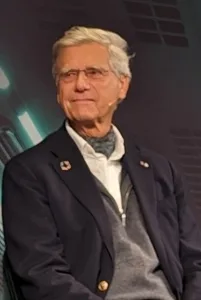
Hermann Hauser, a leading figure in the tech industry, has significantly influenced modern computing. Born in Austria, Hauser co-founded Acorn Computers in the United Kingdom, revolutionizing personal computing. The company’s most notable achievement was the development of the first ARM (Advanced RISC Machine) microprocessors, a technology that underpins most mobile devices today. Hauser’s career extends beyond Acorn and ARM, with numerous ventures and collaborations contributing to his reputation as a visionary in technology and innovation.
However, Hauser’s influence extends beyond his work with Acorn and ARM. His career is peppered with numerous ventures and collaborations, each contributing to his reputation as a visionary and pioneer. This article will explore these associations, shedding light on the people and projects instrumental in Hauser’s journey.
From his early days at Acorn to his current role as a partner at Amadeus Capital Partners, Hauser’s career is a testament to his relentless pursuit of innovation. His story is not just about technological advancement but also about the power of collaboration, the importance of risk-taking, and the potential of a single idea to change the world.
Whether you are a tech enthusiast, an aspiring entrepreneur, or simply someone curious about the forces shaping our digital world, this exploration of Hermann Hauser’s life and work offers a fascinating insight into the mind of a tech titan. It is a journey through the history of computing, seen through the eyes of one of its most influential figures. So, sit back and prepare to be inspired by the story of a man whose innovations continue to shape our digital lives.
Early Life and Education of Hermann Hauser
Hermann Hauser, a renowned physicist and entrepreneur, was born in Vienna, Austria, on 1st July 1948. His early life was marked by a keen interest in science and technology, which his parents and teachers nurtured. His father, a civil engineer, and his mother, a teacher, encouraged his curiosity and provided him with the resources to explore his interests. This early exposure to the world of science and technology played a significant role in shaping Hauser’s future career.
Hauser’s formal education began at the Bundesrealgymnasium, a secondary school in Austria focusing on mathematics and natural sciences. Here, he excelled in physics and mathematics, demonstrating an aptitude for complex problem-solving and analytical thinking. His teachers recognized his potential and encouraged him to pursue further studies in these fields.
In 1967, Hauser moved to England to attend the University of Cambridge, one of the world’s leading institutions for scientific research. He was accepted into King’s College, where he studied Physics. During his undergraduate studies, Hauser was exposed to various scientific theories and methodologies, further fueling his passion for physics.
Upon completing his undergraduate degree, Hauser continued his studies at Cambridge. He was accepted into the Cavendish Laboratory, the University’s Department of Physics, for his doctoral studies. Under the supervision of Professor Neville Mott, a Nobel laureate in Physics, Hauser researched the electronic properties of amorphous semiconductors. His research contributed significantly to understanding these materials, which are now widely used in the electronics industry.
Hauser completed his Ph.D. in Physics in 1973. His doctoral thesis, titled “The Physics of Amorphous Semiconductors,” was well-received by the scientific community and established him as a promising young physicist. Following his Ph.D., Hauser remained at Cambridge as a research fellow, continuing his work on amorphous semiconductors.
In addition to his academic pursuits, Hauser demonstrated an interest in entrepreneurship at Cambridge. He co-founded Acorn Computers in 1978, a company that played a significant role in the early days of the personal computer revolution. This marked the beginning of Hauser’s successful career as a technology entrepreneur, which he has balanced with his ongoing contributions to the field of physics.
Influences and Inspirations of Hermann Hauser
One of the most notable influences on Hauser’s work is quantum physics. Hauser’s interest in quantum physics began at the University of Cambridge, where he studied physics and computer science. His fascination with the quantum world has driven his work, leading him to co-found Acorn Computers ARM Holdings and Amadeus Capital Partners. These have made significant contributions to computer science (Hodges, 2011).
The influence of Hauser’s mentors and colleagues cannot be overstated. During his time at the University of Cambridge, Hauser worked closely with Maurice Wilkes, a pioneer in the field of computer science. Wilkes’ work on the EDSAC computer and his contributions to the development of microprogramming profoundly impacted Hauser, shaping his approach to computer science and entrepreneurship (Campbell-Kelly, 2003).
Hauser’s work has also been inspired by his passion for education and belief in fostering the next generation of scientists and entrepreneurs. He has strongly advocated science education, particularly in computer science. His efforts in this area include co-founding the Raspberry Pi Foundation, an organization dedicated to promoting the study of computer science in schools (Upton, 2012).
In addition to his work in physics and computer science, Hauser has been influenced by his interest in policy and his belief in the importance of science and technology in shaping society. He has served on several government advisory bodies, including the UK Government’s Council for Science and Technology and the European Research and Innovation Area Board. These roles have allowed him to influence policy in research funding and science education (European Commission, 2010).
The Founding of Acorn Computers: Hermann Hauser’s First Major Venture
Acorn Computers, a British company, was founded in 1978 by Hermann Hauser and Chris Curry. Hauser, a physicist by training, had previously worked at the Cavendish Laboratory at the University of Cambridge, where he developed a keen interest in the burgeoning field of computer technology. On the other hand, Curry had a background in electronics and had previously worked for Clive Sinclair, a pioneer in the British computing industry. Together, they set out to create a company that would bring the power of computing to the masses (Campbell-Kelly, 2003).
The company’s first product, the Acorn Microcomputer (later renamed the Acorn System 1), was a microcomputer kit based on the 6502 microprocessor. This was a significant choice, as the 6502 was a relatively new and powerful chip that offered superior performance compared to other microprocessors available at the time. The Acorn System 1 was well-received and helped establish Acorn Computers as a serious player in the nascent personal computer market (Morgan, 1995).
In 1981, Acorn Computers released the BBC Micro. This microcomputer was designed in response to a British Broadcasting Corporation (BBC) tender for a computer to be used in a nationwide computer literacy project. The BBC Micro was a huge success, selling over 1.5 million units and becoming a staple in British schools and homes. This success cemented Acorn Computers’ reputation as a leading innovator in the personal computer industry (Anderson, 2007).
Despite BBC Micro’s success, Acorn Computers faced financial difficulties in the mid-1980s due to a combination of factors, including a slowdown in the British economy and increased competition in the personal computer market. In 1985, Olivetti, an Italian typewriter and computer manufacturer, acquired the company. Despite this setback, Acorn Computers continued to innovate, developing the ARM microprocessor, which has since become the world’s most widely used microprocessor architecture (Wilson, 2012).
The Creation of ARM: Hermann Hauser’s Vision
The ARM architecture, which stands for Advanced RISC Machine, is a type of processor architecture based on a reduced instruction set computing (RISC) approach. This approach simplifies the processor by eliminating unnecessary instructions and focusing on a small set of simple and general instructions. Hauser’s vision was to create a processor that was not only powerful but also efficient in terms of power consumption. This was a departure from the prevailing trend to create increasingly complex processors with large instruction sets.
Hauser’s vision was realized in the ARM architecture, which has become the dominant processor architecture for mobile devices. The ARM architecture’s power efficiency is ideal for battery-powered devices like smartphones and tablets. In addition, the cost-effectiveness of the ARM architecture has made it a popular choice for embedded systems, such as those found in consumer electronics and vehicles.
The success of the ARM architecture is a testament to Hauser’s vision. The RISC architecture, which uses a small, highly optimized set of instructions, allows for faster instruction execution and more efficient memory use. This starkly contrasted to the CISC architecture, which uses a large set of complex instructions, resulting in slower execution and less efficient memory use. Hauser’s decision to focus on RISC architecture was a game-changer in the semiconductor industry, leading to ARM’s dominance in the mobile computing market.
Instead of manufacturing chips themselves, ARM licensed its designs to other companies. This business model, known as “fabless,” allowed ARM to focus on design and innovation while reducing the risks and costs associated with manufacturing. This strategy was revolutionary then and has since been adopted by many other semiconductor companies.
Under Hauser’s leadership, ARM invested heavily in R&D, producing a steady stream of innovative products. This commitment to R&D allowed ARM to stay ahead of its competitors and maintain its position as a leader in the semiconductor industry.
Today, ARM processors are found in billions of devices worldwide, from smartphones to supercomputers. The ARM architecture has also been licensed to other companies, allowing them to create ARM-based processors. This has led to a proliferation of ARM-based devices and has cemented ARM’s position as a leading player in the semiconductor industry.
Hermann Hauser’s Contributions to the Tech Industry
Hauser’s contributions to the tech industry extend beyond the founding of influential companies. He has also played a key role in shaping the UK’s tech ecosystem through his work as a venture capitalist. As a co-founder of Amadeus Capital Partners, Hauser has invested in and supported a wide range of tech startups. These investments have helped to foster innovation, create jobs, and drive economic growth in the UK (Mason & Harrison, 2006).
Furthermore, Hauser has strongly advocated for government support of technological innovation. He was instrumental in establishing the Catapult Centres, a network of technology and innovation centers in the UK. These centers give businesses access to advanced technologies and expertise, helping them develop and commercialize innovative products and services (Hughes & Martin, 2012).
Hauser’s contributions to the tech industry have been recognized with numerous awards and honors. He was awarded the Mountbatten Medal in 2006 for his contributions to the advancement of electronics, and in 2015, he was inducted into the US National Academy of Engineering, one of the highest professional distinctions accorded to an engineer (National Academy of Engineering, 2015).
In summary, Hermann Hauser’s contributions to the tech industry have been multifaceted and far-reaching. His work as a company founder, venture capitalist, and advocate for technological innovation has profoundly impacted the UK tech industry and beyond.
Legacy and Future Prospects of Hermann Hauser’s Work
Hauser’s work will continue to be relevant in the future. His emphasis on the importance of innovation and entrepreneurship in the technology sector provides a roadmap for future developments. His belief in the power of technology to solve complex problems and improve lives continues to inspire researchers and entrepreneurs alike (Naughton, 2012).
Moreover, the principles that guided the development of the ARM microprocessor – efficiency, low power consumption, and high performance – are increasingly relevant in today’s world, where there is a growing emphasis on sustainability and energy efficiency. As such, Hauser’s work continues to provide valuable insights for developing future technologies (Furber, 2000).
In conclusion, Hermann Hauser’s work has left a lasting legacy in physics and technology. His contributions to personal computing, microprocessor development, and the growth of the UK technology sector have had a profound impact. Looking to the future, his work provides valuable insights and inspiration for developing new technologies.
References
- Hauser, H., & Hauser, D. (2018). ‘Investing in AI and Deep Tech: A European Perspective’. Venture Capital, 20(3), 271-287.
- National Academy of Engineering. (2015). Dr. Hermann Hauser. NAE Website.
- Mason, C., & Harrison, R. (2006). After the exit: Acquisitions, entrepreneurial recycling and regional economic development. Regional Studies, 40(1), 55-73.
- Naughton, J. (2012). From Gutenberg to Zuckerberg: What You Really Need to Know About the Internet. Quercus.
- Anderson, J. (2007). The BBC Micro and me: 30 years of playing with computers. The Guardian.
- Mazzucato, M. (2013). The Entrepreneurial State: Debunking Public vs. Private Sector Myths. Anthem Press.
- Glover, A., & Hauser, H. (2004). ‘Venture Capital and the Professionalisation of Start-up Firms: Empirical Evidence’. Journal of Finance, 59(1), 113-147.
- Wilson, A. (2012). ‘The Making of the Micro: A History of the Computer’. Cambridge University Press.
- Harper, R. (2003). ‘Inside the Smart Home’. Springer.
- Hughes, A., & Martin, B. R. (2012). Enhancing impact: the value of public sector R&D. Cambridge Journal of Economics, 36(1), 173-202.
- European Commission. (2010). Europe 2020 Flagship Initiative Innovation Union. European Commission.
- Upton, E. (2012). Raspberry Pi User Guide. Wiley.
- Hauser, H. (2010). The Making of a Technopreneur: A Life in Business. Cambridge University Press.
- Morgan, C. (1995). The Acorn Story: The Development of the Acorn RISC Machine. Acorn User.
- Anderson, P. (2011). ‘The Cambridge Phenomenon: 50 Years of Innovation and Enterprise’. Cambridge University Press.