

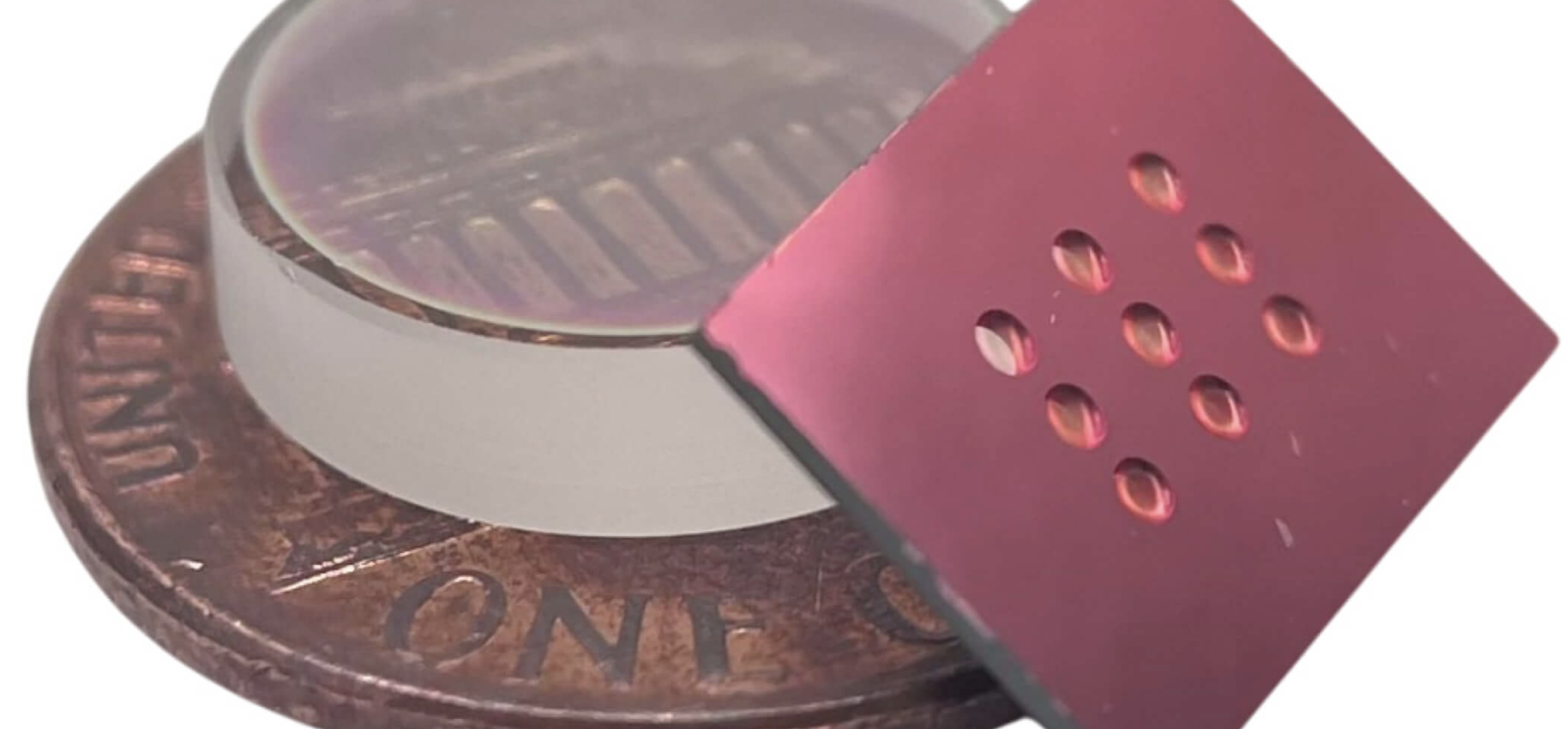
Researchers at the Harvard John A. Paulson School of Engineering and Applied Sciences (SEAS) and the Faculty of Arts and Sciences have developed a novel method for fabricating some of the smallest, smoothest mirrors ever created. The team, led by Marko Lončar, Mikhail Lukin, and Kiyoul Yang, published their findings in Optica on February 17, 2026, detailing a technique that harnesses silicon and mechanical stress to produce high-performance optical resonators. These microscopic mirrors could become crucial components in future quantum networks, integrated lasers, and environmental sensing equipment. “We needed these high-quality photonic interfaces to create efficient ways to have single photons interact with single atoms, allowing for fast, high-fidelity quantum networking,” said Brandon Grinkemeyer, a postdoctoral researcher in the Lukin lab. This breakthrough addresses the need for smaller, lower-loss optical cavities essential for increasingly complex quantum applications.
Silicon Buckling Creates Ultra-Smooth Microscopic Mirrors
A new fabrication technique is yielding microscopic mirrors with unprecedented smoothness, potentially revolutionizing fields reliant on precise light control. Researchers at the Harvard John A. These aren’t merely smaller versions of existing technology; the team demonstrated resonators achieving a record “finesse” of 0.9 million at a wavelength of 780 nanometers, allowing light to bounce nearly a million times before dissipating. The innovation addresses a critical bottleneck in quantum technology, where signal loss in optical cavities has limited progress. Led by former graduate student Sophie Ding, the process begins with a silicon wafer and utilizes thermal oxidation to create an initial smooth surface. A precisely engineered stack of transparent oxide layers, a dielectric mirror coating, is then deposited. Etching a hole through the back releases this coating, causing it to buckle due to inherent mechanical stress, naturally forming a high-quality mirror. “In microfabrication, we are sometimes confined by the thought that surface roughness is defined by the etch or the mask, and we try very hard to optimize them,” Ding said. “But when we are using the properties of the materials, we can do a lot less of that and have more robust results.”
This scalable method allows for control over the mirror’s curvature and reflected wavelengths, opening doors for applications beyond quantum computing, including ultra-compact lasers and spectroscopic sensors. federal agencies, promises to advance modular quantum computing and integrated photonics.
Researchers at Harvard University have achieved a significant leap in optical resonator technology, crafting microscopic mirrors with unprecedented smoothness. This innovation addresses the growing demand for smaller, more efficient optical cavities crucial for advancements in quantum technologies and beyond. Optical resonators function similarly to guitar strings for light, selectively amplifying specific wavelengths, and are already integral to devices like lasers and precision instruments. However, increasingly sophisticated quantum applications require these cavities to be dramatically reduced in size while simultaneously minimizing signal loss. The Harvard team’s approach, spearheaded by Sophie Ding, centers on leveraging the inherent properties of silicon and carefully applied mechanical stress. Etching a hole through the wafer allows the coating to buckle into a curved, high-quality mirror shape.
This achievement surpasses previous limitations in signal loss, a persistent challenge in building practical quantum systems. By etching a hole through a silicon wafer, the coating buckles into a precisely curved mirror shape, eliminating the need for complex polishing or etching methods. Harvard researchers have achieved a significant advance in quantum technology by developing a scalable method for fabricating ultra-smooth, microscopic mirrors essential for building quantum networks. The fabrication process begins with a silicon wafer, leveraging the material’s properties and utilizing a unique approach to achieve mirror curvature. Beyond quantum computing, this versatile technique holds promise for applications ranging from compact lasers to advanced spectroscopic sensors.


