The application of machine learning (ML) techniques in multimodal biomedical data analysis has significantly advanced our understanding of biological systems. However, there is a lack of a comprehensive taxonomy to guide the process. A robust framework categorizing diverse ML architectures and offering insights into their advantages and limitations is needed.
This framework would aid in informed decision-making within the complex realm of biomedical and clinical data analysis, crucial for advancing personalized medicine. The article also discusses the dual process of representation and integration in harmonization, the impact of technological advances on biomedical data, and the promising future of multimodal integration in biomedical research.
What is the Importance of Harmonisation Methods for Multimodal Biomedical Data?
The application of machine learning (ML) techniques in classification and prediction tasks has significantly advanced our understanding of biological systems. There is a growing trend towards integration methods that specifically target the simultaneous analysis of multiple modes or types of data, showcasing superior results compared to individual analyses. Despite the availability of diverse ML architectures for researchers interested in adopting a multimodal approach, the current literature lacks a comprehensive taxonomy that includes the pros and cons of these methods to guide the entire process.
Closing this gap is crucial, necessitating the creation of a robust framework. This framework should not only categorize the diverse ML architectures suitable for multimodal analysis but also offer insights into their respective advantages and limitations. Additionally, such a framework can act as a guide for selecting an appropriate workflow for multimodal analysis. This comprehensive taxonomy would provide clear guidance and aid in informed decision-making within the increasingly complex realm of biomedical and clinical data analysis and is imperative for advancing personalized medicine.
The aims of the work are to comprehensively study and describe the harmonization processes that are performed and reported in the literature and present a working guide that would enable planning and selecting an appropriate integrative model. A systematic review of publications that report the multimodal harmonization of biomedical and clinical data has been performed.
How is Harmonisation Achieved in Multimodal Biomedical Data?
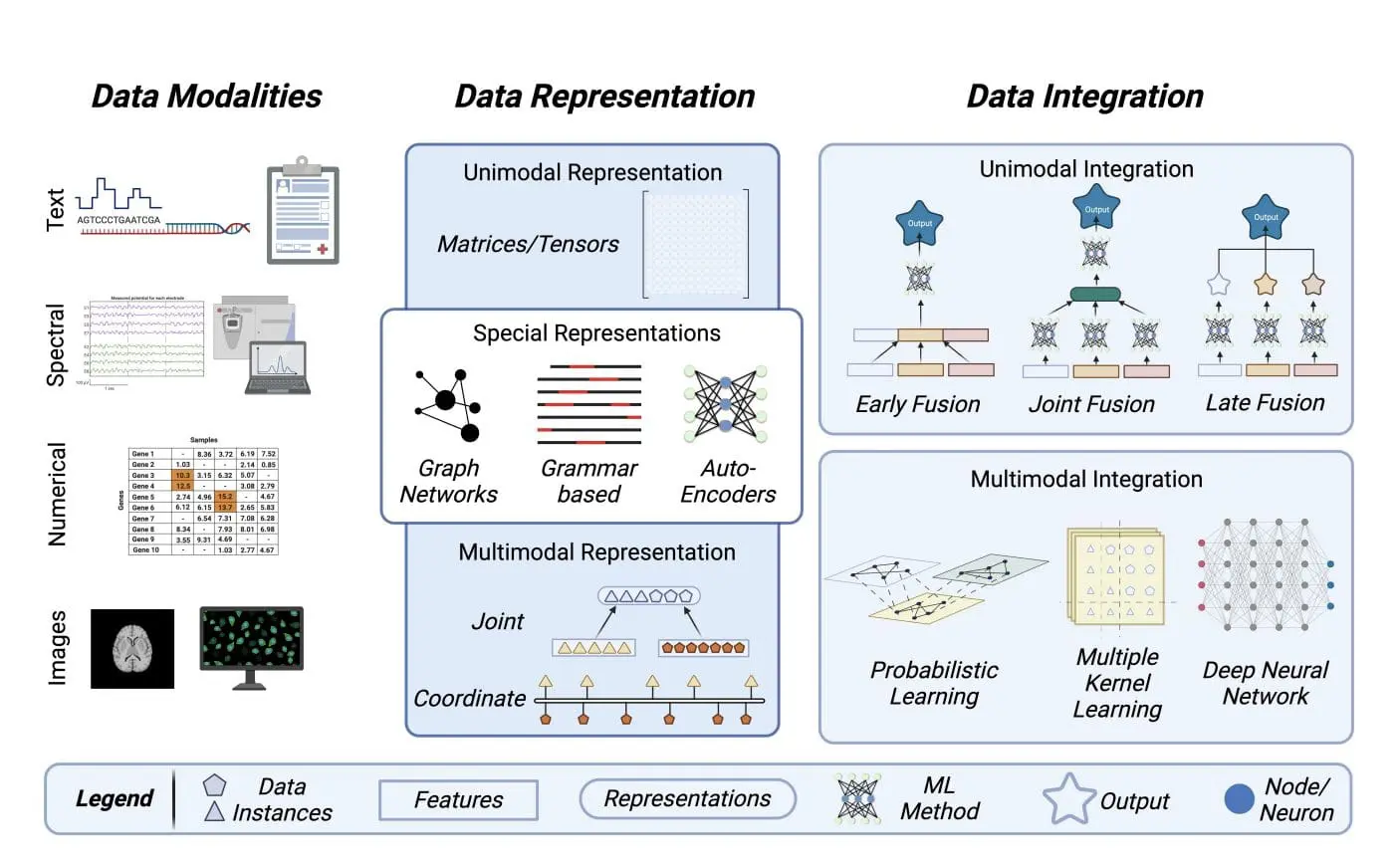
Harmonization is presented as a dual process of representation and integration, each with multiple methods and categories. The taxonomy of the various representation and integration methods are classified into six broad categories and detailed with the advantages, disadvantages, and examples. A guide flowchart that describes the step-by-step processes that are needed to adopt a multimodal approach is also presented along with examples and references.
This review provides a thorough taxonomy of methods for harmonizing multimodal data and introduces a foundational 10-step guide for newcomers to implement a multimodal workflow. The keywords for this process include multimodal integration, feature representation, data integration, deep learning, and digital health.
What is the Impact of Technological Advances on Biomedical Data?
The growth of biological and healthcare data in terms of volume, velocity, and variety has been exponential and driven by technological advances in electronics, communication, and infrastructure. Concurrently, there has been an increase in data analysis tools to understand and analyze the data. Progress in computational techniques, artificial intelligence (AI), and machine learning (ML) methods have been identified to contribute towards the analysis and interpretation better than traditional analytical methods.
Data generated in the context of biological systems can manifest in various forms such as quantitative, qualitative, or narrative, each of these has its subtypes which are collectively referred to as a modality. These diverse modalities can capture several aspects of a biological system such as nucleic acid and protein sequences, gene expression, and the biomolecular structure and its activity. Other modalities include the epigenetic state and methylation information of the genome, metabolites, and anatomic and phenotypic data.
How Does Multimodal Integration Enhance Understanding of Biological Systems?
Different modalities capture different aspects of the system. Thus, integrating them provides a comprehensive multi-view understanding of both biological and clinical conditions. Combining multiple types of omics data or a multi-omics approach to study biological systems has gained momentum lately due to their demonstrated superiority over single-omics approaches.
Furthermore, healthcare data is integrated with omics datasets to reveal their interconnections, providing a comprehensive 360-degree view of an individual’s condition. Such studies have reported results with significant validation. However, a vast portion of the biological complexity still requires an explanation, which is an ongoing challenge for the research community.
What is the Future of Multimodal Integration in Biomedical Research?
The future of multimodal integration in biomedical research is promising. The development of a comprehensive taxonomy and a robust framework for multimodal analysis will significantly advance personalized medicine. The integration of diverse modalities will provide a more comprehensive understanding of biological and clinical conditions, leading to more effective treatments and interventions.
Moreover, the integration of healthcare data with omics datasets will provide a more holistic view of an individual’s condition, leading to more personalized and effective treatments. The ongoing challenge for the research community is to explain the vast portion of biological complexity that still requires an explanation. However, with the continued advancement of machine learning techniques and computational tools, this challenge is likely to be overcome in the future.
Publication Date: 2024-03-22
Authors: Murali Aadhitya M S, Mithun K. Mitra and Sonika Tyagi
Source: medRxiv (Cold Spring Harbor Laboratory)
DOI: https://doi.org/10.1101/2024.03.21.24304655