

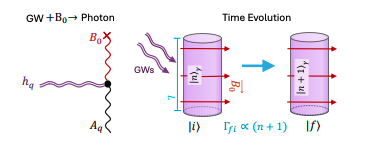
Research demonstrates that utilising qumodes, bosonic modes of light, enhances gravitational wave detection via the inverse Gertsenshtein effect, improving sensitivity by up to 1.7 orders of magnitude. This approach, leveraging Bose-Einstein statistics, nears the cosmological bound and promises single-graviton level detection at microwave frequencies.
The search for high-frequency gravitational waves, ripples in spacetime predicted by Einstein’s theory of general relativity, receives a novel impetus from recent theoretical work exploring the potential of ‘qumodes’ – quantised modes of the electromagnetic field – to dramatically enhance detection sensitivity. Researchers are investigating how these bosonic modes, when utilised within a magnetized cavity, can convert gravitational waves into detectable single photons via the inverse Gertsenshtein effect, a process where a gravitational wave resonantly interacts with the electromagnetic field. This conversion probability benefits from Bose-Einstein statistics, offering a significant amplification of signal strength. Dmitri E Kharzeev, from Stony Brook University and Brookhaven National Laboratory, alongside Azadeh Maleknejad of Swansea University, and Saba Shalamberidze also from Stony Brook University, detail this approach in their article, ‘QuGrav: Bringing gravitational waves to light with Qumodes’, outlining a pathway towards sensitivities approaching, and potentially exceeding, the cosmological bound for detecting these elusive waves. Their calculations suggest existing technology, combined with continuous qumode preparation and non-demolition measurement, could improve current detector sensitivity by an order of magnitude, and even reach the single-graviton level.
Researchers are actively developing a novel method for detecting high-frequency gravitational waves (HFGWs) utilising qumodes, which are bosonic modes of electromagnetic radiation, and the inverse Gertsenshtein effect. This approach offers a potential pathway to observe signals currently beyond the reach of conventional instruments like LIGO and Virgo, which primarily detect lower frequency waves. The inverse Gertsenshtein effect facilitates the conversion of gravitational waves into detectable photons within a magnetized cavity, a process crucial to the technique’s functionality.
The method leverages Bose-Einstein statistics, a principle governing the behaviour of identical particles, to amplify the probability of converting gravitational waves into photons. This amplification is directly proportional to the number of photons occupying the qumode, meaning a higher photon count leads to a stronger signal. Continuous preparation of these qumodes, alongside the implementation of non-demolition measurements on the coupled qumode-qubit system, significantly enhances detection capabilities. A qubit is a quantum bit, the basic unit of quantum information. Non-demolition measurements allow for repeated measurements without destroying the quantum state being measured.
Current results demonstrate sensitivities approaching the cosmological bound
Current results demonstrate sensitivities approaching the cosmological bound for HFGW detection at microwave frequencies. The cosmological bound represents a theoretical limit on the detectable gravitational wave signal, dictated by the background noise of the universe. Scientists are currently employing superconducting circuits and squeezed states of light to achieve these sensitivities. Squeezed states are a non-classical form of light where quantum noise is reduced in one quadrature, enhancing the signal-to-noise ratio. Parametric amplification, a technique used to boost weak signals, further enhances signal detection.
The proposed setup currently achieves sensitivities within 1.7 orders of magnitude of the cosmological bound at microwave frequencies, utilising existing technology. Researchers anticipate significant improvements with advancements in quantum technologies, potentially surpassing the cosmological bound and enabling the first exploration of high-frequency cosmological gravitational wave backgrounds. These backgrounds, remnants of the early universe, offer insights into fundamental cosmological processes and may reveal new physics beyond the Standard Model.
Furthermore, this method promises to enhance the sensitivity of existing detectors by one order of magnitude at higher frequencies. This improvement brings the prospect of detecting individual gravitons, the hypothetical quantum particles mediating gravitational interactions, closer to realisation. The study benefits from, and contributes to, ongoing advancements in quantum technologies, potentially ushering in a new era of gravitational wave astronomy and offering a complementary approach to existing large-scale detectors.
👉 More information🗞QuGrav: Bringing gravitational waves to light
🗞 QuGrav: Bringing gravitational waves to light with Qumodes
🧠 DOI: https://doi.org/10.48550/arXiv.2506.09459


