
Researchers have unearthed a novel class of quantum states in a bespoke graphene structure, paving the way for potential advancements in quantum information. By introducing a precise rotational twist between stacked two-dimensional materials, scientists from the University of British Columbia, the University of Washington, and Johns Hopkins University have created a system that exhibits topological electronic crystals in twisted bilayer-trilayer graphene.
This phenomenon is characterized by electrons freezing into a perfectly ordered array, yet twirling in unison, giving rise to a remarkable phenomenon where electric current flows effortlessly along the edges of the sample while the interior remains insulating. The discovery, published in Nature, has far-reaching implications for the development of qubits for topological quantum computers, and its unique properties, guaranteed by topology, make it an exciting area of study in the field of quantum matter.
Introduction to Quantum States in Graphene
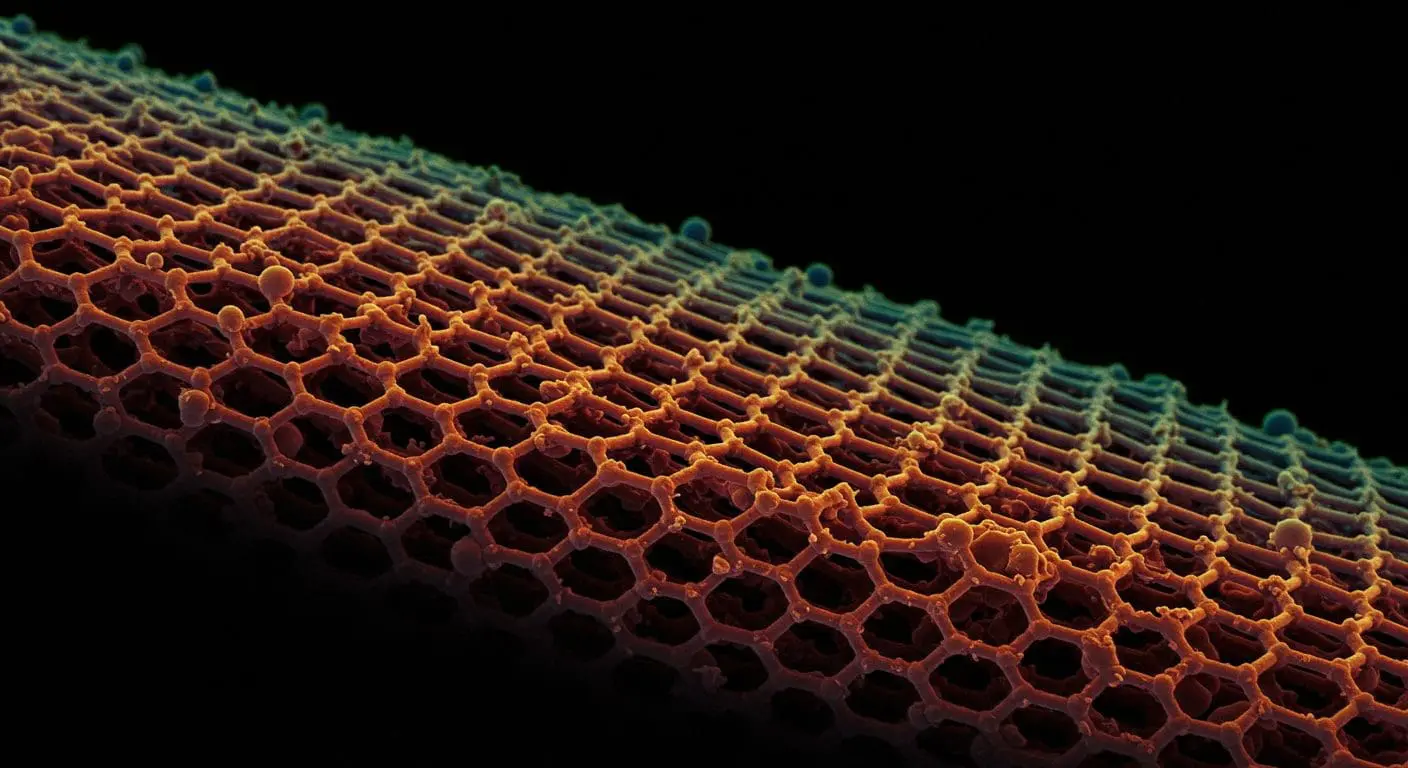
The discovery of a new class of quantum states in custom-engineered graphene structures has been reported by researchers from the University of British Columbia, the University of Washington, and Johns Hopkins University. This study, published in Nature, reveals the existence of topological electronic crystals in twisted bilayer-trilayer graphene. The research began with two flakes of graphene, which are made up of carbon atoms arranged in a honeycomb structure. By introducing a precise rotational twist between the stacked two-dimensional materials, the researchers created a geometric interference effect known as a moiré pattern.
The moiré pattern has a significant impact on the electronic properties of the graphene. When electrons hop through this pattern in the twisted stack, their properties are altered. For example, the electrons slow down, and sometimes they develop a twist in their motion. This phenomenon is similar to the vortex in water at the drain of a bathtub as it is draining out. The discovery of the topological electronic crystal was made by an undergraduate student, Ruiheng Su, who observed a unique configuration for the device where the electrons in the graphene froze into a perfectly ordered array.
The synchronized rotation of the electrons gives rise to a remarkable phenomenon where electric current flows effortlessly along the edges of the sample while the interior remains insulating. This behavior is due to the topology of the electron crystal, which describes the properties of objects that remain unchanged by modest deformations. The precision of this value is guaranteed by the ratio of two fundamental constants of nature—Planck’s constant and the charge of the electron.
Topological Electronic Crystals
The topological electronic crystal is a fascinating phenomenon that has not been seen in conventional Wigner crystals of the past. Despite the crystal forming upon freezing electrons into an ordered array, it can nevertheless conduct electricity along its boundaries. This behavior is due to the topology of the electron crystal, which leads to edges where electrons flow without resistance. The rotation of the electrons in the crystal is analogous to the twist in a Möbius strip, a simple yet mind-bending object that has only one side and one edge.
The Möbius strip is an everyday example of topology, where a surface with a single twist cannot be untwisted back into a normal loop without tearing it apart. Similarly, the rotation of the electrons in the crystal leads to a remarkable characteristic of the topological electronic crystal: edges where electrons flow without resistance, despite being locked in place within the crystal itself. This phenomenon has significant implications for advancements in quantum information, including future attempts to couple the topological electron crystal with superconductivity.
The discovery of the topological electronic crystal is not only fascinating from a conceptual point of view but also opens up new opportunities for research in quantum physics. The study of these crystals can provide insights into the behavior of electrons in complex systems and has potential applications in the development of quantum computers. The researchers involved in this study are exploring ways to couple the topological electron crystal with superconductivity, which could form the foundation of qubits for topological quantum computers.
Quantum Information and Topological Quantum Computers
The discovery of the topological electronic crystal has significant implications for advancements in quantum information. The study of these crystals can provide insights into the behavior of electrons in complex systems and has potential applications in the development of quantum computers. Topological quantum computers are a type of quantum computer that uses the principles of topology to perform calculations. These computers have the potential to be more robust and reliable than other types of quantum computers, as they are less susceptible to errors caused by decoherence.
The coupling of the topological electron crystal with superconductivity is a crucial step in the development of topological quantum computers. Superconductivity is a phenomenon where certain materials can conduct electricity with zero resistance, which is essential for the operation of quantum computers. By combining the topological electronic crystal with superconductivity, researchers can create qubits that are more stable and reliable than other types of qubits. This could lead to significant advancements in the field of quantum computing and has potential applications in fields such as cryptography and optimization.
External Link: Click Here For More