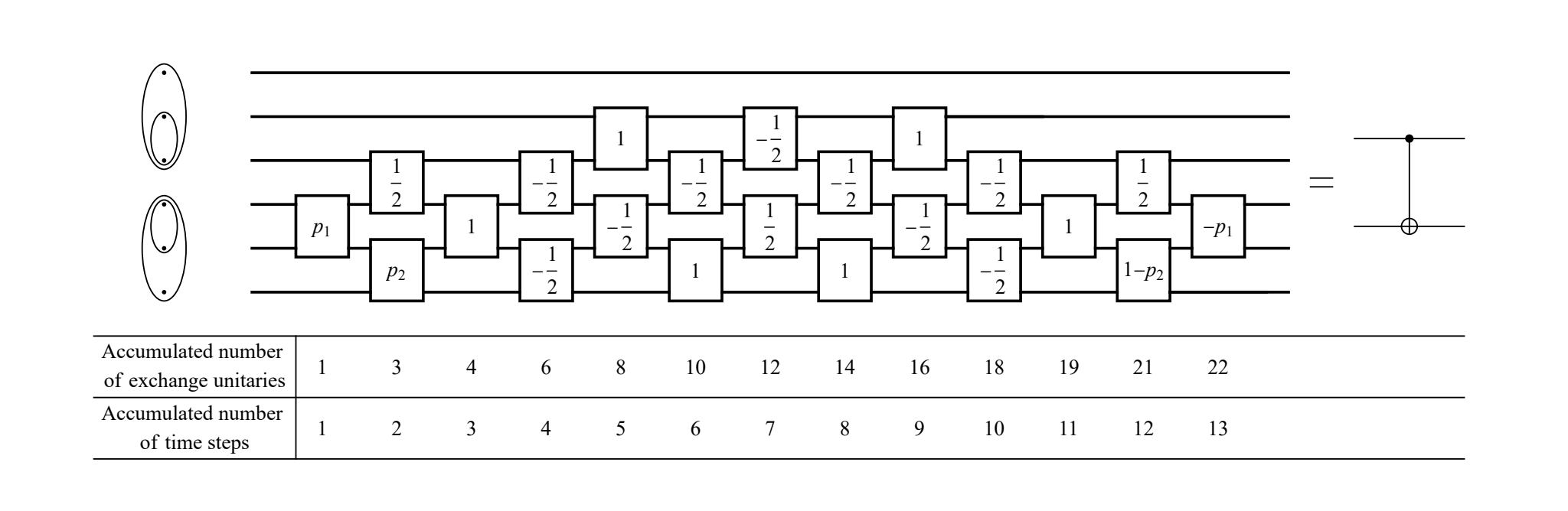
The creation of practical quantum computers hinges on the ability to control multiple qubits simultaneously, but building complex operations with these fragile systems presents a significant challenge. Jiahao Wu, Guanjie He, and Wenyuan Zhuo, all from City University of Hong Kong, alongside Quan Fu from Wuhan University and Xin Wang from City University of Hong Kong, address this problem by introducing a new algorithm for designing sequences of operations on qubits that rely solely on ‘exchange’ interactions. Their method, named Jenga-Krotov, dramatically simplifies the construction of multi-qubit gates, such as the Toffoli gate, reducing the number of steps required from 216 to just 92 and shortening the overall operation time. This optimisation not only streamlines quantum computations but also significantly improves accuracy, achieving an order of magnitude lower error rate compared to conventional methods, and represents a crucial step towards building scalable and reliable quantum computers using semiconductor technology.
Optimized Gates for Exchange-Only Quantum Dots
Quantum computing promises to revolutionize fields from medicine to materials science, but building practical quantum computers presents significant challenges. Current quantum devices are limited by imperfections in the fundamental operations that manipulate quantum information. Recent research focuses on a promising qubit technology called Exchange-Only (EO) qubits, and introduces a novel method to streamline the creation of multi-qubit gates. EO qubits, built using tiny structures called quantum dots, offer a potentially scalable platform for quantum computing. Unlike many other qubit types, EO qubits rely solely on the exchange of electrons between neighboring qubits, simplifying control and potentially increasing speed.
Constructing more complex multi-qubit gates remains a major hurdle, as traditional methods result in lengthy and error-prone sequences. To address this challenge, researchers have developed a new optimization algorithm called Jenga-Krotov (JK). This algorithm efficiently designs compact, high-fidelity pulse sequences for multi-qubit gates, directly synthesizing the desired operation rather than piecing it together from simpler components. The JK algorithm works by iteratively refining a sequence of control signals, minimizing errors and maximizing the accuracy of the resulting gate. The team demonstrated the power of JK by applying it to the Toffoli gate, a fundamental three-qubit operation crucial for many quantum algorithms.
Using JK, they significantly reduced the complexity of the Toffoli gate, requiring far fewer control steps and achieving a substantial improvement in fidelity compared to standard methods. Specifically, the algorithm compressed the required operations from 216 to 92 and reduced the time steps from 162 to 50, all while maintaining the desired level of accuracy. Importantly, simulations show that the optimized gate sequence exhibits significantly lower error rates under realistic conditions, paving the way for more reliable quantum computations.
Toffoli Gate Implemented with Exchange-Only Qubits
Researchers have developed a new method for constructing complex operations within quantum computers based on exchange-only (EO) qubits. These qubits rely on interactions between electrons confined within tiny structures called quantum dots, offering potential for scalability and long coherence times. A key challenge in building larger quantum processors is efficiently creating multi-qubit gates. The team focused on the Toffoli gate, a fundamental three-qubit operation essential for universal quantum computation. Traditional methods of building this gate require a large number of individual steps and interactions, increasing the potential for errors.
The standard approach necessitates 216 separate operations and takes 162 time steps, creating significant overhead. To overcome this limitation, the researchers introduced a new algorithm called Jenga-Krotov (JK), a gradient-based optimization technique designed to discover compact and high-fidelity pulse sequences for multi-qubit gates. This algorithm directly synthesizes the desired gate, rather than constructing it from smaller components, significantly reducing the number of steps required. Applying JK to the Toffoli gate, they reduced the number of necessary operations to 92 and the time steps to 50, while maintaining the target level of accuracy.
The improvement in efficiency translates to a substantial reduction in errors. Under realistic conditions that include noise and imperfections, the optimized sequence generated by JK exhibited an order of magnitude lower error rate compared to conventional methods. This represents a significant step towards building more robust and reliable quantum computers, as it minimizes the accumulation of errors during complex calculations. The JK algorithm is broadly applicable and can be adapted to different qubit arrangements and gate designs.
Jenga-Krotov Optimizes Multi-Qubit Gate Synthesis
This research introduces a new optimization algorithm, Jenga-Krotov (JK), to improve the synthesis of multi-qubit gates in exchange-only (EO) qubit systems. The team successfully applied JK to the Toffoli gate, reducing the number of necessary steps from 216 to 92 and significantly shortening the operation time, all while maintaining high fidelity. The results indicate that JK offers a general and scalable strategy for designing high-fidelity multi-qubit gates within EO architectures, potentially enabling the implementation of complex quantum algorithms on semiconductor platforms. The study also reveals inherent complexities in EO qubit design; while the encoding scheme allows universal quantum computation, it introduces challenges in constructing efficient multi-qubit gates. This complexity scales with system size, presenting an ongoing challenge for EO architectures. Future work could focus on extending these optimization techniques to other multi-qubit gates and further addressing the complexities of maintaining robust encoding alongside efficient gate realizations.
🗞 Jenga-Krotov algorithm: Efficient compilation of multi-qubit gates for exchange-only qubits
🧠 DOI: https://doi.org/10.48550/arXiv.2507.12448