Researchers at Quantum AI, led by Founder and Lead Hartmut Neven, have made significant strides in quantum computing with their latest quantum device named Willow. This state-of-the-art system boasts 105 qubits and has demonstrated best-in-class performance across two key benchmarks: quantum error correction and random circuit sampling.
Principal Scientist Sergio Boixo and renowned physicist John Preskill discussed the significance of this achievement in a video discussion. The team’s focus on quality over quantity has led to impressive results. T1 times are approaching 100 microseconds, a five-fold improvement over previous generations. The next challenge is demonstrating a “useful, beyond-classical” computation with real-world applications. Quantum AI is optimistic that Willow can help achieve this goal. This could unlock breakthroughs in fields like medicine, energy, and artificial intelligence.

The team at Quantum AI has made significant strides with their new chip, Willow. It boasts 105 qubits and demonstrates best-in-class performance across two system benchmarks: quantum error correction and random circuit sampling (RCS). The latter is particularly noteworthy, as it showcases the chip’s ability to perform computations beyond the capabilities of classical computers.
The RCS benchmark is a clever way to demonstrate the power of quantum computing. By randomly generating circuits and measuring their output, researchers can compare the performance of quantum chips against classical computers. As the team notes, they’ve made conservative assumptions about the classical computer’s capabilities, assuming full access to secondary storage without any bandwidth overhead. Despite this generous allowance, the gap between quantum and classical performance is growing rapidly, with quantum processors outperforming their classical counterparts at an exponential rate.
10 septillion years on one of today’s fastest supercomputers
Willow’s performance on this benchmark is astonishing: It performed a computation in under five minutes that would take one of today’s fastest supercomputers 1025 or 10 septillion years.
The Willow chip’s impressive specifications include a T1 time of nearly 100 microseconds, a ~5x improvement over the previous generation of chips. This means that the qubits can retain their quantum state for longer, enabling more complex computations.

What’s next for the field? The team is optimistic about the Willow generation of chips. They believe it will help demonstrate a “useful, beyond-classical” computation. This computation will be on today’s quantum chips and relevant to real-world applications. This requires bridging the gap between RCS benchmarks and scientifically interesting simulations of quantum systems. These simulations have led to new scientific discoveries. However, they are still within the reach of classical computers.
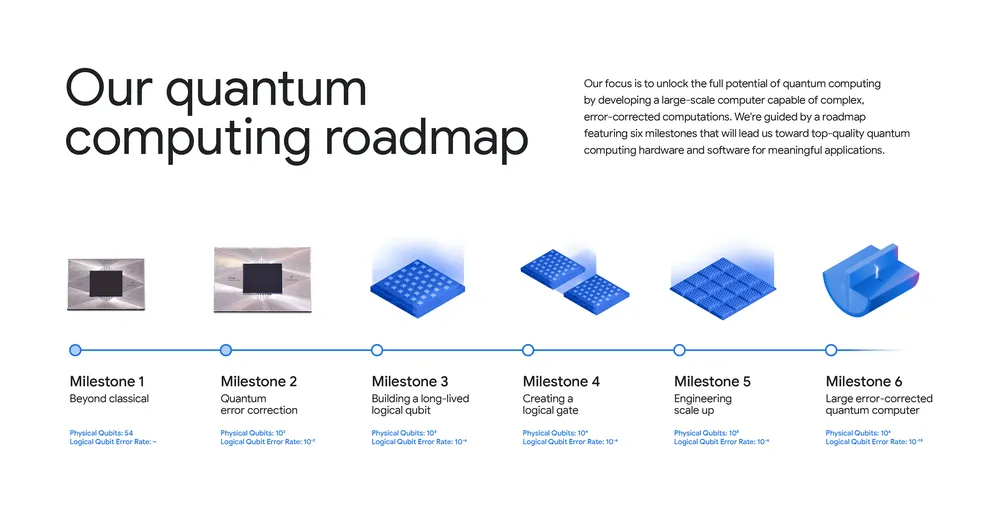
The roadmap for quantum computing is clear: from demonstrating beyond-classical performance to developing large error-corrected quantum computers. The team invites researchers. Engineers are also welcome to join them on this journey. They provide open-source software and educational resources. This includes a new course on Coursera.
Hartmut Neven notes that the connection between quantum computing and AI is crucial. Quantum algorithms have fundamental scaling laws that will significantly benefit advanced AI, enabling it to collect training data inaccessible to classical machines, train and optimize certain learning architectures, and model systems where quantum effects are important. This has far-reaching implications for fields like medicine, energy, and materials science.
In conclusion, the advancements made by the Quantum AI team mark a significant milestone in the development of quantum computing. This appears to be a substantial reboot for Google, who will have seen the significant recent interest in quantum computing, particularly the pureplay quantum companies such as D-Wave, Rigetti and IonQ.
External Link: Click Here For More