

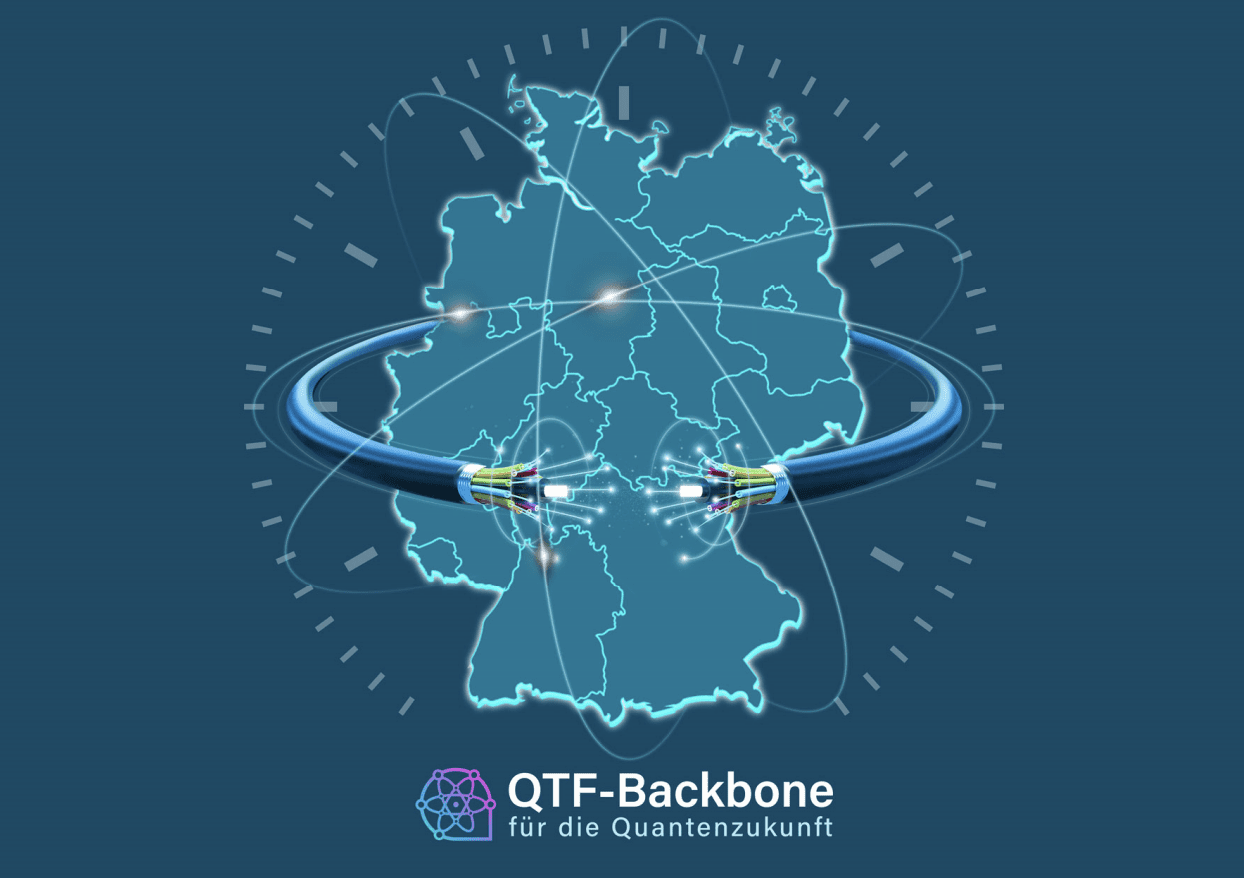
Germany plans a decade-long national fibre-optic infrastructure, the QTF-Backbone, to distribute high-precision time and frequency signals. Building on existing European networks, this dedicated system aims to provide scalable access for research and industry, establishing a national and European hub for networked time and frequency transfer.
The secure transmission of information and highly accurate timekeeping are cornerstones of modern infrastructure, yet current systems exhibit vulnerabilities and limitations in precision. Researchers are now proposing a dedicated national fibre-optic network to address these challenges, enabling the widespread distribution of quantum information and precise time and frequency (T&F) signals. This initiative, detailed in a new proposal, seeks to move beyond isolated laboratory demonstrations and establish a scalable, nationwide resource for both research and industry.
The project is the work of Klaus Blaum (Max Planck Institute for Nuclear Physics), Peter Kaufmann (German National Research and Education Network, DFN), Jochen Kronjäger, Stefan Kück, Tara Cubel Liebisch, Harald Schnatz (all Physikalisch-Technische Bundesanstalt), Dieter Meschede (University of Bonn), Susanne Naegele-Jackson (Friedrich-Alexander-Universität Erlangen-Nürnberg), and Stephan Schiller (Heinrich Heine University Düsseldorf), and is outlined in their paper, “The QTF-Backbone: Proposal for a Nationwide Optical Fibre Backbone in Germany for Quantum Technology and Time and Frequency Metrology”.
Europe activates pan-European quantum and time infrastructure
A continent-wide infrastructure distributing precise time and frequency signals via optical fibre networks is now operational across Europe. The Quantum and Time-Frequency (QTF)-Backbone simultaneously supports the development of quantum communication technologies, addressing increasing dependence on accurate timing for critical national infrastructure.
The QTF-Backbone mitigates vulnerabilities associated with reliance on Global Navigation Satellite Systems (GNSS) – such as GPS and Galileo – which are susceptible to interference, intentional jamming, and signal manipulation known as spoofing. These systems provide timing signals essential for synchronising communications networks, financial transactions, and energy distribution grids.
The initiative utilises existing and newly deployed fibre optic cabling, employing techniques such as Wavelength Division Multiplexing (WDM). WDM increases data transmission capacity by transmitting multiple signals simultaneously over different wavelengths of light within the same fibre. This maximises bandwidth and facilitates the distribution of highly accurate time and frequency signals. These signals are crucial for synchronising networks, calibrating scientific instruments, and enabling precise measurements across diverse applications.
Beyond time and frequency distribution, the network is engineered to accommodate Quantum Key Distribution (QKD) and other emerging quantum communication protocols. QKD uses the principles of quantum mechanics to generate and distribute cryptographic keys, offering a theoretically unbreakable method for securing communications and protecting sensitive data.
The QTF-Backbone builds upon prior successful demonstrations of long-distance time and frequency transfer across Europe, integrating previously isolated regional efforts into a coordinated, pan-European system. Several European nations have independently developed their own national quantum and time/frequency backbones, recognising the strategic importance of both precise timing and secure communication. The current initiative aims to connect these national infrastructures, fostering collaboration and avoiding fragmentation.
National Metrology Institutes (NMIs), such as the Physikalisch-Technische Bundesanstalt (PTB) in Germany and the National Physical Laboratory (NPL) in the UK, are central to maintaining and disseminating time and frequency standards. They ensure traceability – the unbroken chain of comparisons to a primary standard – and accuracy across the network. Research institutions, alongside collaborative networks like GEANT – a high-speed European research network – and the European GNSS Agency (GSA), contribute to the development and testing of the underlying technologies, accelerating innovation and driving advancements in the field.
👉 More information
🗞 The QTF-Backbone: Proposal for a Nationwide Optical Fibre Backbone in Germany for Quantum Technology and Time and Frequency Metrology
🧠 DOI: https://doi.org/10.48550/arXiv.2506.03998


