
The challenge of maintaining quantum information for useful lengths of time receives a boost from new research into suppressing unwanted energy loss in superconducting circuits. Mustafa Bakr, Mohammed Alghadeer, and Simon Pettersson Fors, working with colleagues at the University of Oxford and Chalmers University of Technology, demonstrate a novel method for passively controlling how quickly quantum states decay. Their approach leverages the natural electromagnetic environment within the circuit itself, using carefully designed asymmetries to create destructive interference between different decay pathways. This interference effectively shields the quantum information, leading to significantly improved coherence times and representing a crucial step towards building larger, more stable quantum processors.
This research demonstrates a new method for improving the coherence of superconducting qubits, a critical step towards building practical quantum processors. The team successfully suppresses a major source of qubit decoherence – radiative decay – by actively engineering the electromagnetic environment within the quantum circuit itself. Current approaches often involve adding filters or complex materials to block unwanted energy leakage, but these methods become increasingly impractical as quantum processors scale up.
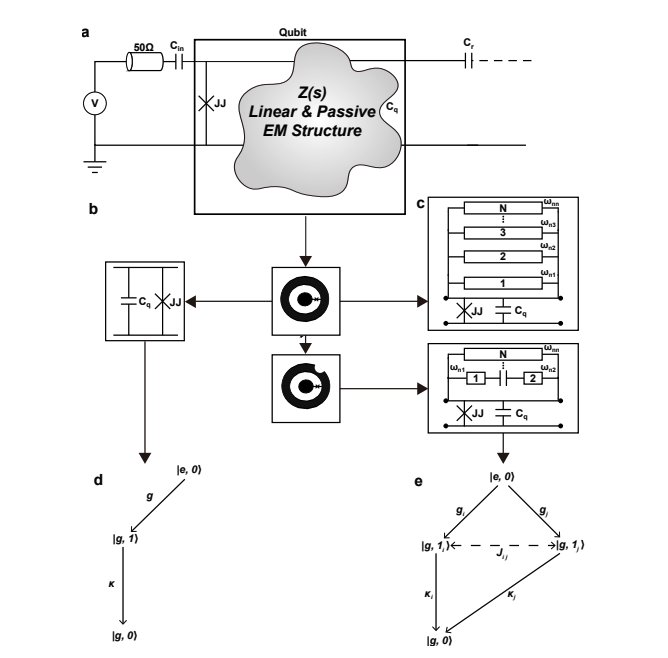
Instead of shielding the qubit, this team pioneers a fundamentally different strategy: manipulating the existing electromagnetic environment to suppress energy loss without adding new components. The key lies in introducing controlled asymmetries into the circuit’s design, specifically by perturbing the geometry of the qubit’s capacitor. Conventional models often treat superconducting qubits as simple circuits, but physical qubits possess a multitude of internal electromagnetic modes arising from their geometry.
These asymmetries enhance the hybridization of these modes and activate interference between multiple decay pathways. By carefully designing these geometric perturbations, the researchers create multiple pathways for energy to dissipate. Crucially, these pathways are engineered to interfere with each other, creating destructive interference where energy dissipation through different channels cancels out.
This is conceptually similar to noise-cancelling headphones, but applied to the internal electromagnetic environment of the qubit. Through a combination of theoretical modelling, electromagnetic simulations, and experimental validation, the researchers demonstrate that this interference significantly extends qubit coherence times. The team’s modelling and experimental results show substantial improvements in coherence, offering a promising path towards building more stable and scalable quantum processors.
While the analysis simplifies certain aspects of the system, such as neglecting higher-order coupling terms assumed to be negligible under their experimental conditions, the results are compelling. Future work could explore extending this interference-based approach to more complex qubit architectures and investigating its performance under realistic operating conditions, including the influence of external control signals. This research provides a promising pathway for improving qubit coherence without relying on complex shielding techniques, potentially paving the way for larger and more stable quantum processors.
👉 More information
🗞 Intrinsic Multi-Mode Interference for Passive Suppression of Purcell Decay in Superconducting Circuits
🧠 DOI: https://doi.org/10.48550/arXiv.2507.09715