Recent discoveries of tunable superconductivity in atomically thin tungsten ditelluride (WTe₂) present a fascinating puzzle for physicists, as the material exhibits unexpected behaviour not predicted by conventional theories. F. Yang, G. D. Zhao, Y. Shi, and L. Q. Chen investigate these anomalies by developing a new theoretical framework that accounts for the complex interplay of quantum fluctuations within the material. Their work moves beyond standard models by explicitly incorporating both Nambu-Goldstone and Berezinskii-Kosterlitz-Thouless fluctuations, revealing how these fluctuations dramatically influence superconductivity, particularly under conditions of strong disorder. This refined understanding not only explains previously observed experimental results in monolayer WTe₂, but also provides a crucial step towards designing and controlling superconductivity in two-dimensional materials.
D Materials and Superconductivity Research
Scientists are actively exploring novel quantum phenomena in two-dimensional materials, particularly transition metal dichalcogenides like tungsten ditelluride. This research focuses on inducing and controlling superconductivity, ferroelectricity, and exciton condensation within these materials, opening doors to new technological possibilities. A central theme involves understanding how superconductivity arises and behaves in these atomically thin layers. Investigations into tungsten ditelluride reveal unconventional superconductivity, deviating from established theories. Researchers are employing electric fields to tune and manipulate superconducting properties, and are studying the conditions under which superconductivity emerges, examining associated quantum phase transitions.
They are also exploring exciton condensation, a state where bound electron-hole pairs form a macroscopic quantum state, and investigating the emergence of spontaneous electric polarization in these materials, potentially coupling it with superconductivity. Computational materials science, using advanced simulations, plays a vital role in predicting material properties and guiding experimental work. This process involves growing these 2D materials, fabricating devices, and measuring their electrical, optical, and structural properties. Terahertz spectroscopy is also employed to study dynamic material properties and induce ferroelectricity. This work represents a forefront of materials science, aiming to unlock the potential of 2D materials for future applications in quantum computing, energy storage, and advanced electronics.
Fluctuations and Superconductivity in Tungsten Ditelluride
Scientists have developed a theoretical framework to understand superconductivity in monolayer tungsten ditelluride, addressing anomalies observed in its behaviour. This new method combines the treatment of superconducting gaps with both Nambu-Goldstone and Berezinskii-Kosterlitz-Thouless fluctuations, moving beyond traditional theoretical approaches. Researchers explicitly incorporated these fluctuations into calculations of the superconducting gap and superfluid density, crucial for understanding the material’s behaviour, particularly when imperfections are present. The team began with a microscopic model for s-wave superconductors, defining the superconducting order parameter in terms of its gap and phase.
They decomposed the phase fluctuations into longitudinal and transverse components, associating the former with Nambu-Goldstone fluctuations and the latter with Berezinskii-Kosterlitz-Thouless vortex fluctuations. Recognizing that Nambu-Goldstone fluctuations act as a superconducting momentum, they renormalised the gap accordingly. This led to a modified equation for the gap, incorporating the Doppler shift from these fluctuations in the energy of quasiparticles. To quantify the impact of imperfections, scientists calculated the superfluid density using the current-current correlation function, incorporating a factor to account for scattering effects. This factor, dependent on the coherence length and mean free path, effectively models the suppression of superconductivity due to imperfections and potential electron localization. By combining calculations informed by Density Functional Theory and accounting for excitonic instability, the simulations quantitatively reproduce key experimental observations of gate-tunable superconductivity in monolayer tungsten ditelluride, providing a consistent understanding of the reported anomalies.
Tungsten Ditelluride Superconductivity Reveals Key Influences
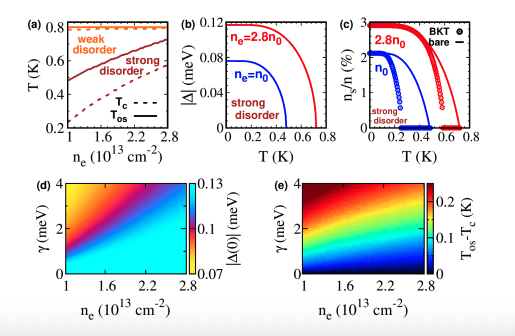
Scientists have demonstrated a detailed understanding of superconductivity in monolayer tungsten ditelluride, revealing how material properties influence the emergence of this zero-resistance state. Simulations, informed by Density Functional Theory calculations, quantitatively reproduce key experimental observations and provide insight into previously unexplained anomalies. The team measured the transition temperature, T c, and the zero-temperature gap, |Δ(0)|, across varying carrier densities and levels of imperfections, revealing a complex interplay between these factors. Results show that in a relatively perfect system, both T c and |Δ(0)| remain largely density independent, aligning with standard theory.
However, under significant imperfections, the zero-temperature gap and the gap-closing temperature exhibit a clear dependence on both density and the level of imperfections, decreasing as density decreases or imperfections increase. This behaviour arises from enhanced Nambu-Goldstone quantum fluctuations, which renormalize the superconducting gap in a density- and imperfection-dependent manner. Experiments reveal a significant difference between T c and the gap-closing temperature, T os, under significant imperfections, creating a pseudogap regime where pairing exists without global phase coherence. Specifically, the team found that T c can be significantly pushed below T os, with the difference becoming more pronounced at lower densities and higher imperfection levels.
Measurements confirm that the effective electron mass is 0. 33 m 0, consistent with experimental estimates of 0. 3 m 0, and that a large phase stiffness suppresses fluctuations at high carrier densities. Furthermore, the simulations demonstrate that Berezinskii-Kosterlitz-Thouless fluctuations drive the superconducting transition at T c under significant imperfections, leading to a discontinuous drop in superfluid density. The team established that the calculated T c closely matches experimental data after adjusting the band gap and determining the imperfection strength from the high-density gap behaviour. These findings provide a comprehensive framework for understanding superconductivity in this material and offer insights into the role of fluctuations and imperfections in two-dimensional systems.
Disorder Drives Superconducting Transition Suppression
This research provides a comprehensive understanding of superconductivity in monolayer tungsten ditelluride, explaining anomalies observed in recent experiments. The team demonstrates that fluctuations, specifically Nambu-Goldstone and Berezinskii-Kosterlitz-Thouless fluctuations, play a crucial role in determining the superconducting behaviour, particularly when imperfections are present. In relatively perfect systems, these fluctuations are minimal and the material behaves as predicted by standard theory, but significant imperfections significantly enhance these fluctuations, suppressing the superfluid density and ultimately lowering the superconducting transition temperature. The simulations successfully reproduce key experimental observations by incorporating these fluctuations into a theoretical framework, revealing a density-dependent superconducting gap and a clear distinction between the gap-closing temperature and the actual transition temperature when imperfections are present. This explains the emergence of a pseudogap phase where pairing exists without full superconductivity.
👉 More information
🗞 An Efficient Phase-Transition Framework for Gate-Tunable Superconductivity in Monolayer WTe
🧠 ArXiv: https://arxiv.org/abs/2509.08332