

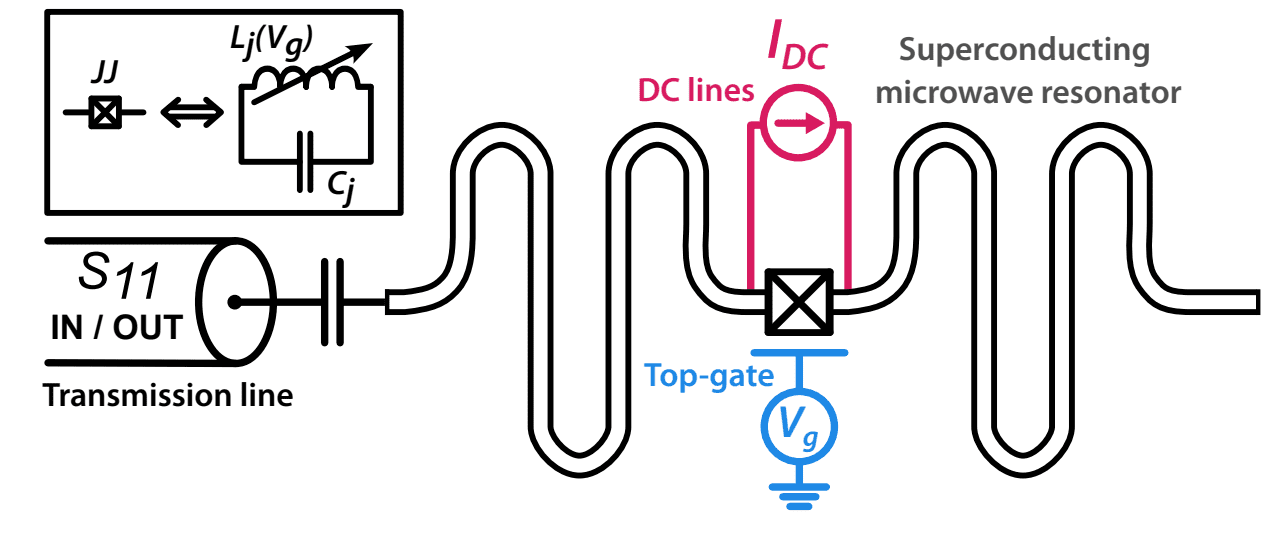
Researchers are increasingly focused on building complex quantum circuits, but a critical component has remained challenging to integrate, the high-performance, tunable amplifier needed to read out quantum information. Raphael Rousset-Zenou, Nicolas Aparicio, Simon Messelot, and colleagues at the University Grenoble Alpes and the University of Copenhagen now demonstrate a new type of Josephson parametric amplifier built from arrays of indium arsenide nanowires. This innovative design achieves both significant amplification, exceeding 20 dB at multiple frequencies, and a remarkable degree of tunability, with resonance frequencies shifting by almost 1GHz via an applied gate voltage. The team’s work establishes a promising platform for fully integrating gate-tunable quantum devices with near-quantum-limited amplifiers, all fabricated from compatible hybrid materials and potentially on any substrate, representing a substantial step towards more complex and scalable quantum systems.
Researchers are developing innovative quantum devices based on electrically tunable superconducting circuits. Josephson junctions, essential components in these circuits, traditionally rely on materials and fabrication techniques that limit performance. Recent advances utilize nanowire weak links to create gate-tunable qubits, but implementing comparable Josephson parametric amplifiers, crucial for nearly quantum-limited amplification, has remained a challenge. Scientists have now presented Josephson parametric amplifiers constructed from arrays of parallel indium arsenide nanowires, demonstrating a new pathway for high-performance quantum circuits.
Josephson Amplifier Fabrication and Noise Analysis
This research details the fabrication and characterization of a Josephson Parametric Amplifier (JPA), providing a comprehensive understanding of its performance. The team meticulously analyzed the theoretical background, experimental setup, and data analysis techniques employed in the study. Key concepts include the JPA itself, which achieves amplification through parametric modulation, and the importance of minimizing noise to approach quantum-limited performance. The analysis also considers the impact of Kerr nonlinearity and two-photon loss on amplifier performance. Experiments are conducted at extremely low temperatures to suppress thermal noise and enable superconducting operation.
The JPA is connected to a measurement chain incorporating a High Electron Mobility Transistor (HEMT) amplifier, filters, and attenuators. Precise noise measurements are performed to characterize the amplifier’s performance, and the entire measurement chain undergoes careful calibration to account for losses and noise contributions. Data analysis techniques, including noise temperature extraction and loss compensation, are employed to accurately assess the JPA’s characteristics.
Tunable Nanowire Amplifiers Exceed Critical Current Limits
Researchers have achieved a significant breakthrough in developing Josephson parametric amplifiers using arrays of indium arsenide nanowires. These amplifiers demonstrate a critical current exceeding 1200 nA, substantially higher than previously reported values for single nanowire/aluminum junctions. This enhanced critical current, achieved through the parallel arrangement of multiple nanowires, enables high-performance amplification. Experiments reveal that the resonance frequency of these devices is remarkably gate-tunable, exceeding 800MHz in some devices. Adjusting a gate voltage to maximize critical current aligns the resonance frequency with the bare resonance frequency of the resonator, while decreasing the critical current shifts the resonance frequency downwards, demonstrating precise control over the device’s characteristics.
Measurements confirm that both the internal loss rate and coupling rate are sensitive to the applied gate voltage. Further analysis demonstrates a clear Kerr-like non-linearity, a critical ingredient for parametric amplification, as the resonance frequency shifts with increasing input probe power. The team extracted the effective transparency of the Josephson junction, finding it close to unity, suggesting low disorder within the nanowires and at the interface with aluminum, and indicative of a skewed current-phase relation. These results establish a promising new approach to on-chip integration of gate-tunable quantum devices with quantum-limited amplifiers, utilizing a single hybrid material system and compatible with any substrate.
Nanowire Amplifiers Approach Quantum Noise Limit
This research demonstrates a new platform for Josephson parametric amplifiers built from arrays of indium arsenide nanowires, achieving significant advances in quantum circuit technology. Scientists successfully fabricated and tested amplifiers with a critical current large enough for linear amplification, a key requirement previously challenging to meet with nanowire-based devices. The resulting amplifiers exhibit gate-tunability of nearly 1GHz and gain exceeding 20 dB across multiple frequencies, while approaching the quantum limit of noise performance. This achievement enables the integration of gate-tunable quantum devices and quantum-limited amplifiers on a single chip, utilizing a common semiconductor-superconductor material base.
The team found that these nanowire junctions exhibit reduced Kerr nonlinearity compared to traditional tunnel junctions, a beneficial characteristic for amplifier performance. Future designs could further optimize performance by employing a three-wave mixing scheme and integrating larger gap superconductors, potentially allowing operation under magnetic fields. This work paves the way for co-integrating superconducting qubits and Josephson amplifiers on the same chip, representing a significant step towards more complex and integrated quantum circuits.
👉 More information
🗞 Gate-tunable Josephson parametric amplifiers based on semiconductor nanowires
🧠 ArXiv: https://arxiv.org/abs/2510.00305

