
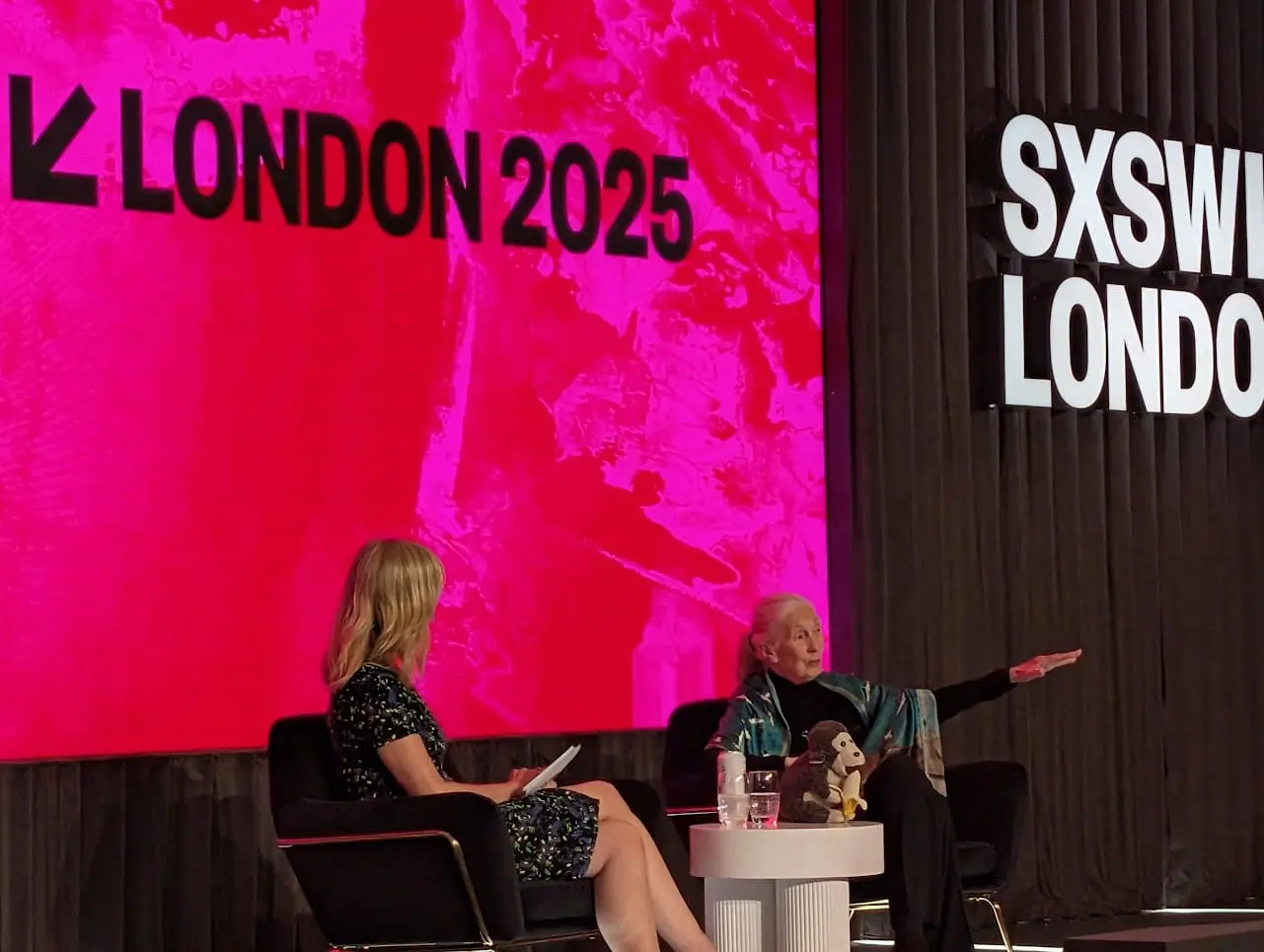
Jane Goodall leans forward as she speaks, her voice carrying the same passion that has driven her for more than six decades since she first set foot in what is now Tanzania’s Gombe National Park. At 91, the pioneering primatologist shows no signs of slowing down, maintaining a punishing schedule of 300 travel days per year to spread what she calls her most important message: hope.
“More and more people are losing hope,” Goodall told an audience at SXSW London this week. “But there’s no question we’re living in a very tough time, politically, socially, environmentally. This is a crucial time in human history, and every single one of us must do our bit.”
It is a message that has taken on new urgency as global challenges mount. From climate change to biodiversity loss, from political instability to social inequality, the problems facing humanity can seem overwhelming. Yet Goodall, who revolutionised our understanding of animal behaviour and intelligence, remains convinced that collective action can prevail.
The power of individual impact
Her optimism stems partly from witnessing seemingly impossible victories before. Growing up during World War II on England’s south coast, Goodall recalls when Britain “stood alone” against Nazi Germany with minimal defences. “We couldn’t win, but we did,” she reflects, drawing parallels to today’s seemingly intractable problems.
This historical perspective informs her central thesis: that individual actions, however small they may seem, can create meaningful change when multiplied across millions of people. “Every day, each one of us lives to make an impact,” she says. “We have to think about what sort of impact we make.”
The philosophy underpins her Roots & Shoots programme, which began in 1991 with 12 Tanzanian students and has since expanded to 75 countries. The initiative encourages young people to choose three projects to improve their communities—one focused on people, one on animals, and one on the environment.
“From that little beginning, we now have members from kindergarten through university, even some adults now in 75 countries, and growing. The last group was in Ukraine,” Goodall notes. The programme’s success lies in its recognition that environmental, social, and economic challenges are interconnected, requiring holistic solutions.
Technology as conservation tool
While Goodall’s early work was conducted with little more than “a pencil and a notebook,” modern conservation increasingly relies on sophisticated technology. Her team now employs satellite imagery, GPS systems, camera traps, and artificial intelligence to monitor wildlife and assist local communities in developing sustainable land management plans.
“We do use AI, which I’m a bit nervous about,” she admits with characteristic honesty. “But with camera traps, AI can actually identify different individuals [chimpanzees], which you couldn’t possibly have done without AI. So it’s a tool. Like everything else, it depends on how we use it.”
This measured approach to technological adoption reflects Goodall’s broader philosophy of progress tempered by wisdom. Her groundbreaking 1960 observation of chimpanzees using tools—a discovery that challenged the prevailing definition of what makes humans unique—taught her that intelligence and adaptation are not exclusively human traits.
Collaboration over competition
Perhaps most critically, Goodall emphasises the need for unprecedented collaboration to address today’s challenges. “We need to collaborate, collaborate, collaborate, get together, because we are at a crossroads,” she insists. “What we do today will affect the future of all of us on the planet.”
This call for unity extends beyond environmental activism to encompass broader social and political cooperation. Goodall notes that many organisations working on different aspects of global challenges operate “in silos,” missing opportunities for more effective joint action.
Her own journey from a working-class English girl with limited formal education to one of the world’s most respected scientists demonstrates what persistent effort can achieve. When critics dismissed her early work because she lacked a university degree, Goodall pragmatically focused on securing funding to continue her research. “All I wanted was that money to go and study the chimps,” she recalls.
The urgency of now
The woman who once described herself as feeling “like a missionary” now faces a world grappling with what she terms “terrible wars” and environmental destruction on an unprecedented scale. Yet her faith in human potential remains unshaken, particularly when she observes young activists. “They are so dedicated, so passionate,” she says of Roots & Shoots participants. “They have this indomitable spirit. They’re not going to give up.”
For business leaders and policymakers listening to Goodall’s message, the implications are clear: the window for meaningful action is narrowing, but the tools and human capacity for change have never been greater. The question, as she has framed it for decades, is not whether we can create a better future, but whether we will choose to do so.
“We must get together,” Goodall concludes, “and every single one of us must do our bit.” In an era of global challenges, it is both the simplest and most complex prescription imaginable.