Altermagnetism, a recently discovered form of magnetism offering unique electronic properties, holds considerable promise for future spintronic technologies, and researchers are now demonstrating new ways to engineer this phenomenon into materials. Diego López-Alcalá, Alberto M. Ruiz, Andrei Shumilin, and José J. Baldoví, all from the Instituto de Ciencia Molecular at Universitat de València, have pioneered a chemical engineering approach to induce altermagnetism within two-dimensional metal-organic frameworks. Their work demonstrates that carefully selecting the molecular building blocks of these materials, specifically by replacing symmetrical ligands with non-symmetrical alternatives, effectively breaks the symmetry needed to create substantial altermagnetic spin splitting, reaching up to 83. 9 meV in some structures. This achievement establishes coordination chemistry as a powerful tool for controlling material symmetry and opens new avenues for designing molecular materials with tailored electronic and magnetic properties, potentially leading to advancements in spin-based devices and technologies.
Altermagnetism in Two-Dimensional Metal-Organic Frameworks
This research explores two-dimensional metal-organic frameworks (MOFs) and their potential for spintronic applications, focusing on tailoring their electronic and magnetic properties. Scientists are designing MOFs to leverage electron spin, in addition to charge, for advanced information processing and storage. A key focus is engineering altermagnetism, a unique magnetic state where spins are canted, resulting in zero net magnetization but a distinct spin texture, promising for generating and manipulating spin currents. Researchers manipulate the electronic structure of these MOFs, specifically the frontier orbitals, with the choice of organic ligands playing a crucial role in controlling the MOF’s structure, electronic properties, and magnetic behavior.
Utilizing aromatic heterocyclic frameworks enhances Curie temperatures and magnetic ordering, while efforts are underway to create materials with spin-split valleys, which can be exploited in spin-based devices. Scientists are also investigating the ability to control the color of these MOFs, potentially opening doors for optoelectronic applications. The team employs density functional theory (DFT) calculations to predict and understand the electronic structure, magnetic properties, and vibrational behavior of the MOFs, using Wannier functions to analyze electronic band structure and tools like Phonopy and Phono3py to calculate phonon dispersion.
Altermagnetic Splitting in Chromium Metal-Organic Frameworks
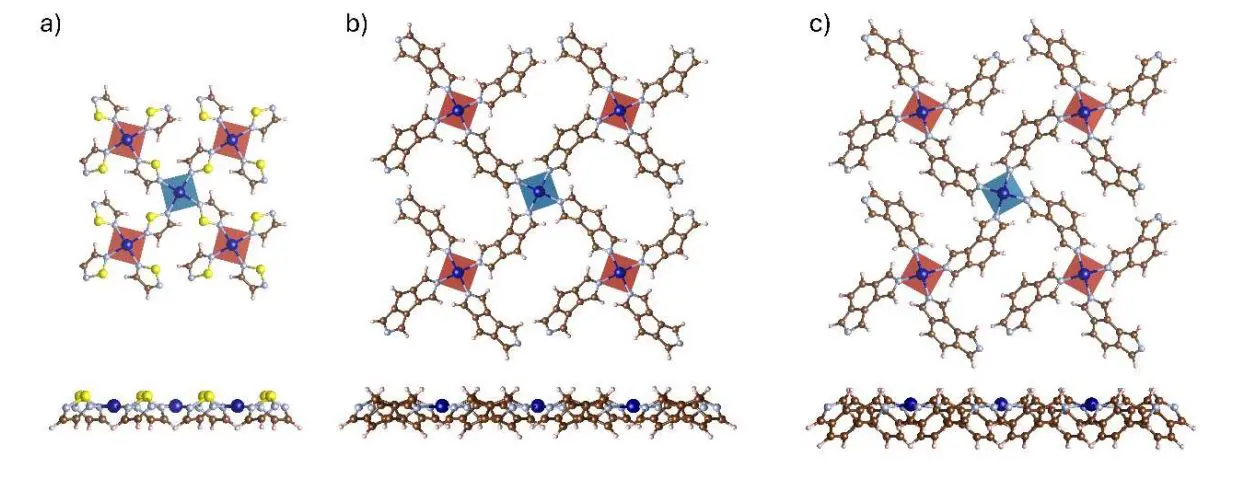
Scientists have pioneered a chemical strategy to achieve altermagnetic spin splitting in two-dimensional metal-organic frameworks (MOFs) based on chromium. This work centers on carefully designing the organic linkers within these MOFs to control symmetry and induce unique magnetic properties, ultimately aiming for materials suitable for next-generation spintronic devices. Initial density functional theory (DFT) calculations predicted how different organic linkers would affect the MOF’s symmetry and altermagnetic behavior. Researchers demonstrated that replacing symmetrical pyrazine ligands with non-symmetrical imidazole linkers reduces lattice symmetry, enabling spin splitting up to 65 meV.
To further enhance this effect, the team employed frontier molecular orbital engineering, selectively polarizing the spin of the ligands, achieving spin splitting up to 83. 9 meV in polycyclic ligand-based MOFs. Detailed analysis of magnetic exchange interactions revealed that coupling between the metal centers and the ligands dominates over direct metal-metal interactions, stabilizing the altermagnetic order, particularly when using radical ligands. The team experimentally confirmed altermagnetic spin splitting using spin spectrum analysis, observing chiral magnon splitting, a key signature of this phenomenon.
Calculations revealed a direct band gap in one MOF configuration, highlighting the potential for engineering MOFs ranging from insulators to narrow band gap semiconductors. Ligand spin polarization introduces an inequivalent set of spin-dependent moments in the lattice, driving a transition to a specific type of anisotropy. This work establishes coordination chemistry as a powerful route to symmetry control in 2D MOFs, enabling rational design of materials with tunable electronic and altermagnetic properties.
Ligand Design Controls Altermagnetic Spin Splitting
This research demonstrates a new strategy for creating altermagnetic materials, a class of compounds exhibiting spin splitting without net magnetization, through careful design of metal-organic frameworks. Scientists successfully induced altermagnetism in two-dimensional chromium-based MOFs by replacing symmetrical ligands with non-symmetrical alternatives, achieving spin splitting up to 83. 9 meV. This symmetry breaking, achieved through coordination chemistry, allows for control over the material’s magnetic properties. Furthermore, the team demonstrated that manipulating the frontier molecular orbitals of the ligands, specifically the energy difference between metal and ligand orbitals, can tune the degree of spin polarization and influence the material’s magnetic anisotropy.
This “frontier molecular orbital engineering” provides a pathway to tailor the electronic and magnetic characteristics of these materials. Importantly, the researchers confirmed altermagnetic spin splitting through observation of chiral magnon splitting in spectroscopic analysis, and showed that this splitting can be harnessed for charge to spin conversion, offering potential for spintronic applications. Calculations show that the 2D Cr(imz)2 lattice exhibits an indirect band gap, with AM splitting reaching values in the valence and conduction bands near the Fermi level. The team confirmed the non-relativistic origin of the spin splitting and demonstrated the structural and thermodynamic stability of the 2D MOF through phonon analysis and molecular dynamics simulations.
🗞 Chemical Engineering of Altermagnetism in Two-Dimensional Metal-Organic Frameworks
🧠 ArXiv: https://arxiv.org/abs/2512.14623