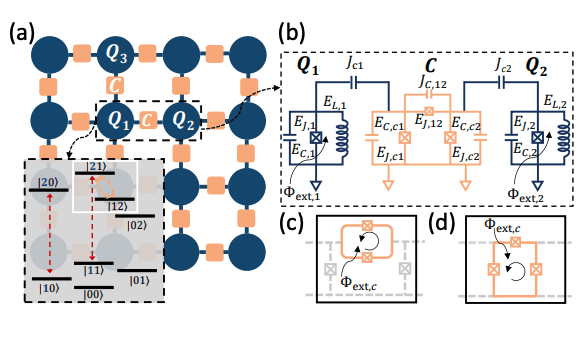
On April 14, 2025, researchers Peng Zhao and colleagues published ‘Scalable fluxonium qubit architecture with tunable interactions between non-computational levels,’ introducing an innovative approach to overcome scaling challenges in quantum computing by decoupling qubit states while maintaining tunable couplings.
The fluxonium qubit offers long coherence times and high-fidelity gates but faces challenges in scaling due to crosstalk and residual interactions. This work introduces a scalable architecture enabling decoupling of qubit states while maintaining tunable couplings between non-adjacent levels. Beyond ZZ crosstalk, the study identifies significant fidelity degradation caused by always-on interactions involving non-computational states. The authors demonstrate mitigation through tunable couplings for fluxonium plasmon transitions, achieving fast, high-fidelity gates with passive ZZ suppression. They emphasize careful design of coupling mechanisms to suppress residual interactions, given fluxonium’s multi-octave frequency range.
Quantum computing stands at the forefront of technological innovation, promising solutions to problems that classical computers find insurmountable. Central to this revolution are superconducting qubits, which harness quantum mechanics principles for computation. Recent advancements have focused on enhancing qubit interactions, crucial for building scalable quantum systems.
Superconducting qubits, made from superconducting materials, are leading candidates for practical quantum computers due to their scalability and compatibility with existing manufacturing techniques. A key challenge lies in ensuring effective qubit interaction while preserving fragile quantum states. Recent research has addressed this by developing novel methods to enhance qubit coupling, improving the fidelity of quantum operations essential for accurate complex calculations.
Researchers employed theoretical modeling and experimental validation to explore new qubit coupling approaches. They optimized coupler designs to minimize energy loss and reduce errors, achieving higher control over qubit interactions. Key findings include significantly enhanced coherence times—duration qubits maintain their states—and reduced leakage errors, crucial for error correction codes.
These advancements bring us closer to practical large-scale quantum computers, potentially revolutionizing fields like cryptography, optimization, and drug discovery. The techniques developed may also inform research into other quantum systems, underscoring the importance of continued investment in quantum computing.
Enhanced couplings between superconducting qubits mark a significant milestone in quantum computing. By improving operation fidelity and reliability, researchers address critical challenges, though further work is needed. This progress highlights the potential for transformative real-world applications, setting the stage for future advancements in quantum technology.
👉 More information
🗞 Scalable fluxonium qubit architecture with tunable interactions between non-computational levels
🧠 DOI: https://doi.org/10.48550/arXiv.2504.09888