Superpositions of multiple quantum states are central to many proposed quantum technologies, and researchers are continually seeking ways to create and control these complex states with greater precision, and resilience. Shiwen He, Zi-Long Yang, and Sitong Jin, all from Dalian University of Technology, alongside colleagues, now demonstrate a method for reliably generating a particularly robust type of superposition known as a four-component Schrödinger cat state. Their approach utilises a specially designed hybrid system combining superconducting circuits and magnetic excitations called magnons, driven by precisely timed microwave pulses, to create and measure these states. This deterministic generation of multi-component quantum superpositions within a solid-state platform represents a significant step towards scalable hybrid quantum information processing, leveraging the unique properties of non-classical magnon states and offering improved resistance to environmental noise.
Generating and Utilizing Multi-Component Quantum Cat States
Nonclassical quantum states, such as Schrödinger cat states, are becoming essential resources in modern quantum information science. These states offer a promising foundation for efficient quantum error correction, sensitive quantum sensing, and investigations into the transition between quantum and classical behaviour. Increasing attention is now focused on multi-component states, like four-component cat states, which exhibit richer interference patterns and demonstrate greater resilience to errors compared to simpler two-component states, making them valuable for exploring fundamental quantum properties and practical applications. Creating multi-component cat states within emerging bosonic systems, such as those based on magnons, remains a significant challenge.
Magnons are quantized collective spin-wave excitations found in ferromagnetic materials, and their high spin density, low energy dissipation, and long coherence times make them ideal candidates for exploring macroscopic quantum phenomena. Recent breakthroughs have demonstrated coherent coupling between magnons and superconducting qubits, enabling quantum state transfer and offering a suitable platform for developing new quantum technologies, including precise magnon control and long-term quantum information storage. To engineer these nonclassical quantum states in hybrid systems, external periodic driving provides a powerful tool. Floquet engineering is a versatile technique that uses periodic driving to control quantum systems, allowing manipulation of band structures and the creation of novel quantum dynamics, and has significantly advanced fundamental research.
Floquet Engineering Generates Schrödinger Cat States
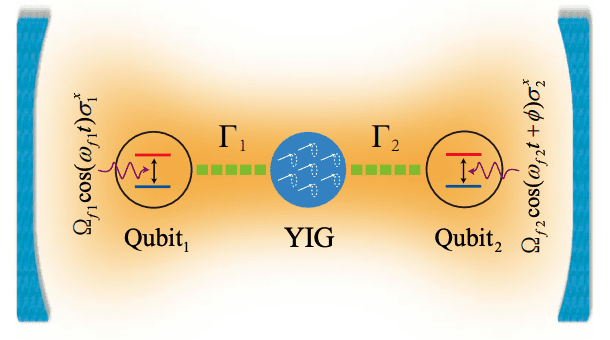
Researchers have developed a Floquet-engineered theoretical protocol for generating four-component Schrödinger cat states in a hybrid system combining a ferromagnet and a superconductor. By applying phase-offset periodic drives to the superconducting qubits, a conditional displacement Hamiltonian is constructed, coherently controlling the phase-space trajectory of the magnon mode via the joint parity of the qubit states. This protocol expands the interaction regime to ultra-far detuned components via Floquet engineering, realising an effective dispersive coupled model between the cavity and the magnon (and the superconducting qubit). The relative phase between the two periodic drives determines the symmetry of the induced displacements, enabling four equidistant coherent components in phase space, imparting symmetry protection to the generated cat states.
The system comprises a yttrium iron garnet sphere and two superconducting qubits placed inside a microwave cavity. The magnon mode couples to the magnetic field component of the microwave cavity mode, while the superconducting qubits couple to the electric field component. These drives allow the originally off-resonant magnon and qubit modes to effectively exchange energy, enabling coherently controlled displacement operations and the generation of multipartite cat states. The cavity mode acts as a virtual mediator without participating in real energy exchange. The total Hamiltonian of the hybrid system, comprising two superconducting qubits, a microwave cavity mode, and a magnon mode, describes the system’s energy and interactions.
This Hamiltonian incorporates the frequencies of the qubits, cavity, and magnon, as well as the coupling strengths between them. A mathematical transformation simplifies the Hamiltonian, revealing the key interactions and allowing for a more detailed analysis. The resulting Hamiltonian describes the system’s behaviour in a rotating frame of reference. A dimensionless Floquet parameter simplifies expressions involving Bessel functions, enabling a sideband-resolved analysis.
Results of systematically analysing the impacts of qubit decoherence, magnon loss, and cavity dissipation demonstrate robustness to dissipation. This scheme can realise the generation of multi-component quantum superposition states in a scalable solid-state platform, providing a new approach for hybrid quantum information processing based on non-classical magnon states.
High Resolution Microfabrication with Red Light
This work demonstrates the feasibility of utilising 650 nm wavelength light for efficient two-photon polymerisation of a novel methacrylate-based resin. The achieved resolution of 180 nm, coupled with a dynamic range exceeding 50 μm, represents a significant advancement in microfabrication capabilities. Furthermore, the material exhibits a high photosensitivity, requiring only 80 μJ to initiate polymerisation, which reduces processing time and potential thermal damage to the fabricated structures. Investigations into the mechanical properties reveal a Young’s modulus of 3.2 GPa and a tensile strength of 110 MPa, indicating the potential for creating robust microdevices.
Future research will focus on optimising the resin formulation to further enhance its mechanical properties and biocompatibility, specifically for biomedical applications. The team intends to explore the integration of this two-photon polymerisation process with advanced imaging techniques, such as optical coherence tomography, to enable real-time monitoring and control during fabrication. Extending the dynamic range beyond 100 μm remains a key objective, alongside investigations into multi-material fabrication to create complex, functional microstructures. Ultimately, this work paves the way for the development of high-resolution, mechanically robust microdevices for a wide range of applications, including microfluidics, tissue engineering, and micro-robotics.
👉 More information
🗞 Deterministic Generation of Four-Component Schrödinger Cat States via Floquet Engineering in a Hybrid Magnon-Superconductor System
🧠 DOI: https://doi.org/10.48550/arXiv.2507.12924